This image was taken this morning from the platform of the village station I catch my train to work from. I should be doing some work on the journey but I might have to stare out of the window instead…


This image was taken this morning from the platform of the village station I catch my train to work from. I should be doing some work on the journey but I might have to stare out of the window instead…
An early walk to the bottom of the lane gave quite a magical view this morning…


After moving to Northamptonshire in early 2021 we have found and explored many of the nature reserves both nearby and a bit further away.
We fairly regularly go to the local Wildlife Trust’s nature reserves at Pitsford Water and Summer Leys, and less often go to Titchmarsh (a reflection of the distance not its loveliness). We also once a year or so head further east to the Nene Washes and Ouse Washes; we now benefit from not being very far from The Fens, so these sites, as well as others like Wicken Fen, are within easy reach.
However, we haven’t really headed very far west in search of wildlife sites. That is, before yesterday. With an unplanned Saturday on our hands, we headed to the Warwickshire Wildlife Trust site at Brandon Marsh, just south of Coventry.
We had been thinking of going to Brandon before now, particularly for the winter starlings murmuration, but hadn’t quite got round to it.
The reserve is a mix of grassland, woodland and reedbed spread over 92 hectares. There are a lot of trails through the site and plenty of hides to watch the wildlife from. This was perhaps quite a quiet time of year to go. With breeding season for the birds well past, the summer visitors drifting south, and the winter visitors yet to arrive in big numbers, the birdlife was lower than it might be at other times of year. However, there was still plenty to see and hear. Of particular note were four sightings of kingfisher at three different locations and we could hear Cetti’s warblers all around the reserve. Unfortunately we missed the double osprey of a couple of days but we did find a good selection of birdlife given the time of year.
I could imagine that the reserve is usually bouncing with life in the spring with the woodlands full of songbirds and the warblers calling endlessly from the reedbeds but we have many months to wait to find out. Beforehand, hopefully, we will go back this winter to see whether the starlings have returned in big numbers.
I should also mention the cafe does a very good sausage bap and we got in free being members of a different wildlife trust.

We’ve just been across the lane to put our neighbours’ chickens and ducks away for the night and we’re treated to the sight of a few noctule bats flying high above us.
They’re one of the UK’s largest bats with a wingspan of between 32cm and 40cm, much larger than the pipistrelles we more commonly see.
They were flying around at tree-top level, looping around us and diving on their prey – a quite spectacular dusk view.
Sadly, I had to cancel my trip to Ramsey Island over August bank holiday week. Unforeseen circumstances at home meant that plans had to be changed and my trip was put off until next summer.
However, this did give me an opportunity to try out some local conservation volunteering instead. My company gives me two paid days per year to volunteer for social or environmental causes, so with Ramsey no longer happening I searched quickly for local opportunities. I soon found a two-day task with Northamptonshire Conservation Volunteers.
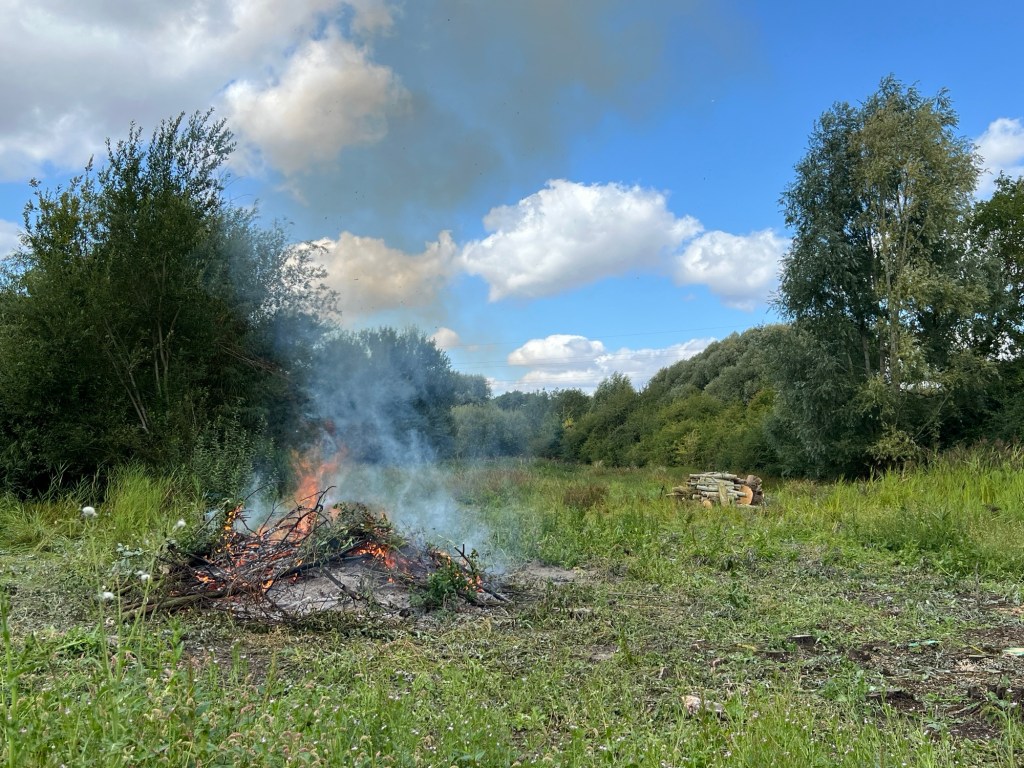
Last Wednesday I headed out to Abington Meadows Nature Reserve near Weston Favell. On a warm but grey morning I met rangers from Bedfordshire, Cambridgeshire and Northamptonshire Wildlife Trust and a small group of other volunteers at the edge of the meadows. We walked out to the centre of the site, each of us carrying a bow saw and pair of loppers. We stopped at a central area where the rangers had already used a chainsaw cut down a number of willow trees. Our task was to cut up the fallen trees and to put them on a fire.
Whilst cutting down trees and setting fire to them might not seem the most conservation-minded thing to do, I have learnt over many years of volunteering that it’s an often vital activity in maintaining many protected sites. With so many of our water meadows and reedbeds having been lost since the Second World War, those that remain need to be managed. This is to prevent natural succession leading to them being overtaken by willow and eventually drying up. In this case, this was exactly what was happening. The trees needed to be burned as the amount of willow taken down couldn’t all be taken off the site and if left on the ground it would re-grow not just from the stumps but also the cut down timber and brash.
So, for two days, I cut up the fallen trees and put them on the fire and, when the originally cut down trees had all gone, we cut down some more by hand to reduce the willow further.
This was an activity that took me back to some of my original conservation volunteering in Cheshire nearly 13 years ago. I have spent many a Sunday out of a Cheshire Wildlife Trust wetland site doing exactly the same task and over that time have seen what a significant positive impact a group of volunteers can have.
The only sad thing about this experience is that so many of the similar opportunities are only during weekdays when I’m out at work. However, I did learn of a couple of weekend volunteer groups which I might have to give a try.
 Daft Mumblings