A lunchtime walk down the lane and the heat is already building. What rain we had last month has dried up and the land is again turning brown and the wheat fields are becoming indistinguishable from the meadows.
But not all moisture is gone – a last few blackberries (small but sweet) and elderberries are still in the hedgerows and I might venture back down the track this evening to pick a few.
I have to admit a fascination for combine harvesters and I could watch them do their thing for hours. One of my usual cycle routes heads straight through an area of arable fields and this sometimes gives me a good view of the action.
Last year the harvest seemed to go on for weeks and I saw a lot of it happening. However, this year, it seems to be over far too quickly and the action seems to have been while I’ve not been on my bike to see it.
This seems to be the story of the year so far; the days and weeks passing very quickly and before I know it the seasons have moved on. With August already here I need to make sure I’m out in my bike as much as I can be to make best use of the remaining summer.
Two great, but contrasting, examples of driver entitlement on one short section of rural byway near where I live.
The byway isn’t a major thoroughfare and doesn’t really go anywhere, it’s just a farm track through some fields. It’s heavily potholed – well, there largely isn’t a tarmac surface at all, it’s more of a gravel track with holes large enough to swallow a small pony. Despite the risk of damaging their car, people still seem to insist on driving along it; except that they don’t…
The first image is an example of people who like to drive off-road but get worried when it gets too bumpy and they think they might damage their pride and joy. So instead of turning back, they’ve made their own parallel muddy track through what is usually an area set aside for wildlife.
The second image is an example of the same track not being bumpy enough; some off-road enthusiasts last winter decided to carve up the farmer’s field instead of driving along the track, resulting in a section of the field being unusable for planting crops.
I love the countryside, I crave being out in it and I long to have more access to it. However, I can equally see that landowners and their tenants are worried about increasing access when a small (but impactful) minority of people abuse what little rights they already have.
Last weekend we had a night in Ross-on-Wye and two nights in Pembrokeshire. Unfortunately the weather stopped us getting across to Ramsey Island but we did have some great views of swifts. Ross is a very swift town with screaming parties all around the town centre. I also know a great spot just above the Cathedral in St David’s to do a bit of late evening swift watching.
One evening we watched the swifts circle about the valley and come into their nests in a house high above the cathedral. I don’t recall ever seeing them at their nest sites before and it was quite startling just how fast they fly up to their holes and enter with a thud.
Sadly, they’ll be gone soon and sightings have already dropped off around our house. We had a screaming party of 30 last week but I’ve only seen three or four birds at one time so far since we returns from Wales.
For the first time in ages, I had a wander down the lane this morning and to my surprise there were still some birds singing a chorus. This is the time of year when the gardens and fields go quiet as the avian breeding season comes to an end. However, there were one or two calling from trees and hedgerows including a song thrush, yellowhammer and a few tits. There were also a few crows and an alarmed green woodpecker.
This is a slightly melancholic point of the summer when I can feel the year moving from its vibrant burst of life that started in the spring to a slower pace of life as the heat lingers and nature takes a breath.
A good place to start talking about our Shetland adventure is with an animal I had largely forgotten in planning the trip.
Whilst I do spend a lot of time watching birds, I actually have more interest in mammals. In planning the holiday, I had only really thought about the possibility of seeing orca, which unfortunately we didn’t, and the almost certainty of seeing seals, which we did. The possibility of watching otters in the Shetlands had almost completely escaped me. Despite this lapse in thinking, Shetland, perhaps, was the best place I’ve been to in search of this lovely species.
To date, I’ve only ever seen otters in Scotland, specifically in the Hebrides, having previously had some great views in Mull and Skye. I’ve seen tracks and signs of otters elsewhere including the Hebrides but so far I’ve never seen them or their signs anywhere else in the UK.
Our otter watching had a slow start with a momentary glimpse of a splash and tail in a loch as we drove past. Despite turning around and looking around the spot, there was no further sighting. That was almost it for the first of the two weeks until I had a late evening view of a distant otter on the far side of the loch above which we stayed for our first five nights. The brief view through my telescope revealed the otter searching around the shoreline in the failing evening light before it disappeared into a hole beneath a rock.
For the second week, we moved away from the west of Shetland, where we had stayed near to the village of Walls, to the far north and island of Unst. We had thought from what little research we had done before our trip, that otter spotting in Unst was quite difficult and less likely to be productive than other places. This was actually far from the case and we had four excellent sittings.
Our first came in a gloomy and damp afternoon as we drove from Clivocast to Uyesound. As we passed over the narrow strip of dry land between Easter Loch and the sea, we saw a head and then the rest of an otter’s body appear in the fresh water of the Loch. Stopping the car, we watched as the animal fish momentarily before it moved off, avoiding a swan, left the water and trotted up through a meadow on the opposite bank. I suspect this is quite a good place for finding otters as a lady we spoke to later in the week had also seen on at this spot a few days earlier.
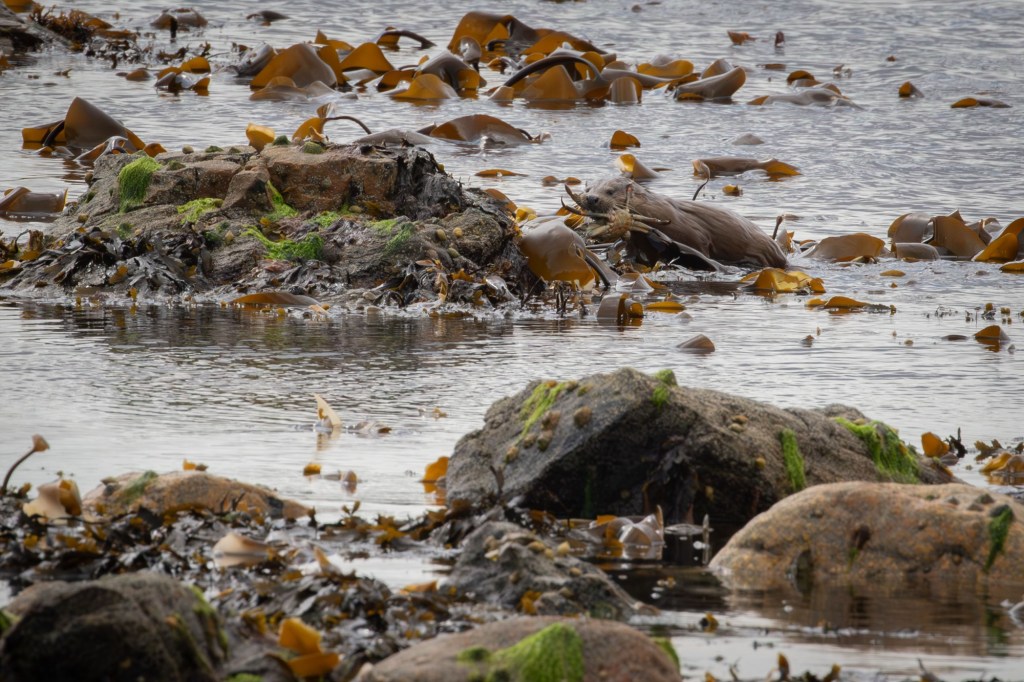
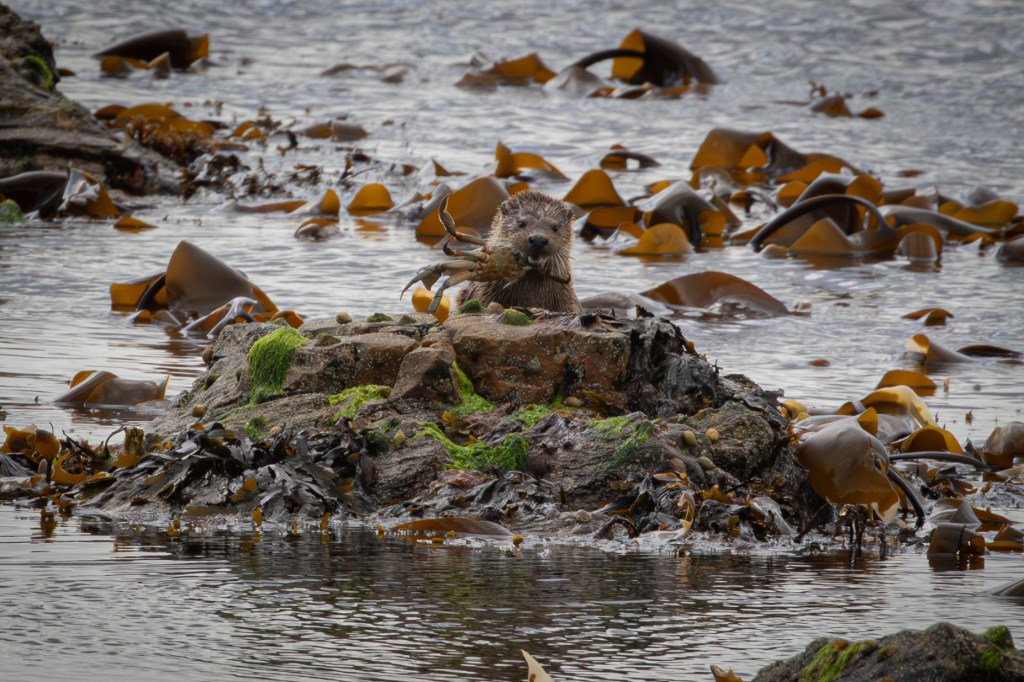
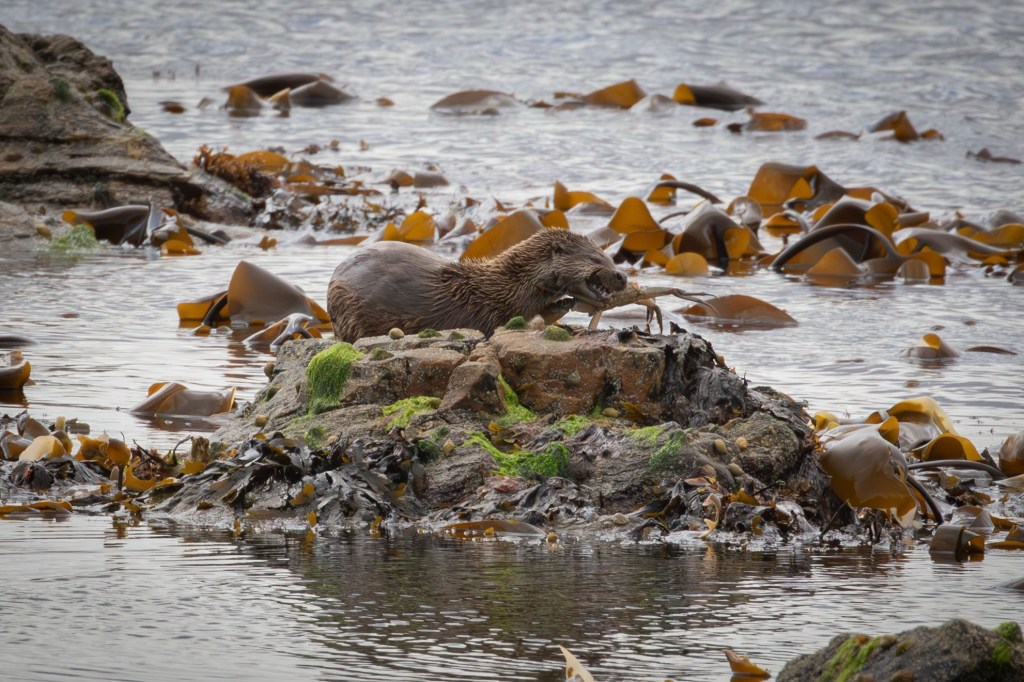
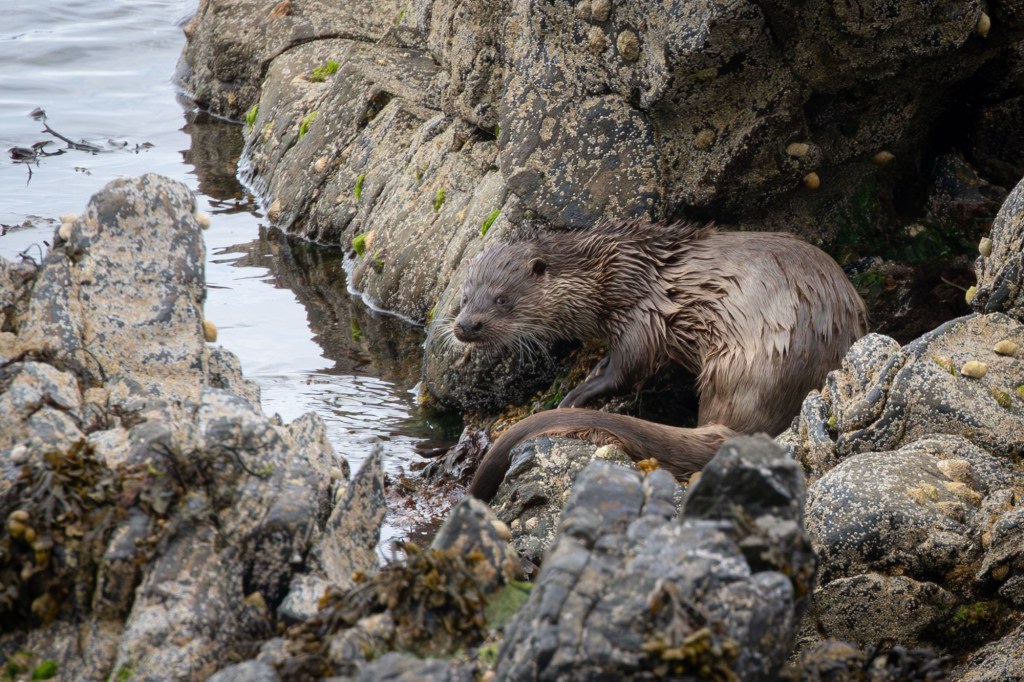
Our next encounter was on a day trip off Unst to the smaller island of Fetlar. As we were making our way back to the ferry for our return journey we stopped off at the old slipway below Brough Lodge. At first we saw curlew and great northern divers but then an otter appeared on the water’s surface, diving down in search of prey. After a while it reappeared with a huge crab and proceeded, with some difficultly, to swim to the land. As it came to the shoreline it sat on a large rock to start to break up the crab and eat its contents. Unfortunately, we had to leave for the ferry and missed the opportunity to better the photographs shown below.
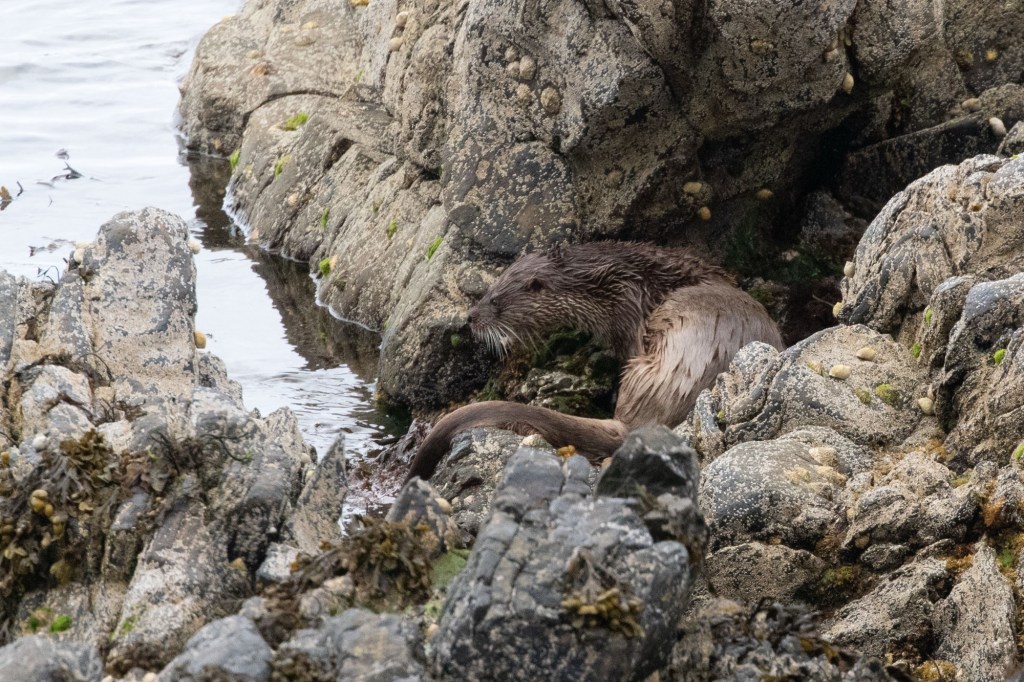
The day was not complete for our otter sightings. As we returned to our holiday rental that evening, we decided to stop off at a turning head next to the bay below Westing. It wasn’t long before we struck lucky and found a slightly distant otter fishing between the shoreline and Brough Holm. We decided to walk along the coast to get a bit closer and as we did the otter came to shore and then disappeared. As we walked further searching the rocks we found it again, eating its meal in a secluded spot. We stood for a few minutes watching it chomp away contentedly and managed to get some nice photos of it. Eventually, it moved off back into the water and out of sight.
We had one final otter sighting, this time on Yell. As we drove down towards the ferry to the mainland (checking out the food truck for breakfast the next morning – which is worth a try while waiting for your crossing), an otter ran across the road. As we drove slowly up to the spot where it had crossed, it ran along a drainage ditch beside us and then disappeared into a culvert.
For that second week, it almost seemed easy to find otters in Shetland and I’m sure we could have seen more if we had spent additional time at some of those spots. It really was worth putting in the effort to find them, although, I have to say that our stop at Otterswick on Yell came up with a blank!
Yesterday we got home from two weeks on Shetland. I’ve been a bit quiet on my blog lately and this is largely why – two weeks travelling the length and breadth of a truly stunning place.
I was planning on blogging while I was there but in the end I wanted to keep my eyes away from a screen and more on the scenery and wildlife. So, now I’m back, I plan to do some posting over the next few weeks (perhaps months) with a focus on the places, the scenery, the wildlife and perhaps some of the history too…there’s quite a lot to say.
Despite doing quite a few osprey nest protection shifts in North Wales between 2012 and 2019, I never got to see one fishing. The nearest I’ve got to seeing one do so was some years ago in Swedish. I was canoeing down a quiet, slow-moving river when an osprey appeared a couple of hundred metres in front of us, rising up from the surface and shaking mid-flight to rid itself of the water in its feathers. We had missed the fishing attempt as it had been around a bend in the river; the bird had missed its target and flew away empty-taloned.
Today we went for a lunchtime walk to Pitsford Reservoir, only about 10-minutes drive from our house. We had a lovely amble alongside the waterside meadow on the nature reserve side of the reservoir. As it so often is, it was very quiet with only three other people seen in the hour we spent there (you need to be member of the local Wildlife Trust and obtain a permit, to visit the reserve).
We walked to the Bird Club Hide and sat in there for a while, using the eBird app to record the species of bird we saw. It does really feel like summer now with the common terns, sand martins and swifts all showing very well. There were also quite a few young birds about including geese, black-headed gulls and treecreepers.
However, the star of the show was an osprey which we spotted just as it lifted from the water’s surface, shaking the water off and holding a large fish. The gulls were flushed from their nesting rafts and gave pursuit but the osprey seemed unbothered by them as he disappeared into the distance. I say ‘he’ as it was most likely a male if the bird has a nest nearby and was catching fish for its chicks.
Here’s a very rubbish zoomed-in phone photo, clearly showing the fish in the osprey’s talons and there’s an equally rubbish video below that.
May has flown past in a flash and this year I feel I’ve missed much of it as I’ve been battling a stomach bug for several weeks. It’s a real pity as I think that May is the best of the months. It is the height of spring where the landscape transforms into its green lushness, so many wildflowers bloom and wildlife has an intensity like no other time of year. Stuck at home, I’ve only been able to witness the spring from the window and out in the garden.
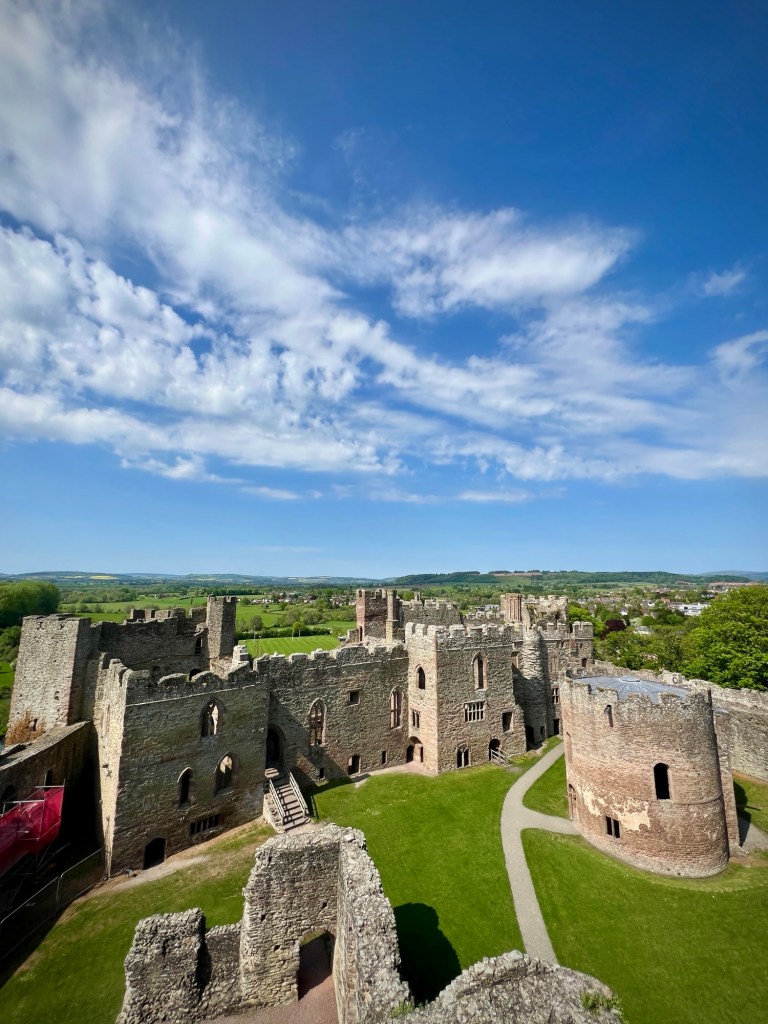
However, I haven’t missed all of the month. Over the first weekend of May we spent three nights staying in the centre of the very lovely Shropshire market town of Ludlow. It is a quintessential English country town with a castle, tightly packed narrow streets, a market square and a wide selection of local shops and eateries; and all this inside a loop of the River Teme. We stayed in a spectacular three storey townhouse in a courtyard off the main square, with views across the rooftops and in sight and earshot of the church tower and its musical bells.
On the drive in to Ludlow, it struck me just how remote and sparsely populated this part of England is. We live in a rural village but it’s what I would term ‘near rural’; in easy distance of a large town and, in fact, we can see Northampton, just a few miles away, from the end of our lane. Ludlow is in a very different position, sitting on a hill surrounded by rolling countryside and a larger town no nearer than 45 minutes away by car to the north, south or east. To the west is the even more remote and sparse mid-Wales and the nearest city, Birmingham, is 90 minutes away by car and nearly two hours by train. Staying there really did feel like we were a long way from anything truly urban and we were in a deeply rural place; and I loved it.
On one day we walked out of Ludlow on a loop across fields and back around and along the river. On the second full day we drove out into the villages and had another riverside walk. There were two very memorable wildlife moments on those two days; the first was finding a dipper feeding in the quick waters of a small stream and the second was coming across a sand martin colony on another river. The former was the first dipper I’ve seen in many a year and, perhaps, the first I’ve seen in England. The sand martins were in a natural colony of holes on the sandy vertical river bank. Whilst the dipper was a fleeting sighting, I could have stopped and sat for hours watching the sand martins; it was a very quiet, peaceful and isolated little spot where nature was just doing its thing. Here’s a couple of videos…
Despite being stuck at home for much of May, these are two wildlife memories which will stick in my head for quite a while.
Hopefully my recovery will continue as we’ve got our biggest trip of the year coming up in a couple of weeks and we’re hoping to spent a lot of time out in nature.
After a lovely first visit to Bedfordshire, Cambridgeshire & Northamptonshire Wildlife Trust’s reserve at Strawberry Hill a few weeks ago, I retuned today to see what summer migrants I could find; I wasn’t disappointed!
We arrived just after 7:00am on a slight chilly but very sunny May morning. We could see our breaths as we left the car behind but the sun brought warmth whenever it shone through the trees.
As soon as we stepped onto the footpath into the reserve we were enveloped by the rich cacophony of spring bird song. The voices were so numerous and so loud that it was at first quite difficult to tell one from another. Chiff chaffs, song thrushes, blackbirds, blackcaps, garden warblers, great tits and robins were all singing at the tops of their voices and together creating a wave of sound that was almost overwhelming. The senses were further bombarded by the sweet smell of blossom, particularly from the swathes of white hawthorn blooms throughout the reserve.
As we walked on further, the sound did not decrease and the deeper we ventured the richer and more intense the sounds became. It was not until I stopped to take a picture of a dew-dusted spider’s web that the spring soundscape reached its peak. As I knelt down as sweet, fluting and trilling song came from a nearby bush; a nightingale was calling from deep within its thorny cover. We stopped for a little while to listen to its lovely song. At times, it was quite hard to decipher its call from all the others, especially as a loud song thrush started up nearby but it really is an unmistakable song when you become attuned to it.
As we walked on we came across other birds that had made their way here for the summer with willow warblers, grasshopper warblers, lesser and greater whitethroats, and, often the star of spring, a couple of cuckoos.
However, today, the real stars were the nightingales of which we found seven singing alongside the footpaths and bridleways through the reserve. They were the main reason I wanted to go, although I had hoped for turtle dove too. They far exceeded my expectations and it was a drag to leave them behind.
The experience this morning was everything I’d hoped for in visiting this rewilded site. It was full of wildlife at the height of the breeding season, an example of what is possible if we give nature space and tome, and just let it return on its own terms.
Strawberry Hill is a soul-liftingly magical place and I can’t wait to make another visit.







 Daft Mumblings