We had a quiet walk around part of Pitsford Water Nature Reserve today on what was a very bright and cloudless afternoon. There was some warmth in the sun and in sheltered spots it felt later in the year than the end of February. However, out in the open there was a chilly breeze, particularly across the reservoir, that took us back into winter.
Even the wildlife was a mixture between the two seasons. Along some of the tree-lined rides were some remaining winter thrushes feeding on the ground, the redwings and fieldfares ‘seeping’ and ‘chuckling’ as they flew off before our approach. Out on the water there were diminishing flocks of wintering wildfowl including wigeon, pochard and goldeneye. However, sharing the water were tentatively displaying great crested grebes and there were some springtime calls from a range of passerines in the surrounding woodland. A song thrush called loudly from within a thick hawthorn, and great tits sang amongst mixed flocks of other tits. I saw my first willow tit in a couple of years as well as the first tree sparrows of 2022 in their usual spot on the entrance to the reserve.
Finally, today it did seem that spring is just around the corner and the season is starting to turn, even if there is still plenty of time for cold days to take us back to winter again.
It was only in the last 6 months of living in my previous house, where I’d been for over 20 years, that I started to get badgers coming into the garden. It was a joy to have these amazing animals visiting on a regular basis and I was a little sad to leave them behind when we moved to Northamptonshire.
I did have a little hope that we might have badgers visiting the garden at our new house but so far none have appeared on our camera trap. Instead, we’ve had a much wider list of mammals over the past year with a semi-regular fox, a daily squirrel, six species of bat in the warmer months, as well as mice, voles and moles. However, the stars so far have to have been the hedgehogs.
From spring onwards, we had started to see their dropping around the garden but it took a while to actually see one. We put food out for them and left out the camera trap. We soon captured videos of them coming wandering around the patio and eventually saw one as we looked out of the window one evening. Front then on, we saw them almost nightly and up to three at a time. They often quarrelled over food and we could sometimes even hear them snorting at each other when we went to bed at night.
As summer turned into autumn, a small hedgehog started to appear, one of the year’s young. We saw the hoglet grow and after a time it was difficult to tell him (or her) apart from others. He eventually disappeared with the others as the colder weather came in.
A little while later, we saw a very small hoglet in the garden, much smaller than the previous small one we had been seeing. Being November, it was possible that this little one had been abandoned by its mother before it had weaned. We saw it for a couple of nights and were concerned but when we saw it out in the daylight, seemingly desperately hungry, trying to eat the empty food bowl, we had to act.
We picked it up and put into a box with straw and a warm hot water bottle and blanket, to keep it safe while we found a rescue centre. We found that the centres closest to us were full, so we had to drive 45 minutes to the nearest one with any space. We left him (he was confirmed as a boy) there with quite a few others and hoped for the best. We heard he had survived the first few days, which gave us hope, but after a few weeks we learned that he had not made it after all.
We had been told we would get him back to release in the garden when he got better but this wasn’t to be. However, we were offered another youngster instead to set fee. We went to pick him up and bought a second hedgehog house (we already had one which is hopefully in use) and a feeding station (to stop the cats eating all the food). Arriving home we waited until night had arrived before releasing him outside his new home and waited for him to go inside.
Over the last few weeks we have regularly seen him as he gets to know his new home. With the relatively warm winter, he’s unlikely to hibernate, and is out foraging most evenings, taking food we leave out for him.
It was great to get a happy ending to first year of hedgehog watching and feeding in our garden – and hopefully we get even more in the garden this year.
For the first time in ages, possibly even this year (apart from a Friday or two), we went for a post-work walk down at our favourite spot below Hanging Houghton.
A sudden return to cold weather came during the day with some sleet showers in mid-afternoon following a sunny start. I began my morning listening to a song thrush calling from a nearby garden but that moment was soon pushed away by the working day.
Heading out for the walk it was time to put on the heavy coat and big woolly hat. Getting out of the car after the short ten-minute drive, I was very glad I had. The freezing wind blows mostly unimpeded in that spot once out of the cover of the trees. The walk was cut short at about half the usual distance as the cold began to bite and the peace was disturbed as a rumbling 747 trundled slowly across the sky.
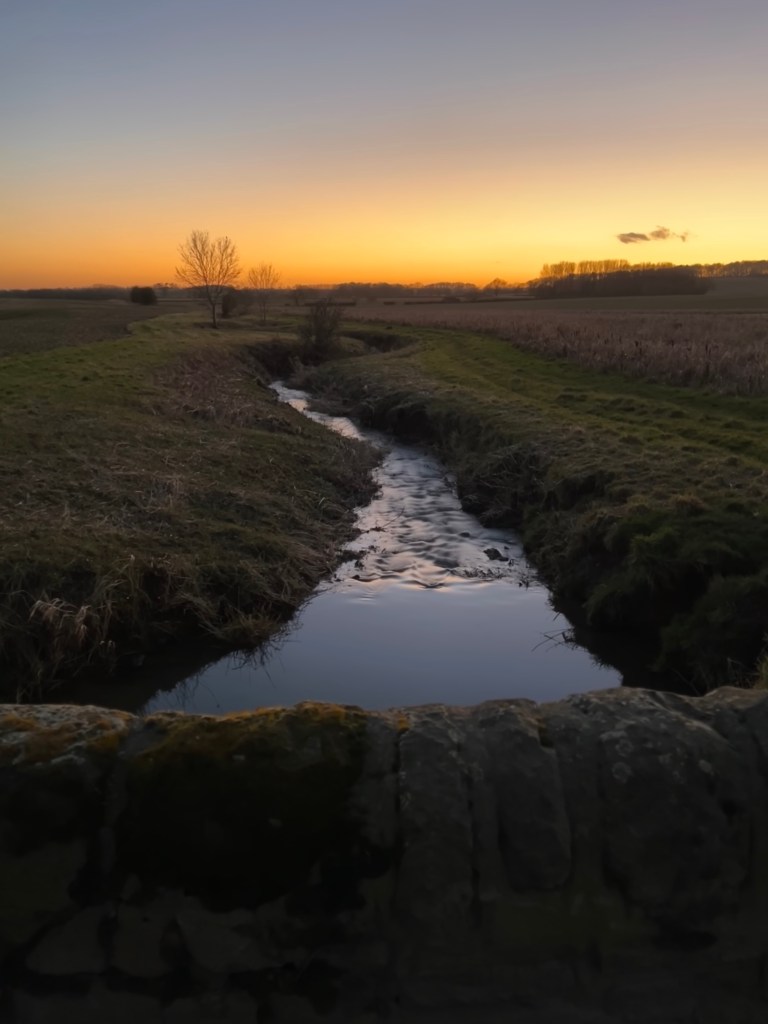
Nearly back at the car, we stopped to stand on the little bridge over which the dirt farm track crosses a stream, watching the orange glow of the sunset beneath the darkening blue above. This time it was a mistle thrush calling from a nearby stand of trees, heard clearly over the lightly babbling water. One of the usual local buzzards broke the spell momentarily but then a sudden dart appeared, racing towards us. A kingfisher flew beneath the arch of the bridge and away behind us into the darkness around the first meander.
Quite a lovely moment of release to end a working day…
We had a lovely short walk this afternoon but one of two halves. The first was almost springlike with blue skies, light wind and a skylark singing from somewhere high above us. The second half was very much like winter with the gloom descending, a cold wind starting to blow and large flocks of winter thrushes passing through.
I’ve been to the Wildfowl and Wetlands Trust’s Welney reserve a few times, including late last year and the Ouse Washes on which it sits have been spectacular when I have visited in autumn and winter. However, I’m not sure I have ever really heard of the Nene Washes before but today has changed that as we spent a few late morning/early afternoon hours there.
Both ‘Washes’ are huge winter flood storage areas for their neighbouring rivers with the Nene site extending to 1,522 hectares, bounded by large embankments to keep the water from flooding the surrounding flat and low-lying fenland. The RSPB manages a portion of the site, amounting to around 280 hectares and it was this part of the Washes we visited today.
Walking routes from the car park are limited to heading east or west on the southern embankment overlooking the Washes. It gives great views over the site, from an elevated position, although it was particularly windy today making the use of a telescope and binoculars quite challenging.
We started off heading in the direction of a group of people looking into some fields and found them watching three short-eared owls. Two were hunkered down in a small hawthorn tree beside an old barn while the third was more in the open, perched on some logs in the middle of a neighbouring field. After watching them for a while we headed west and were soon told of a particularly special bird that had been seen to fly over and into a small, waterlogged copse. We quickly made our way down and it wasn’t long until we saw it on the woodland edge – a glossy ibis!!! I thought it might have been the first time I’d ever seen one; checking later, I had seen one before when in Botswana, but this was definitely a first sighting in the UK for me, of what is a comparative rarity.
After watching a the ibis for a little while and wandering a little further west to see what other birdlife was in the flooded fields, we headed back east towards the car. Walking east beyond the car park we had great views of perhaps the most lapwings and golden plovers I’ve ever seen – several thousand of each have been recorded there in the last few days. They were constantly being spooked by birds of prey and lifting in great clouds. Long broken flocks of lapwings headed along the Washes leaving behind the golden plovers which circled, rose and dived, shimmering as they caught the sun on their wings.
Of the raptors, we saw five marsh harriers in one binocular view, causing other flocks of birds to lift, including big groups of wigeon. There were also buzzards, red kites (of which we saw plenty more on the way from Northamptonshire) and a stooping and chasing kestrel.
Our main reason for going was to get a chance of seeing common cranes. It’s now well over two years since I last saw any, on my final trip to Sweden before the pandemic hit. For me, they are some of the most wilderness evoking birds, particularly their calls crying out across the landscape. There are very few in the UK compared to Sweden, where I have seen many thousands coming in to roost at the start of their autumn migration. I also frequently see pairs in the countryside when I visit family out in the Swedish countryside and hear when I sit in the summerhouse garden. Today we had very distant views of them out across the Washes landscape and heard them call momentarily before the strong wind whipped the sounds away. We saw at least 25 in a loose group; the wind was just too much to get a stable enough view to count more.
This really was a fantastic first visit to the Nene Washes and hopefully more visits will come.
We’re very lucky to have a lot of wetland nature reserves close to us in Northamptonshire; they’re great locations which for winter wildlife. After visiting our nearest sites of Pitsford Water and Ravensthorpe Reservoir over the last couple of weeks, we went a little further afield to Summer Leys today. The national nature reserve, run by Bedfordshire, Cambridgeshire and Northamptonshire Wildlife Trust is a large, flooded former gravel pit about 25 minutes from us. It is located alongside the River Nene, south of Wellingborough and is one of a large network of lakes by the river as it passes through the county.
Parking in the Wildlife Trust’s car park, there is a good circular walk around the whole site and it took us around two hours today. We weren’t racing around, instead, we took our time to stop at most of the viewpoints over the water and we had lunch on a bench at the far end. We also stopped in the various hides, which were all on the second half of the walk (taking a clockwise way around).
It was a quite a dark and gloomy day and it didn’t take long to get quite cold when we stopped but not too cold to shorten our stay. The large open lake, with little bays here and there, is the winter home to a large selection of waterbirds. There were good numbers of duck, with mallard, gadwall, wigeon, teal, tufted duck, goldeneye and pochard all present in varying numbers, as well as small flocks of greylag and Canada geese and some mute swans. We had views of limited numbers little and great egrets, and a grey heron or two, plus quite a few cormorants on the low islands in the centre of the lake.
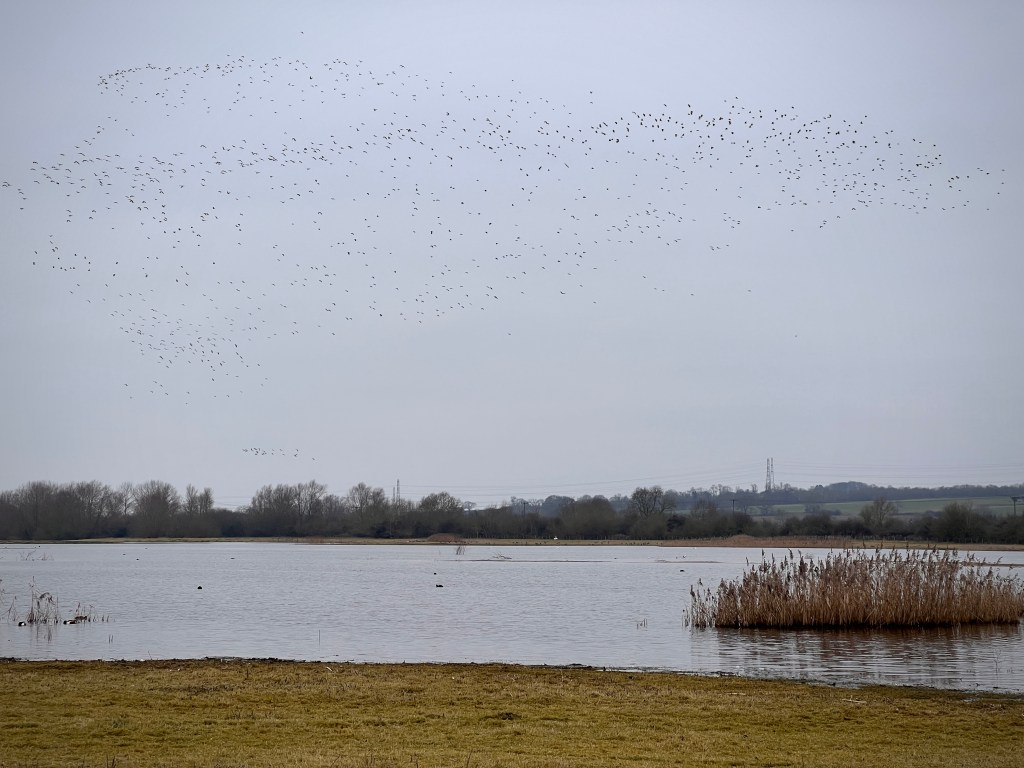
The most spectacular view on our walk was of a large flock of lapwings and smaller flock of golden plovers which settled on one of the small central islands. There were more lapwings at the reserve than I can remember seeing anywhere for a long time; they seemed to be everywhere. Every so often they would lift as they were spooked by something, with the flock on the central island being particularly large. We didn’t get a good view of what was causing them to lift, but they frequently rose in alarm, circling above together or splitting and taking dramatic evasive action. The lapwings were always the first to return to ground while the golden plover stayed in the air, often much higher, waiting for things to calm down again.
The bird feeding station was also very good with loads of tits, finches and reed buntings coming in and out to take the food put out for them. Someone told us they had seen a brambling but we had no luck. However, the good close views of bullfinches made up for it, with more in one place than I have seen for quite some time. Just around the corner, after hearing them several times on the walk, we saw a green woodpecker feeding on the ground in the open grass between the path and the lake.
In all we saw nearly 50 species during our easy walk around the reserve, almost as many as we saw in the much longer walk around Pitsford, which has a lot more variation in its habitats. It won’t be long until many of these species move on as the winter visitors move back north, and then replaced as summer visitors move in. However, there should be time yet to visit more of the wetland sites nearby and slightly further away before the winter is over.
The weather yesterday morning was absolutely lovely for what is approaching the latter end of January. It wasn’t warm, far from it, but the bright sun and the clear skies made the world around me a lot happier and colourful. For the first time this year, in fact for several months, I got my bike out and went for an easy pedal around the area. This part of Northamptonshire really is a pleasant place to cycle, there isn’t much traffic on the small country lanes and there’s plenty of choice in avoiding the busier, more major roads. The countryside is hiller than I was used to in my former cycling area in Cheshire but they add more challenge and interest, once my legs have got back into the swing of things. There is also quite a lot to look at as I pedal my way past, whether it be the great array of country houses and village churches, the scenery in general and, of course, the wildlife, of which there is nearly always something to be seen.
By the time of arrived home, surprisingly less frozen than I was expecting, the skies were starting to cloud up and by the time we went out for a walk in the afternoon, a dark, overcast murk had descended. This was a bit more like it for January, these last two weeks of which month, along with the first two of February, being statistically the coldest of the winter; and it really did feel cold with the sun behind the clouds. We went for a walk along the Brampton Valley Way, the former Northampton to Market Harborough railway line, which is a great place for wandering, running or cycling, with various points of access along its 14 miles. We decided to join at Hanging Houghton and northwards but only went about a mile before turning back. However, during that short walk, despite the gloom and presence of winter-visiting redwings and fieldfares, it did seem like there were some of the first signs of spring in the wildlife. A pair of buzzards were calling to each other within the way-side woods, pairs of red kite circled above the village and a woodpecker could be heard hammering, a little tentatively perhaps, on a nearby tree. These sights and sounds were coupled with us seeing blue tits prospecting our garden bird box earlier in the day, to give the impression that the new season might not be far away. However, I had to remind myself just how long we could have yet to go in winter. Iin two week’s time, it will be a year since we moved into our new house; it was a snowy and icy day and that weather stayed around for the rest of the week and it certainly wasn’t the last time we saw that kind of weather.
This post two years ago had no sign of what has occurred since, both in terms of COVID-19 but also my life in general. Now at the start of 2022, there are all sorts of hopes in my head that could make this year one of the brightest after two very hard years for everyone.
Two weeks into the new year, there are already some glimmers of hope that we are approaching a new phase in the pandemic, Omicron may be subsiding in the UK and becoming somewhere near endemic. Later this month, many of the remaining restrictions may be removed and a greater level of normality returned to us. Finally, there may be hope that, while COVID-19 may not disappear, we can move on and live with it like we do so with many other similar viruses. I’m not daft enough to think there aren’t still risks ahead, especially the emergence of further variants, and people will still die from being infected with COVID-19. However, there is very much more hope now than in this equivalent post from a year ago.
My life has changed such a lot since my 2020 post, so much for the better, and I aim to build on that. Now firmly settled into our new home in rural Northamptonshire, I’m keen to keep exploring the area, looking for wildlife, finding new walks and cycle routes and returning to the places we already like to spend time. The county really is lovely and we’ve very happy to have found somewhere that provides so much for us to enjoy.
Even with the restrictions placed on us last year, we still managed to do quite a lot with it and we have even more planned for this year. One thing that is close to the top of my list of things to do is finding some new volunteering opportunities after I left so many behind when I moved away from Cheshire last year. I did visit a bird ringing group late last summer to see if there was a chance I could join and start training. However, I just couldn’t commit the amount of time they required. I’m very sad about this but perhaps this is something I could consider again in a few years’ time. There are other opportunities I’m considering and I really do need to make some efforts to get involved again. At very least, I would like to get a new BTO Breeding Bird Survey site to do and I need to get on and make enquiries before it’s too late.
Away from home, as usual there are a few trips away planned. For what is becoming an annual occurrence, we may head across to Norfolk for a short break at the end of the January or in early February; it’s such a wonderful place for winter wildlife. We have a holiday to Sweden in late April/early May, to see family particularly, who I haven’t seen in over two years, but to also show my girlfriend places I have come to love and are very close to being like another home. There is also hope that I can return to Ramsey Island to stay for the first time since my three months there in 2019; a week in September would be great, spending time in another place that feels like a home. Our trip furthest away from our real home will hopefully be to Zambia in October. This has been postponed twice due to the pandemic and we’re hoping it will be ‘third time lucky’.
Lastly, but very much not least, is our biggest event of the year; we are getting married in the summer. As readers of my blog might expect, nature will be fairly central to the location, the day and the ceremony and I’m in no doubt that our plans will make it a day, and couple of weeks, that will be unforgettable.
Today we had a sunny and frosty wander around the nature reserve at Pitsford Water. We’re fortunate that the reservoir is only a 10-minute drive away, so is one of our most common spots for a quick walk as well an occasional longer circuit. Today we decided to do the seven mile round trip of the nature reserve. The reserve covers one half of the reservoir’s 14 miles of shoreline and there is a lovely walk that can be started at either end of the causeway that cuts the water in half.
We parked on the Brixworth side of the water at the junction of the old road towards Walgrave that was severed by the building of the reservoir. Walking down what is now a track towards the water’s edge there were nice frosty views across the surrounding countryside and our first encounters with birdlife with reed buntings and yellowhammers feeding on the seed put out for them close to the gate onto the reserve. The signs here are very clear that a permit is needed to visit the reserve, which is amazingly quiet compared to the country park half of the shoreline. The permits can be obtained for free if you are a member of the Bedfordshire, Cambridgeshire and Northamptonshire Wildlife Trust or a day permit can be bought at the fishing lodge on the Holcot side of the causeway.
Starting out on our clockwise walk, we passed through the low, wet meadows on the water’s edge with good views of the water birds immediately with great gatherings of duck, a few flocks of greylag and Canada geese and good numbers of mute swans. The ducks were dominated by wigeon and teal but as we wandered on there were plenty of others including mallard, tufted ducks, pochard, shoveler, pintail, and eventually towards the end of the walk, a few gadwall.
The landscape then changes into shoreline woodland and open rides with intermittent views of the water. It is like this for much of the rest of the walk but views of the wildlife are helped by a number of good hides at irregular intervals. The woodland provided views and sounds of a different variety of birds with plenty of tits and finches flitting about the leafless branches. The trees right by the water also host a number of cormorant colonies and provide perches for herons and great white and little egrets.
About halfway around the walk, there is a spot overlooking the water with a picnic bench. This is a lovely place to stop and usually there is no one else around. In the summer, it’s nice to have lunch there watching and listening to common terns over the water. Today it was quiet but still nice to sit there in the sun, out of the cool breeze.
In the last of the bays, before getting to the causeway, we came across a new species for us, another duck; smew. Two males were hanging out with some wigeon and mallards on the other side of the water but we still had good views as they sat on the water between dives below the surface. The males are rather a flamboyant black and white bird and very easy to spot amongst the others. We had learned that they had been seen in the Holcot Bay area of the reservoir from a great local birdwatching website (Northamptonshire Birding), which is now one of our go-to places for news of wildlife around the area. Usually, things have disappeared by the time I get anywhere near where they might be, but this time, they were in the right place.
To end the walk, a chilly stroll across the causeway was needed, back onto the main road and close to the more public side of the reservoir. It’s amazing how quiet the reserve is and it’s easy to forget how popular the other half is. Usually, we barely meet anyone as we walk there but today there were a few more about, perhaps this is peak season for watching wildlife at Pitsford with the winter wildfowl being a particular draw.
After seven miles of relaxed walking, a few stops in the hides and occasional chats with fellow walkers, we got back to the car, having seen 52 different species of bird as well as our first hare and muntjac of the year. This really is a very special place to have almost on our doorstep and a great way to start the year of wildlife watching.
At this time of year I usually do a review of the previous 12 months and another looking forward to the next 12. I may get around to writing them but I really want to get blogging more and rather than waiting for those longer posts, I thought I would start 2022 with something shorter.
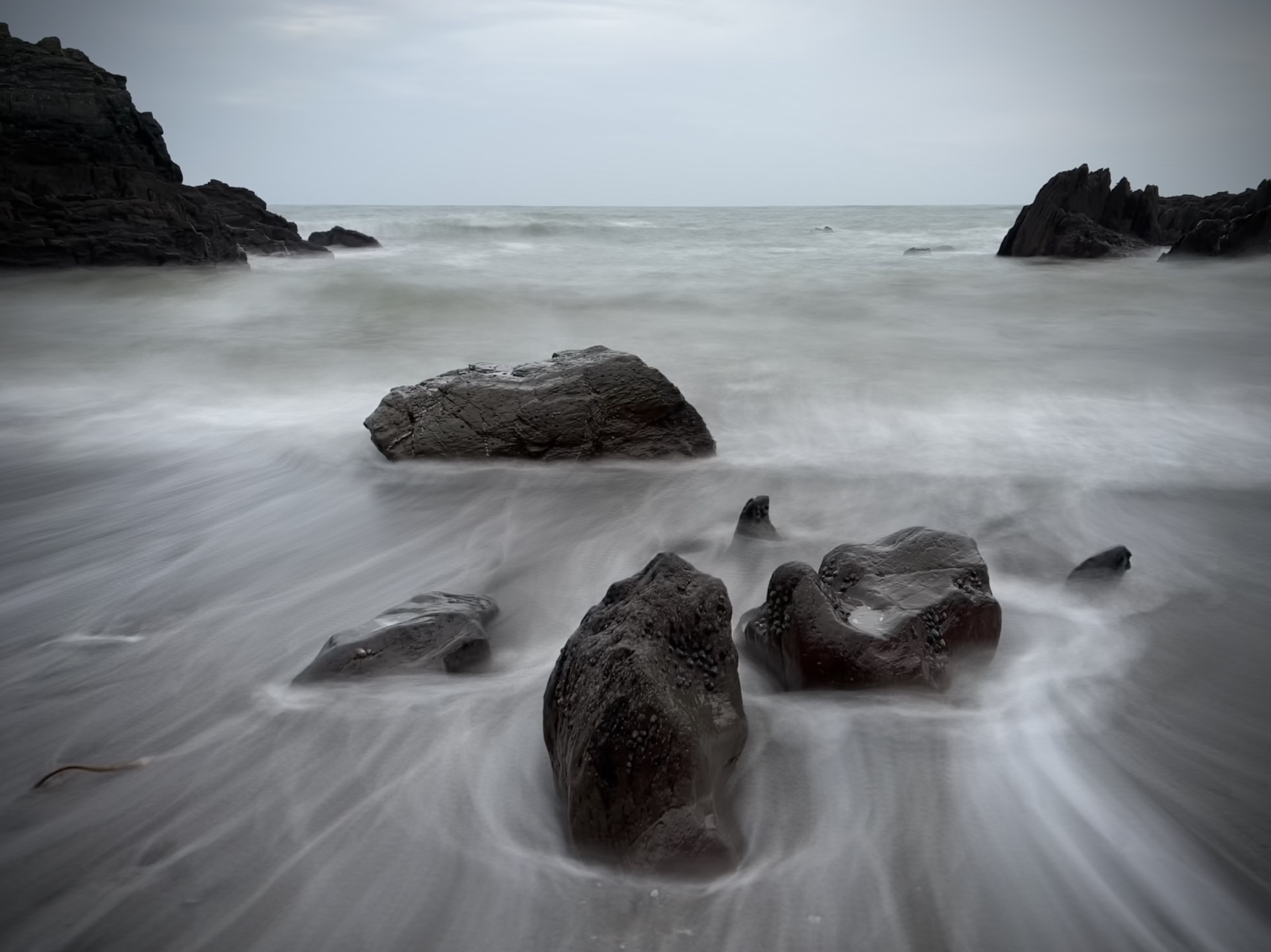
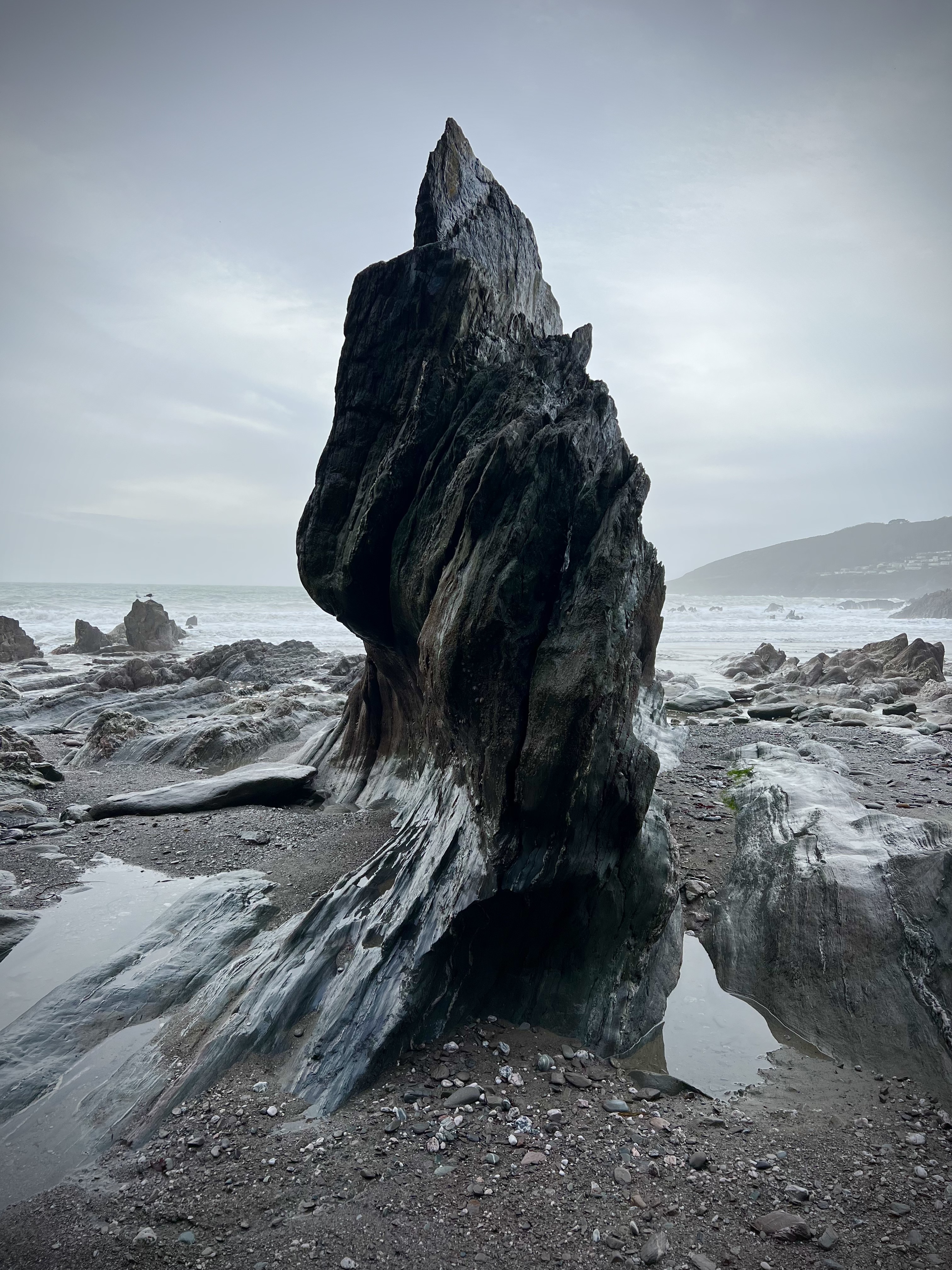
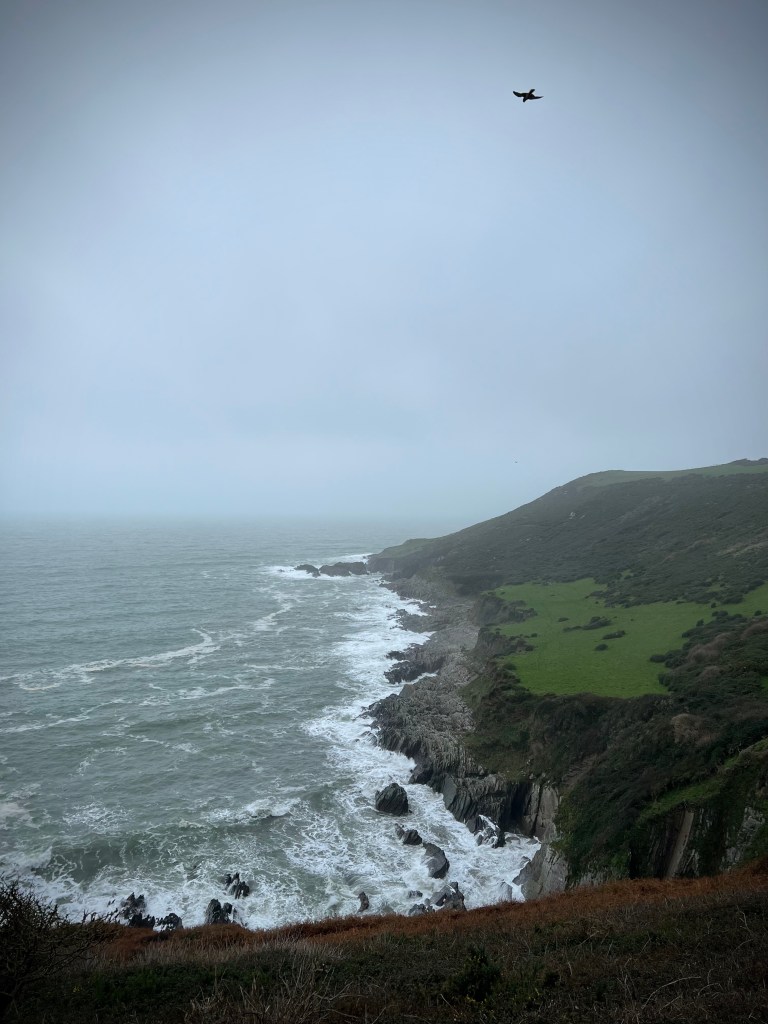
After Christmas as home, we spent New Year with friends renting a couple of cottages on the South Devon coast. We’ve done this before and South Devon was no less lovely, despite not having the best weather. We stayed close to Noss Mayo and just a few metres from the South West Coast Path. Down the hill was Stoke Beach which had some spectacular rock formations and crashing waves racing in with the tide; these photos taken on New Year’s Day…
After the walk on the beach, some of us went for a further walk on the Coast Path and while short, it gave me a chance to see some of more wildlife on the first day of the year, adding to the seabirds seen on the beach. In addition to the hovering kestrel in the image below, at Stoke Point we also saw a long sought-after bird for my UK list – Cirl Bunting. They’re very rare in the UK with the only populations being on the coast around where we were staying and a little further down into Cornwall. We didn’t have great views as the flock of birds was mostly feeding in a stubble field and when they were airborne, they weren’t so for long and the light was really poor but a great bird to see in the new year. On the walk we also saw a whinchat, which is the first time I’ve seen one for a few years.
Hopefully, this year will be full of wildlife and the first day won’t be the high mark for the 12 months!













 Daft Mumblings