The first few days back on Ramsey Island

I’ve been on Ramsey Island, the RSPB’s reserve off the coast of Pembrokeshire, since Saturday but due to my stupidity have been without the internet until now. I was planning to blog each day but will have to start with a post about the first few days of my two-week stay.

The weather has been a bit mixed so far with the conditions only good enough for boats twice since I’ve been here. Yesterday, following two boatless days, we had a bumper load of visitors with an almost capacity crowd of 78. I did my first introductory talk of the year to a full boat shed, which didn’t go too badly and I even got a business card from a wildlife tour leader suggesting I should do a bit of tour leading myself!

On my first full day, the sheep shearers came across in the late afternoon to de-fleece the 96 Welsh Mountain ewes. I was a bit more actively involved this year, particularly in the first task which was to split the ewes from their lambs. The lambs were born over a few weeks from mid-April and have grown a lot since, so the task of dividing them from the ewes wasn’t without some of effort.

The shearers again amazed me with how quick they could get a fleece off a sheep with about one and a half minutes being  the standard. The closely-cropped ewes were soon reunited with their youngsters in the farmyard, all making a racket until they found each other.

5R0A1532

I’ve also helped with manx shearwater surveys and did a house martin survey at the farmhouse (despite what others have said, I was definitely not asleep!).  We also went out on Gower Ranger yesterday (the boat that links the island to the mainland) to do a kittiwake and fulmar survey of the cliffs that could not be seen from the island – a great way to do a survey!

The weather forecast indicates that boats may not come across for the next couple of days, so it will be quiet around the island again but I’m sure there will be plenty to get on with.  There will also be more time to look at the scenery and wildlife which are as good as ever.
5R0A1873-1


House Martin Nest Study 2016

My favourite summer migrants have returned – the swallows, house martins, sand martins and swifts. I’m fortunate that three of these species (not sand martins) breed in the area where I live and I can usually see them flying in the sky above my house. I’m even more fortunate that there’s usually a house martin nest on under my eaves; I say usually but in fact there has been at least one nest for the past 15 summers than I have lived here. I thought the unbroken record was going to come to an end last summer when the house martins failed to return around their usual time. There was no sign of them for most of the spring and summer until I retuned home from work in late August to find droppings on the driveway beneath the nest, which was still up there from the previous year. That seemed very late for a first brood particularly compared to the usual May or June in previous year.

The chicks fledged in late September and it wasn’t clear if this was by accident or design. I worked from home one day and in the afternoon there seemed to be lots of comings and goings from the nest. It was only when I left the house later on that I noticed the nest on the driveway and the fledgelings flying up to the point when it used to cling to the eaves. The next day they were all gone and I didn’t see any more house martins around my home again last year.

Over the years I have sporadically kept a record of when the house martins first arrived back at the nest and most records show it was around mid to late April. When the month changed into May, I started to suspect there would be another late return this year. However, when I was cooking my evening meal yesterday I had a spare moment and popped my head out of the kitchen and popped my head round the corner of my house and looked upwards. Up at the apex of the eaves was the ring of mud, all that remained of the nest, but there was something else up there too. At first it looked like a bit of black plastic blown up there by the wind but after I shaded by eyes from the evening sun, the shape was clearly a house martin and there was another flying around just above the roof.

5R0A7767

House martins are ‘amber listed’ in the Birds of Conservation Concern listings and numbers have been in rapid decline.  I’m sure that when first moved into my house, another pair nested under next door’s eaves and there were other nests in the area.  Now there is mine and very few others.  However, the pattern of decline isn’t uniform.  Ramsey Island for example (the RSPB reserve where I volunteer for a couple of weeks each year), didn’t have any house martins before a first nest in 2014 and it had eight nests last year (extra emergency artificial nests had to be shipped across!). Something is certainly happening to house martins but fortunately it’s been noticed and hopefully before it’s too late to reverse the overall declines.

Last year I took part in the British Trust for Ornithology’s (BTO) House Martin Nest Survey. I was given an Ordnance Survey grid square, luckily for me the one immediately nest to the one in which I live, and I made several visits to record the number of nests on buildings and the amount of activity. This year there’s another house martin survey for the BTO. The House Martin Nest Study 2016 requires surveyors to choose a nest/nests and record the activity over the course of the spring and summer. The survey can be done with varying levels of detail and I hope to do as much monitoring as I can, doing daily records of activity whenever possible (holidays allowing). Now that house martins have returned to my home, I’m going to have a very convenient nest to monitor!

The chortling house martin chicks wafting in through my landing window on warm summer evenings as I lie in bed really is one of my favourite things about the season and I’m hopeful that it won’t be long until I hear those sounds once again. By doing the survey this year, I hope that I can make a small contribution to helping to ensure this will always be a sound of summer.

A short trip across Ramsey Sound

At the weekend I took the long route down to Pembrokeshire to pay a visit to Ramsey Island before it closes for the winter at the end of next month.  After spending another couple of weeks volunteering there in June, I wanted to visit later on in the season, especially wanting to see the grey seals pupping on the beaches.

I tried to make the trip a couple of Septembers ago but poor weather on three consecutive days thwarted my attempt.  This time I left my decision to visit to the last minute and with Saturday’s weather looking to be set fair, I set off down through Wales on Friday afternoon.  The journey took longer than usual as I went via a different route, using country lanes through the heart of mid-Wales, eventually arriving in time to watch the rugby in the pub.

Having left my plans to the last minute, I couldn’t get a room in the B&B I used last time; the Coach House in the centre of St David’s.  Instead, I booked into the sister property, Bwlch Carte, a cottage with a couple of B&B rooms on the edge of town but only about 10 minutes walk from the centre.  I was glad I did as I woke to the view below – having left the curtains open, I woke to see mist across the heathland behind the cottage, with the hills poking out of the top – I’m glad I didn’t lie in!

IMG_7102

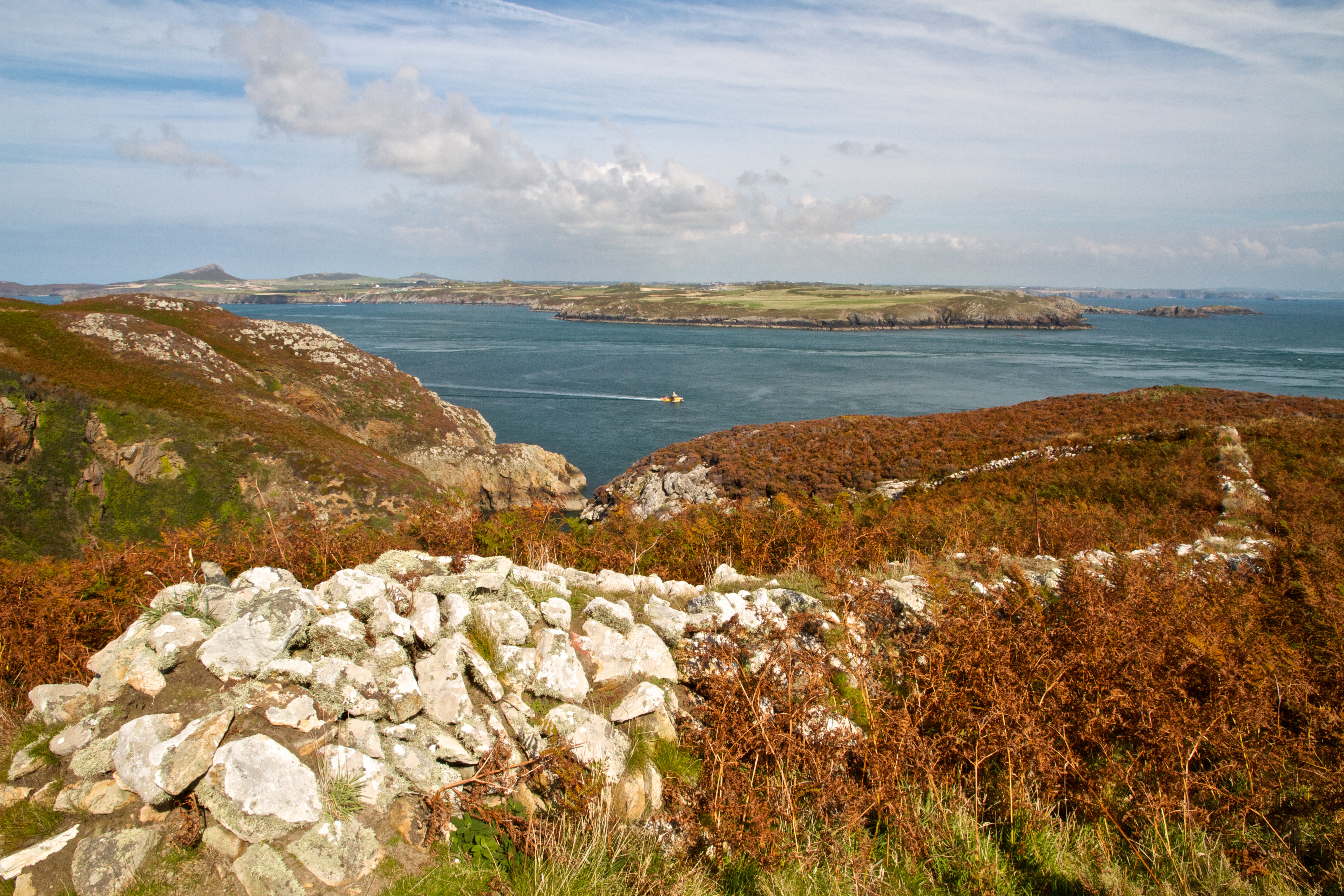
The weather was perfect and the crossing to Ramsey about a calm as I’ve seen it.  I spent the day wandering around the island, feeling like I should be getting on with some tasks, but instead just enjoying the scenery and sunshine.  I had hoped that the heathland flowers would still be out but they had long faded and I will need to visit in late August to get them in their prime.  However, just as photogenic, the drying grass and wilting bracken gave a rusty autumn tint to the land, showing that the fine weather was possibly just a last lingering flicker of the summer.

IMG_7326

Most of the way around the island, where sounds could float up from the bays, I could hear seals, but it was only when I got to Aber Mawr, the largest bay on the island, that the importance of Ramsey Island for pupping could be seen. Ramsey is the largest breeding site for Atlantic grey seals in southern Britain and around 700 are born on its beaches every autumn.  Aber Mawr had its fair share with cows and calves spread out across its sand, pebbles and rocks.

IMG_7278

The bird life was a little quieter than when I was there in June; some of the summer visitors were still around but the cliff-nesting birds were all gone to sea for the winter.  However, the autumn migration was well underway with waves of hirundines (swallows and martins) flying through on their passage south.  Before the 4:00pm boat arrived to take the visitors back across the Sound, including me for once, I spent a little time looking for a wryneck in one of the bays but without any luck – I’ll have to wait longer for my first ever sighting.

It was with sadness that I drove home yesterday – it’ll probably be summer again before I make another trip to the Island – but the long journey was well worth it, even for a visit of just a few short hours.

Maps, ships and Ramsey Island…

…a great combination!

The seas around Ramsey Island are some of the most treacherous in the UK and it can easily be seen why when standing on the island and looking into the Sound.  The speed of the rushing tides, both ebb and flow, are something to be seen, especially where they pass through the Bitches & Whelps (the reef teaching out from the island near to the harbour).  There are also many rocks and small islands around Ramsey and mariners need to be wary – too many haven’t been in the past!

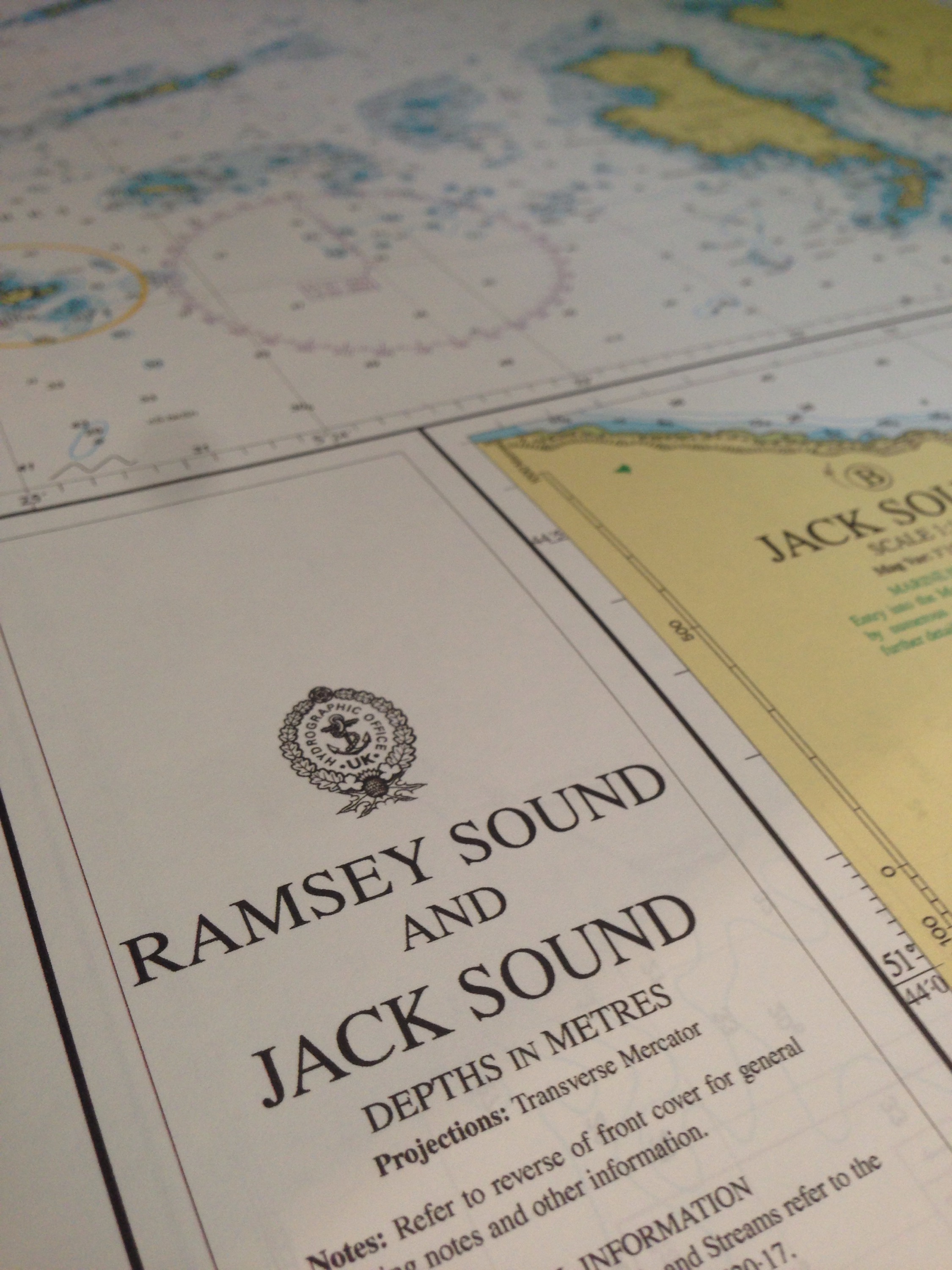
Just to add to my knowledge of the area for my next stay (next year hopefully), I’ve bought the admiralty charts for the seas around the island – I just need to learn all the rocks, islands and their Welsh names now.

VIDEO: Sheep Shearing on Ramsey Island

A short film about the sheep shearing day on Ramsey Island:

There are 100 welsh mountain ewes on Ramsey, used to keep the grass short in the fields in the northern half of the island.  The fields are prime dining tables for chough, a member of the crow/corvid family, which eat invertebrates such as dung beetle larvae.  Ramsey has seven breeding pairs of this rare bird with only around 400 pairs breeding in the UK.

IMG_5617

IMG_5615 (1)IMG_5402