Sweden in the autumn

I’ve been to Sweden in most months of the year but never before stayed for longer than a weekend in the autumn. To make up for that, we have just spent over a week staying in rural Sweden to see what its version of the season of mist and mellow fruitfulness is really like – it didn’t let us down.

Staying as we usually do, in a summerhouse deep in the countryside of central Sweden, we spent days wandering the land, experiencing the season getting into full swing.

We visited the Hälleakogsbrännen nature reserve, went to the Bergslagen forest and walked through the woods and lake edges of Färnebofjärden National Park. At all these locations we went looking for wildlife, seeing the scenery change with the season and partaking in some very Swedish activities.

Hälleakogsbrännen is a fascinating nature reserve covering a huge area affected by the major forest fires of the summer of 2014. I’ve visited the reserve a few times now but hadn’t been there for two or three years. The gap between visits gave us a dramatic show of nature’s return to an area so badly affected by fire. Much of the land is now covered by thick birch and fir scrub which is starting to enclose the views. The authorities have built a boardwalk up to a high point upon which they have erected a watchtower. From there visitors can see across the vastness of the forest fire site but also how life is now strongly returning over a decade on. With the autumn colours starting to show, the growth of the birch woodland was clear to see.

It was here that we did the second of the very Swedish activities, grilling sausages on an open fire next to a lake. This followed the first activity enroute; eating a cake for a late morning fika. Grilling in the wild places of Swedish is one of my favourite things to do; making a fire at one of the many fireplaces located across stunning locations, cooking sausages and eating them looking over a forest, river or lake.

Our trip to the Bergslagen Forest, specifically within the Malingsbo-Kloten nature reserve, was primarily to see if we could find European Elk, however, our driving amble through the low hills and alongside the lakes gave us other sights. We stopped at the Skräddartorpsfallet waterfall and went for a wander through the woods to the north of Kloten. We spent time on the walk doing another very Swedish activity; picking lingon blueberries. Our good haul of lingon accompanied meat balls and mashed potato the next night, both in the cream sauce and as a sauce themselves: food doesn’t get much more Swedish than this.

As darkness began to fall, we drove slowly along the forest tracks hoping to catch site of the elk (the area has some of the highest concentrations of these huge animals anywhere). However, our search came to nothing elk-wise but we did follow a mountain hare down one track for a little while which was a great bonus.

Färnebofjärden National Park, which I have written about before, is very close to where we usually stay and some parts are less than 30-minutes away by car. Our first visit was through the nearest point to us which gave us access to the quietest and perhaps most wild part of the park. We spent a few hours walking the tracks through typical Swedish forest; a mixture of deciduous and evergreen trees standing over the ground dotted by large boulders and carpeted by thick mosses and lichens. We came across a wide variety of fungi on the walk and picked a few chanterelles for our dinner. It was quite quiet for wildlife sightings apart from roving mixed flocks of tits and a few woodpeckers. However we did come across elk footprints and wild boar rootings along the paths.

We also went to my favourite part of the national park, at Skäkarsbo, near the town of Tjärnsjö. Here you can find a high watch tower which looks out across a large part of the park, giving wide and distant views. Unfortunately, it was temporarily closed for maintenance but we made use of jetty jutting out into the water nearby and spent time in the sun looking for wildlife. It was clear that much of the summer birdlIfe had already moved south with gulls and terns conspicuous by their absence. However, we did get good views of two white-tailed eagles soaring on thermals, their tails flashing in the sunlight, before they purposefully glided off into the distance.

What I haven’t mentioned yet is the landscapes and scenery. The area of central Sweden in which we stay and spend most of our time is in the dividing line between the southern and northern ecosystems. It is an area of forests, meadows, lakes and bogs. The trees are a mixture of deciduous oaks, birch, alder and aspens, often in clear stands or at the edges of fields, alongside vast areas of evergreen pine forest. As our time in the area moved on, the colours of the deciduous trees changed dramatically. At the beginning of our stay. The autumn changes had only really started with the birch by as the trip progressed the other trees started to turn into a range of vibrant yellows, oranges and deep reds. The naturally sifting colours provided a charming background to the traditional red and white houses and barns that punctuate the landscape throughout the area.
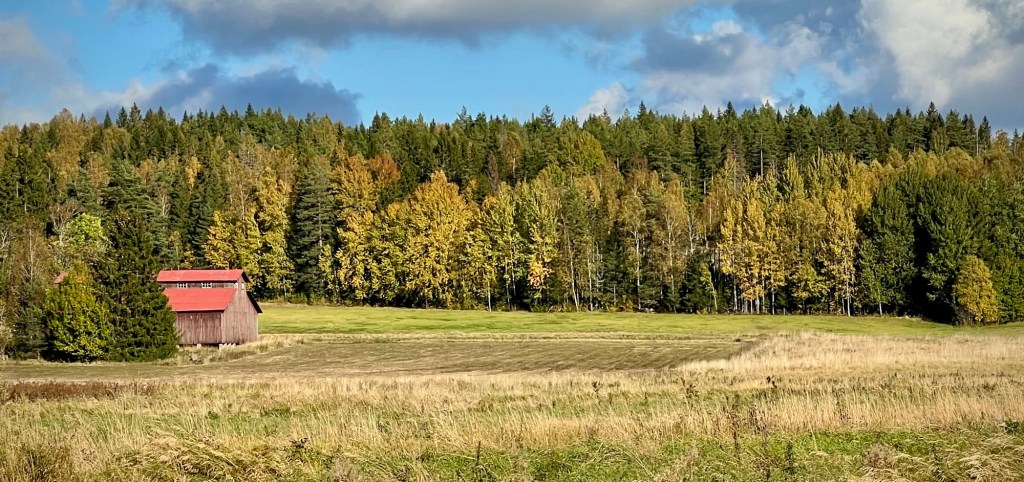
The weather made the views even brighter with most days of our stay having a good deal of sunshine and the only rain came on the last couple of days. The daytime temperatures were not too dissimilar to those of central England at this time of year, with highs around the mid-teens Celsius most days. We even sat outside in the sun a few times, with the day of our arrival being almost summer-like out of the shade. The night time temperatures did drop at times, with low single figure the norm but occasionally dropping closer to freezing.

The wildlife wasn’t saved purely for the trips out into the countryside; the summerhouse itself has a great selection of birds and mammals both within the garden and in the immediate surrounding area. There was a resident brown hare in the garden when we arrived and there were nightly visits by a badger and roe deer. We also had frequent visits by red squirrels to the bird feeders, much to the annoyance of the birds. The feathered visitors included a good range of tits and nuthatches constantly on the food as well as jays, magpies and great spotted woodpeckers in the garden. Further out into the surrounding woodland were green and black woodpeckers and a frequently calling pygmy owl. Our favourite residents close to the summerhouse are the beavers in the nearby lake. After not seeing them at all during your visit last year, we saw two together as dusk on our penultimate evening. We also heard news that brown bear scat had been found in one of the garden of a nearby summerhouse recently; I’m not sure whether it would have been good to see one on our evening wanders! Perhaps it was best to leave that to our planned trip to Finland next year.

Amongst our wanderings we also came across some other notable birds of the landscape including goshawk, marsh harrier, whopper swan, goldeneye, crested tit, willow tit, fieldfare and hooded crow.

I’ve saved the best, and least expected, experience to last. Despite having visited the country throughout the year, most stays have been in the lighter spring and summer months. At these times of year, the sky barely gets dark at night, if dark at all, and it’s a joy to experience such long days. However, the drawback is you don’t get an opportunity to see one of the greatest spectacles of nature.

One evening during this stay, I stepped outside into the rapidly coolly night air to listen for any nocturnal wildlife calls. As I looked into the clear star-studded sky I saw the Milky Way above my head and off to the north what appeared to be clouds. To the naked eye, they appeared to be striped and slightly green-tinged. Having called my wife outside we both took photos with our phones. It was the start of a show of the Northern Lights!!!

Over the next hour or so, both outside the summerhouse and down by the nearby lake, we watched a flickering show of green and purple lights constantly moving in curtains and shafts across the sky. This was only the second time I’d seen them after a pretty tame show in Iceland over 15 years ago.

One night of such views was fantastic but we got a second the following night. The colours we perhaps not as clear but instead we saw rapid pulses of light scudding across the sky above our heads. This was far more difficult to pick up on our cameras, as it just looked like clouds in a still image. However, I also took a photo I had always dreamt of taking but never expected to; the Northern Lights above the summerhouse.

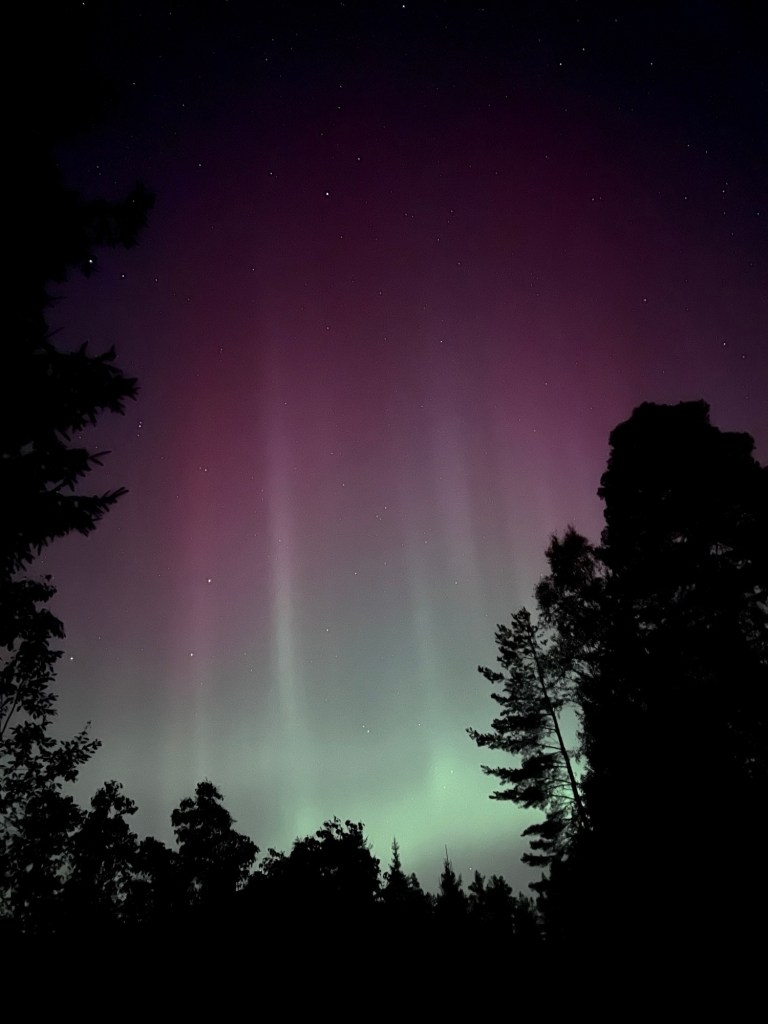
This really was the highlight of the trip but there was so much to like about our autumnal stay in rural Sweden. It was a visit truly in touch with the season, from the birds and mammals, the changing colours of the trees to picking mushrooms and berries, as well as nip in the air as the temperatures fell each evening. It was a visit that gave us a pause in our recently busy lives, to take a breath, to slow the pulse, and to feel more in step with nature’s rhythm. It felt like a celebration of cosiness, changing colours and shortening days, warmed by evening fires and hearty food.

In our morning drive to the airport, the Swedish nature gave us one last bit of joy. Travelling down the fast road to Västerås from Sala, we saw a large bird flying low over the tree tops before crossing the open fields and making its way across our view. At first we thought it was a grey heron, having seen a few during the week, but as it got closer we could make out the clear silhouette of a big bird of prey. It was a golden eagle brightening our journey home!

Wildlife holidays – a look back on a life-changing first trip

Next month it will be 15 years since I had a holiday that, with no exaggeration, changed the course of my life.

In 2009, I was in my eleventh year of my career and settled into a routine of working long hours and doing far too little with my time away from the office. I had long held an interest in nature but was doing absolutely nothing about it apart from some cycling in the local countryside and occasionally thumbing through the pages of BBC Wildlife Magazine. Essentially, an interest I had held since childhood was a barely burning ember of what could have been a passion. 

However, a spark from the ember had been floating in the air for sometime, wafted by the pages of that magazine, in particular the pages showing adverts for wildlife holidays. Every once in a while I had noticed one of those adverts and had a cursory look at the linked website. On one such visit to those pages I came across a holiday that would eventually catch that spark and ignite it.

From being a child, I always felt a calling of the northern forests – probably after seeing pretty rubbish 1970s American TV movies about families surviving in the wilderness either after a shipwreck or heading out to escape the rat race. After very little Googling, I found the one I remember most, called ‘Sea Gypsies’. There were more including ‘The Wilderness Family’, with the father of the family seemingly always played by Robert Logan. 

The holiday I had noticed was to just such forests, but those of central Sweden and the Bergslagen Forest in particular. It seemed a good trip on which to test whether liked such holidays; it was only a short distance from where some of my family live and, so I could see them while also having a few days in nature.

Having already arrived in Sweden a few days earlier, I was given a lift to the local airport at Västerås where I met the guide and the four other guests, before we headed out for the one hour drive to our venue for the first three of the next four nights. We were staying at the basic but very comfortable hostel-type accommodation of Grimsö Wildlife Research Station, which is part of the Swedish agricultural university. Here, amongst other things, they research the interaction of the country’s wildlife with farming.

That first evening, after we had settled in, we headed out in the minibus to search for European elk (älg in Sweden and Moose in American). The sun was dropping slowly, occasionally blinding us as we headed towards it amongst the roadside forest. It had rained not long before leaving Grimsö and the last of the springtime warmth from the early May sunshine was evaporating the lying water and steaming off the road’s surface with mist forming down at the bottom of the shallow valley meadows. We turned off the quiet main road and onto unmade dirt tracks, slowing down to a crawl as we rounded bends and came across each meadow amongst the thick pine forest. We drew a few blanks at first but eventually, standing at the edge of the trees, we saw two dark shapes emerge and there were two adult elk quietly grazing the long, damp grass. They after a little while sloped off into the forest but we were to come across more as we continued along the tracks, finding 17 in all over a couple of hours. In some ways these creatures were the stars of the trip, not just because they are the ‘kings of the forest’ but because we saw a lot of them. Quite often on such trips you get fleeting glimpses of an animal’s hind quarters as it disappears into dense undergrowth but in this case they were very easy to see feeding at dusk in numerous forest clearings.

Before returning to Grimsö, we stopped the minibus at the base of a walking track and hiked the short distance up to a rocky clearing high above the valleys. It was here that we would have our first attempt at trying to converse with the local wolf packs. With a bit of instruction, we cupped  our hands around mouths and howled out chilly evening air over the hills and forest. After 10 or 20 seconds, we stopped to hear if we had a reply. Unfortunately, there no howls coming back and after another failed attempt, we headed back down to the waiting minibus. We were told that the wolves could have heard us much further away that we could have heard them, so I liked to think that they had indeed called back but just out of earshot.

The next morning, after being out late, we had a walk through the forest looking generally for wildlife and experiencing the Swedish wilderness. The evening before was the first time I had ever been in a wolf territory and it stirred something visceral inside me, a true sense of wildness and some trepidation. Even walking in daylight in a group of people, I felt the presence of wolves and a deep feeling of the wild and untamed. Walking across the uneven, moss and rock covered ground amongst the birch and pines, we found wolf prints, scat (droppings) and the very old remains of a wolf-killed elk with only fur remaining. That walk, rather than the attempt at howling the evening before, triggered a yearning to see wolves in the wild that has never left me and it has led to more trips in search of them in several more European countries.

The evening was spent focusing on beavers with a canoe trip on a quiet and slow-moving river. We were picked up by another guide and made our way to a nearby river bank where we unloaded three large Canadian-style canoes and launched them into the river. At dusk we moved off and paddled calming up stream, hearing the slowly quietening birdlife and the rippling of the water against the side of the canoes. Our patience was tested with a long wait and we had seen no sign of the animals by the time we turned back to our launch site. However, almost as we were about to give up hope, we came across a dark lump floating around in the water. A brief glimpse ended with a loud slap of its tail and it dived beneath the water and permanently out of our sight. We returned to minibus with only that short sighting of the beaver and with a little disappointment we headed back to Grimsö for the night. Little did I know that years later, in a lake only a few miles away, I would regularly see both adult and young beavers during annual stays at a family summerhouse in the forest.

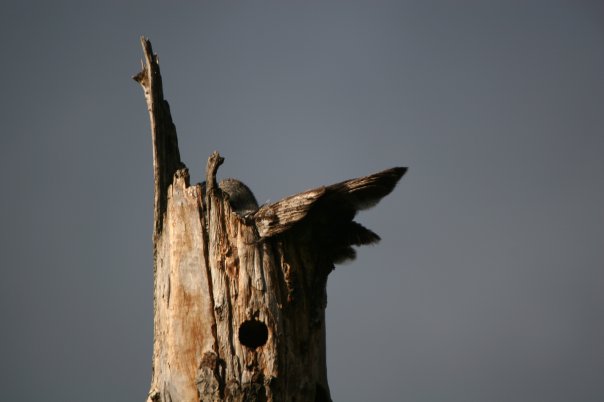
The second full day started with some free time and I took a walk around the area close by the research station. Our guide had heard there was a very special nest that we could possibly go to see and we headed out to find it. After more walking over the uneven forest ground, we came across a tall tree stump with a shattered top. At the very top, at first hard to see, was a nesting great grey owl, sitting very still on a clutch of eggs. It seemed almost oblivious to our presence apart from an occasional glimpse in our direction but we soon reversed away so not to disturb this amazing bird from its nest.

Later that evening we again headed out into the forest in search of wolves in hope of hearing them howl. We had our evening meal out in the open as we sat around a warming campfire, which kept the cooling effects of the damp spring air at bay. As we sat around the first, the tour guide’s small dog walked to the edge of the huddled group and growled out towards the darkness. A shiver shot down my spine; ‘could there be a wolf out there watching us?’ I thought to myself, a sense of both fear and excitement coursing through me. A spotlight was shone out into the surrounding woods, going from point to point, pausing and moving on, trying to pick up movement or the shining retinas of staring eyes but there was nothing looking back at us. 

Afterwards, we had another couple of attempts, at different locations, to howl out into the forest in hope that wolves in the darkness would howl back in return. Unfortunately, it wasn’t to be and we headed back to the research station with perhaps the biggest hope of the trip dashed for a final time.

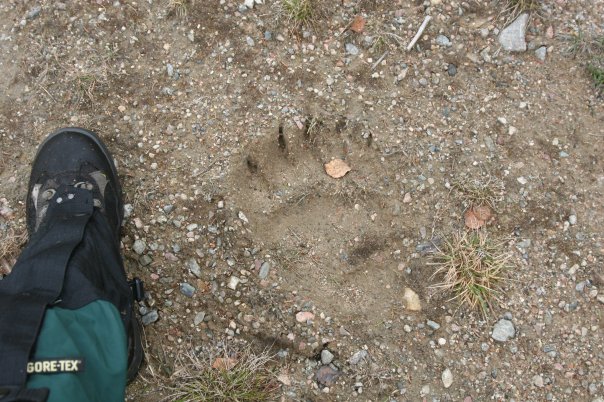
The last full day started with a long drive north. We may our way to a small lakeside homestead and then out into the surrounding forest. Eventually we arrived at a wooden shelter at the edge of a clearing. Set up with desk chairs, bunk beds and a toilet, we settled in for a long night as we waited for brown bears to appear. We had seen their paw prints on route to the hide but that was the closest we got to them. As it became too dark to see beyond the small viewing slots, we all headed to our bunks and in the morning the view was still empty apart from a cawing raven or two. The ravens called out a range of different sounds, varying significantly over the course of our stay in the hide. We were told that they have distinct calls when a bear is nearby and each time they made a different noise there was a little jump in expectation but each time the hope ebbed away again. We reluctantly and sadly made our way back to the homestead for a very good breakfast, but only after very gingerly opening the door to the hide, just in case the bears were waiting for us behind it.

With another long and uneventful drive back south away from the unseen bears, that was it, my first wildlife trip was over. The only notable moment on the journey was when we were driving along a particularly long and straight road and we saw a car heading towards on the wrong side of the road (for Sweden). It only moved back to the correct side at the last moment and we had slowed down to avoid it. Very kindly, I was dropped off at the home of my Swedish family and said goodbye to the rest of the group as they went onwards to the airport for the flight home.

What had I learned from the trip? Well, it showed me that wildlife holidays can be deeply immersive experiences, spending time in nature with people who know so much about it or, like me, want to learn and share it with others. I also found that you can’t guarantee seeing the wildlife but just being in the places they inhabit can be almost as good, even if you don’t see the species you really want to. I’ve come to value finding the breath of nature in the places I visit, the true experience isn’t always seeing a particular animal but being in locations that have so much wealth in their ecosystems that we simply don’t have in the UK. Overall, that trip really did reignite my love of nature and I returned enthused and energised to actually do something with that passion I had found.

That holiday changed so much. Within 18 months, I’d been on three further wildlife holidays with the same tour company, to the Scottish islands of Islay and Jura that autumn, to Iceland in the following late winter and to Spain, to look for wolves again, the following autumn. The Sweden trip also put the idea of wildlife volunteering into my head and I started to look for local opportunities close to home, although I didn’t do anything about it immediately. However, the idea was firmly planted and it was to become a central part of my life away from work.

In 2011, two years after that first trip, I had no more wildlife holidays planned and work was particularly busy and not very happy. Despite those trips, I hadn’t made any further changes to my life to grow that interest in nature. However, not being happy at work and frustration with my home life led to the biggest decision of my life to that date; to take a year off. 

Over that year, I spent many weekdays and Sundays volunteering locally, nine weeks residential volunteering for the RSPB at three sites across Scotland and Wales, I went on wildlife holidays to Speyside, Norfolk, Mull and Iceland (again) and had 11 weeks in Sweden over course of four visits. This intense period focusing on watching and photographing wildlife, and volunteering, transformed my life after I returned to work, ensuring I was infinitely happier in both my work life and home life.

When I returned to work, I continued to volunteer both locally and more widely; with a local group in Cheshire, with an osprey project in North Wales and on RSPB Ramsey Island, with the latter culminating in a three-month stay in 2019. I also continued to take wildlife holidays including, up to now, another trip to Spain to find wolves (which I did), and others to the Falkland Islands, Finland (successfully finding bears), Botswana (twice), Poland and Zambia plus various self-guided trips in England, to the Inner and Outer Hebrides, and Orkney. 

That trip to Sweden, eventually, via a very winding route, led me to take that second trip to Botswana, to the Kalahari, was where I met my wife, Sarah. So, finally deciding to actually do something about my wildlife interest, rather than occasionally imaging that I should, has changed my life way beyond anything my imagination could have come up with when I was thumbing those pages of the wildlife magazine and glancing at the wildlife holiday adverts.

Sweden: Glamping in the wilds

During our two-week trip to Sweden in June we celebrated our first wedding anniversary (on the summer solstice), and to do so in style, we booked two nights ‘glamping’ out in the Swedish countryside.

After going on my first ever wildlife holiday, anywhere, in the Bergslagen area of Central Sweden in 2009, I’ve always wanted to go back and I found that the same local company that ran that trip offers a whole range of wildlife and nature-focused breaks and holidays. After looking through the options, we decided on camping near Kloten.

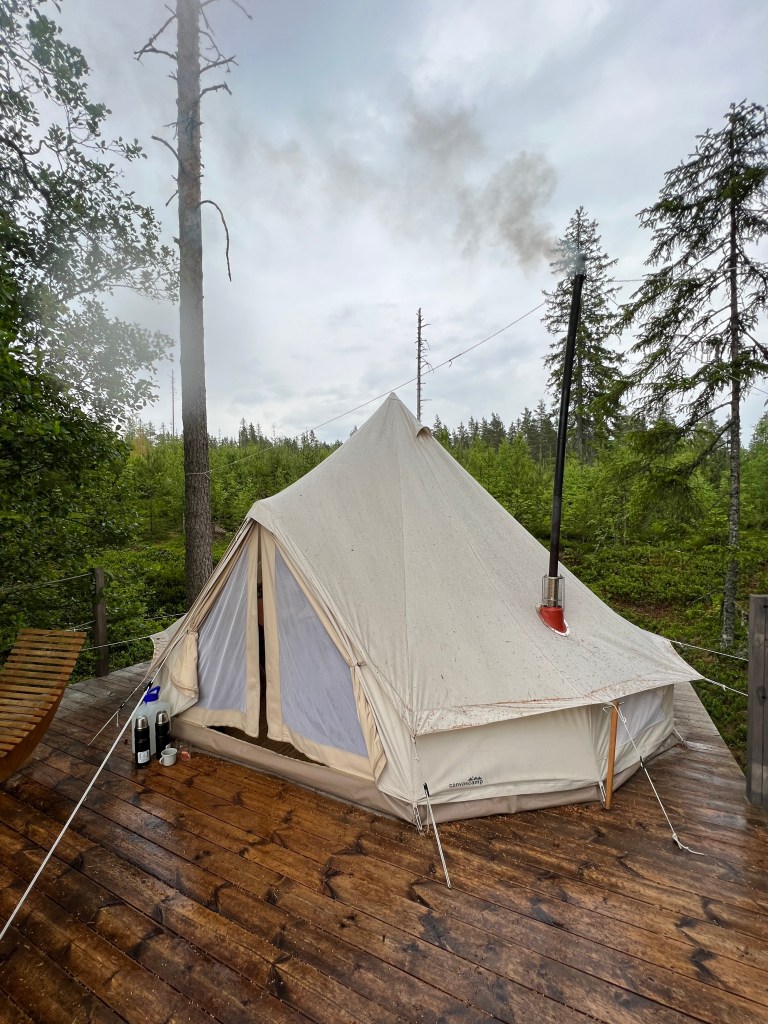
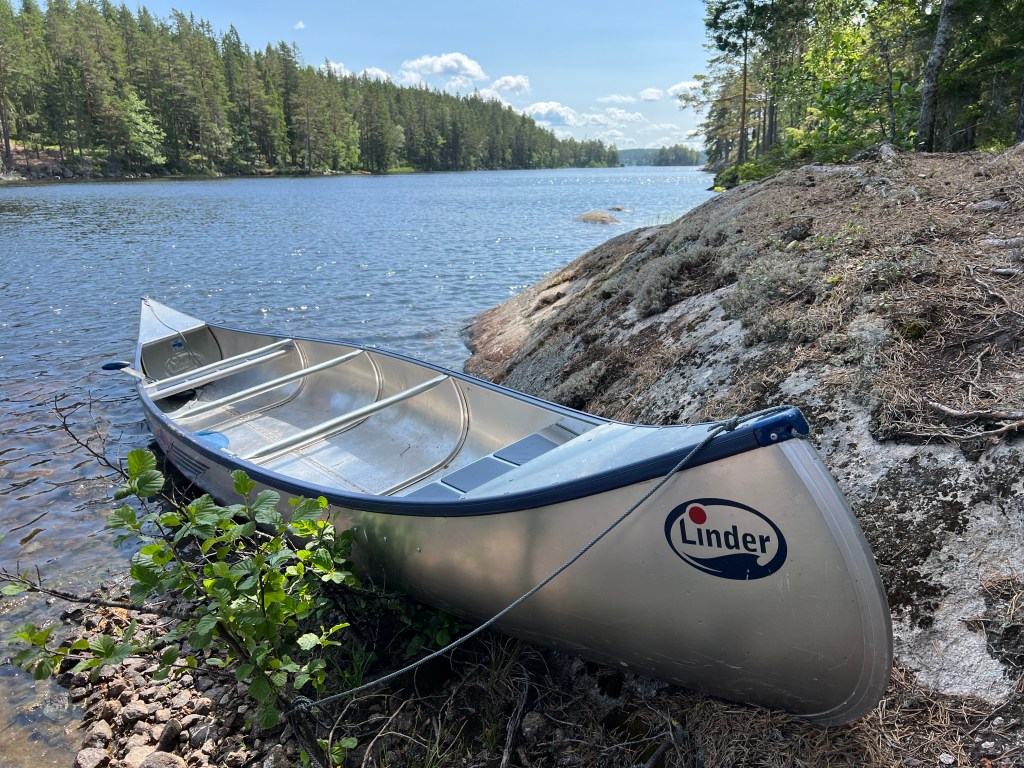
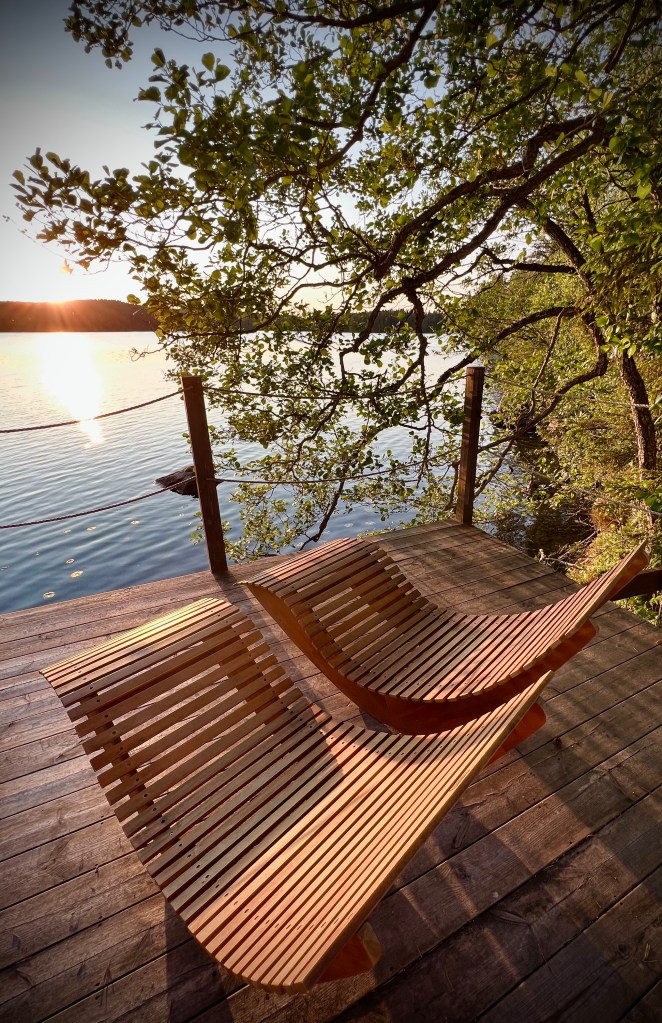
The Kloten Lakeside Camp comprises only four individual bell-tents on wooden platforms at the edge of a large lake. Each tent has a double bed, small woodburning stove, bedside tables, chairs and blankets. Outside on the deck are a dining table and chairs, and two very lovely reclined wooded rocking chairs. Each tent also has its own individual compost toilet. Due to the long-lasting dry weather in that part of Sweden, outdoor fires have been prohibited, therefore the fire pit wasn’t available to us, unfortunately.

The camp is located at Kloten Nature Resort, shown in the map below, and the tents are on the east coast of the lake just north of the long, thin island in the centre of the map below.

As we arrived, we were met in reception and after a cold drink (on what was a warm day) we were taken to our tent via a 15-minute boat ride and given an introduction on the way. After we were dropped off with our luggage (we were told we had actually packed lightly, which came as a bit of a surprise) we unpacked and settled in. However, on what was a lovely afternoon, we couldn’t stay still for long. Each tent comes with its own Canadian canoe and we took it for a quick spin around the nearby shoreline of the lake. On our return we took a dip and swam in the lake, cooling us down in the warm late afternoon. However, the weather soon changed as the rain came in and we had to retreat to our tent for much of the evening.

Our evening meal, along with our breakfast for the first morning, was brought by boat, and we heated the former on the very efficient stove in the tent. We started with salmon rolls, followed by large pieces of salmon with potatoes and vegetables, and finished off with cheese cake; all very delicious.

The rain relented after dinner and we spent a little time outside but unfortunately there was no sunset over the lake. We went to bed listening to the calls of a nearby cuckoo. This made the perfect end to our first anniversary; on our wedding day and our first anniversary, we both woke and went to sleep to the sound of cuckoos and one called throughout the wedding ceremony itself. The cuckoo really is our ‘wedding’ bird!

We woke early the next morning. Sun rises at just after 3:30am in this part of Sweden around the summer solstice and the tent canvas did little to keep the light out. Exiting the tent, we were welcomed by morning very different to the previous evening; a clear day of blue sky and sunshine.  We looked up to see three ospreys circling overhead, with two of them making their ‘chipping’ alarm call, perhaps trying to ward off the third intruding osprey. 

After a typical Swedish breakfast of yoghurt, fruit, breads and jam, eggs and ham, we decided to go for a longer canoe. Our lunch arrived mid-morning and we loaded it into the canoe and headed out onto the water. The lake was actually a series of large lakes connected by narrower straights of water. We paddled out for about two miles, moving in and out of little inlets and across the wider sections of lake. We came across a family of black-throated divers, with the parents escorting on little chick and shepherding it away behind an island. The wind started to pick up so we decided to head back but stopped off at the side of the lake for our lunch.

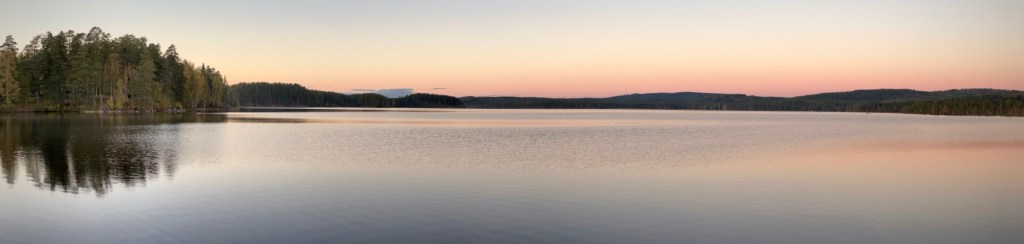
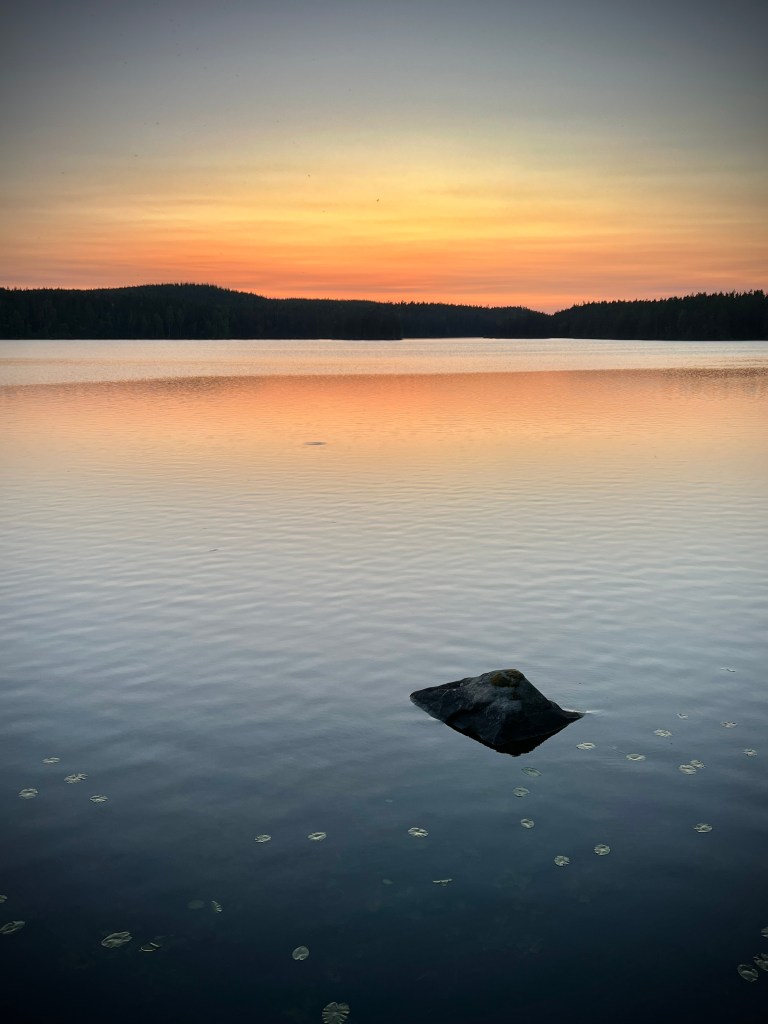
Despite the strong wind, it was lovely spending the late afternoon on the front of the platform over the water. Our dinner arrived along with the last breakfast and we tucked into a beef stir fry, again heated on the tent’s woodburning stove. That evening, we were treated to a proper sunset with the sky glowing orange as the sun dipped behind the tree-covered far shore of the lake.

In the morning we took a final dip in a calmer lake before breakfast, then packed and relaxed before we were picked up in the boat at 11:00am.

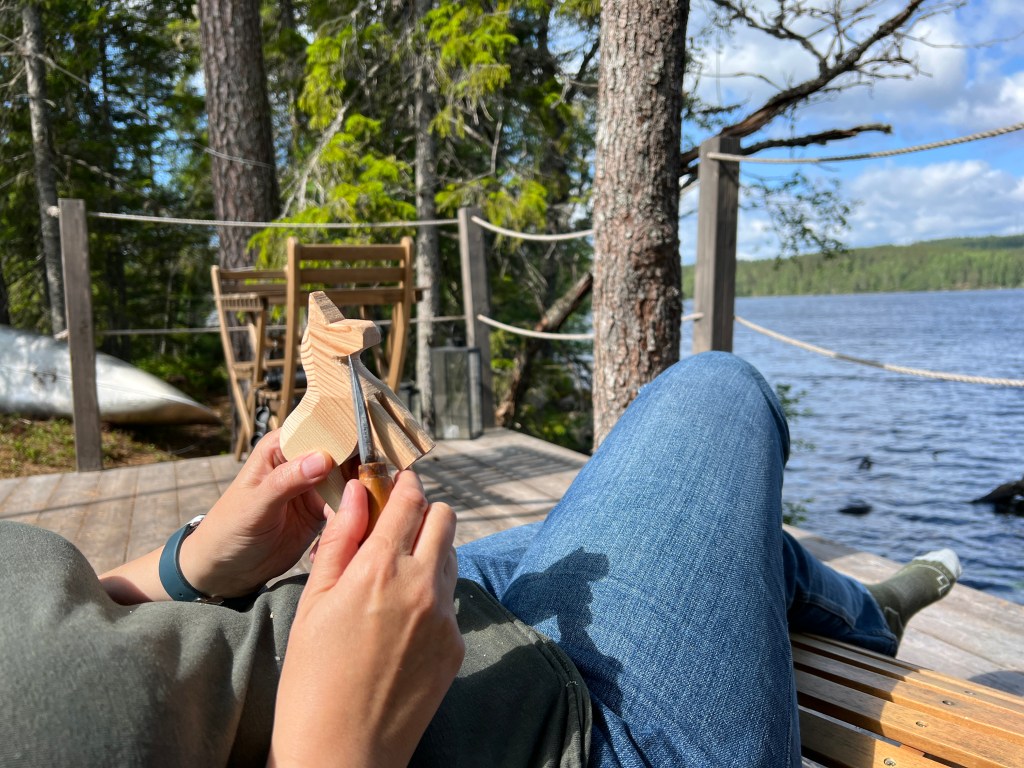
The whole experience was fantastic, spending time in the Swedish wilds, swimming, canoeing, watching the wildlife or simply relaxing. The tent was provided with some extra things to keep us busy including a couple of small wooden dalahäst (dales horse), and a knife to whittle them further, and a polaroid camera to take snaps of the stay and an album to stick them in.

Before we went, we were slightly worried there might be a mosquito problem and that it might actually be quite busy being part of a ‘resort’. We needn’t have worried on either count. We didn’t see a single mosquito the whole time we were there, despite there being quite a few where we were staying for the rest of our time in Sweden. The only other people we saw or heard the entire time we were there were a few canoeists paddling past, some distance away. Even if the other three tents had been occupied, they are far enough away that I doubt they would cause any disturbance or interrupt your privacy. 

Overall, the experience was not at all cheap but worth every penny – both the big things and the little things made it. We will remember it for all the things mentioned above but also for the sights of groups of black-throated drivers flying and swimming past the tent, and the sound of their haunting calls echoing over the lake – magical!

The trip was booked through WildSweden with a link to the webpage here.