A hot osprey shift!!!

The car windows are already open as I turn onto the track, the air under the woodland canopy is cool and fresh compared to the open above the road and valley bottom pastures. The undergrowth has continued to grow in my absence and now brambles flick my wing mirrors as I trundle slowly down the lane. There are few other sounds coming into the car above the crackle of tyres over stones and fallen twigs. The birds are quiet except for an occasional whistle or chirp in amongst the leaves and bracken.

As I break cover, the dazzling light of the mid-summer sun strikes down harshly on the ground. The blue above highlights electric tones in the oaks leaves but the detail in the view is cast out by the mix of dark shadows and unfiltered glare. The heat of the day is continuing to build, both forced down from the cloudless sky and rebounding back up from the hardening ground. Weeks of heat have been stored in the tarmac road, stone walls and bare soil, and each successive day brings no respite. The grass is losing its spring green and lustre, stems are drying out and becoming crisp beneath my footsteps.  

There is still life here, however; there are butterflies flittering over the meadowlands and the young blue and great tits are feeding on the grain left out for them under the trees. Above the river, families of swallows and house martins feed on the abundance of insects rising up from the water, and a small group of swifts scream over head. The river itself is low, the lack of rain has drained its strength. The blooming of weed within the water is now starting to fill from bank to bank, giving respite to the shoals of small fish struggling with the shrinking depth and are increasing danger from the kingfisher’s vision.

The three chicks high up in the tall fir tree have grown beyond recognition since my last visit, now well feathered and wings starting to develop in strength. In the heat and strong sun there is little protection for them but their mother stands above , providing what meagre shadow she can.

I had only a short four hour shift today but it was long enough to enjoy the quietness of the valley. Perhaps a short shift was a good thing as the protection caravan was as hot as a sauna (although lacking the steam). With no clouds to speak of, the site could have been unbearable without the shade of the trees and a increasingly keen breeze. I’m not used to this, the words ‘osprey shift’ and ‘hot’ don’t normally go together for me; today must have been the hottest shift I’ve ever had.

The heat didn’t stop Aran from continuing his fatherly work and provided four fish in the day including a brown trout, two tench and a sea bass. The two tench are unusual compared to the sea fish he normally goes for but perhaps the hot and fry weather has made them more accessible.

It’s another few weeks until my next shift and the chicks may not be far off flying by then. They seem to grow so quickly and go from fresh hatchlings to fledglings in the bat of an eye. However, there’s still plenty of summer to go until they make their first long flights to Africa – if the weather stays like this we will have had an outstanding season.

IMG_9786

Orkney: Stromness

The built environment of Orkney has some jewels, the most lovely of which is Stromness. I certainly didn’t expect to find such an exquisite little harbour town of narrow winding streets, open squares and gaps providing views out to the sea and the islands beyond. I could have spent many more hours wandering happily around.

The town has a charm of its own; on initial viewing, it looks a little grey and foreboding, but taking time to stroll around the streets gives time to really soak it in.  The streets are a mixture of little cottages, grand houses, everyday shops and craft boutiques. There’s been plenty of care taken over the place and I’m sure the photos below give only a small impression of what it’s like. Given more time, I expect there are other little gems hidden around corners and up narrow passageways.

There’s plenty of history to be found in the town with many blue plaques identifying the homes of famous residents and the compact but well-stocked museum is well worth a visit.

I expect many people will drive straight off the Scrabster ferry and ignore the centre of the town. It’s easy to miss when getting away in the first mad rush of an emptying ferry, trying to avoid getting caught behind a lorry or campervan and wanting to get to destinations further onto Mainland or beyond. It would be a shame to do so, though, and I was glad I caught the little foot ferry to Hoy and had the opportunity to take a look after I returned.

Orkney: The green and pleasant islands

For the latest trip in my exploration of the Scottish islands I traveled up to the far north and beyond, to visit the intriguing archipelago of Orkney. After my numerous trips to the west coast islands, it was somewhat of a surprise just how different Orkney is to the often impressively bleak and majestic Outer Hebrides. The islands are primarily comprised of low, green rolling pastureland with only a few higher hills topped with heather moorland and no mountains to speak of with the exception of those on the Island of Hoy. The only real ruggedness comes in the form of the high rocky cliffs that occur frequently along the coastlines. There are very few trees and most fields are enclosed by wire fences rather than hedges, giving the landscape a feel of endless views and huge skies. Under the clear blue skies and bright warm sun I frequently experienced over the course of the week, it was a little paradise of the north.

More like the Hebrides, there are plenty of fine beaches, particularly if you venture on to some of the smaller islands. Sanday has some stunningly nice beaches along its coast and others have a fair selection to choose from too. In addition to Mainland, I visited Westray, Sanday and Hoy, all of which have their own landscapes and feel. As well as those beaches, Sanday is quite flat while Westray is similar to Mainland with rolling green pastures but some of the most spectacular cliffs, while Hoy has the highest hills and is mostly moorland. They were all worth a day trip while the small inter-island ferries gave opportunities to see some of the other islands as I passed on my way to and from those I visited.

The built environment of Orkney also has some jewels, the most lovely of which is Stromness. I certainly didn’t expect to find such an exquisite little harbour town of narrow winding streets, open squares and gaps providing views out to the sea and the islands beyond. I could have spent many more hours wandering happily around.

IMG_9402

Kirkwall, the largest town in the islands, is a little more businesslike in places but also has a few gems and nice pedestrian streets. The Highland Park Distillery is probably the best presented whisky distillery I’ve visited and is worth going to for the buildings alone along although I did make a purchase in the shop too (would have been wrong not to!). The town also has all the facilities you would expect in a much larger town elsewhere in Scotland with a good range of shops and supermarkets. It also has a feeling of prosperity in places with a very impressive looking new school and an equally impressive hospital under construction.

Getting around is easy with quiet but well maintained roads, a central airport and plenty of choices of ferry route from the Scottish mainland. I chose to travel on the Scrabster to Stromness route on Northlink’s MV Hamnavoe. I was impressed with this little ship; it was immaculately presented and loading and unloading were quick and efficient. I should have taken my bike with me too as it appears to be a very easy place to cycle – maybe next time!

Overall, the pleasant nature of Orkney, good range of facilities and the ease of getting around, stops the islands, well at least the main island, from feeling remote and certainly less so than the likes of Harris or the Uists. There’s so much to Orkney that it will take more than this post to cover it and certainly much more than one visit.

IMG_9752

A last task of spring?

With only 11 days to go until the summer solstice my visit yesterday to my Breeding Bird Survey gird square really seemed to mark the change from spring to summer. The weather was warm and dry, the landscape in its prime and the birds plentiful in the fields, trees, hedgerows and woodlands. The early freshness of spring has now worn off the countryside with deeper greens setting in but there are new flowers coming out replacing those earlier blooms.

I’m really lucky to have this particular grid square. It is a mixture of fields and woodlands on and just below the hills of the Cheshire sandstone ridge with the start point for the survey being in the village of Bulkeley and the route crossing over the Nantwich to Wrexham road and passing the Bickerton Poacher. These hills are my favourite part of the county so when I was offered the square five years I go, I didn’t hesitate to accept it.

Over the course of the two visits this year, I recorded 39 species, the second highest number recorded over the 18 years since 1998 that the square has been surveyed (it wasn’t surveyed in 2000, 2001 and 2013). Since I took over the square in 2014, I’ve seen an average of 37 species compared to 26 before. In total, 63 species have been recorded over the years and I’ve added 14 of those. This year I added garden warbler and hobby to the list.

Wandering around the countryside surveying the bird life is a lovely way to spend a morning but it’s made even more lovely by the countryside itself, and I even have a favourite little spot. Towards the end of the first of the two one kilometre transects is a small meadow and yesterday it was looking beautiful with the grassland flowers really starting to show well.

I do have one more survey to do, at my Cheshire Wildlife Trust survey site, but that will have to wait until the last weekend of the month – I just hope the weather allows me to complete it.

A sense of yearning for nature

In the city, people long for silence. I don’t. I long for the cacophony of the dawn chorus, the raging of the sea thrust forward by a storm, the ghostly call of the owl from deep in the darkness and the howl of the wolf that has so far eluded my hearing. Above all sounds, I dream of the screaming of swifts; on flickering wings, they are bringers of summer, bringers of joy, the ever-flying embodiments of the year at its peak.

I long to see beyond the next corner, beyond the houses, offices and factories. I long for the mountain-backed beach, with electric blue waters lapping on the crystal sands and the well-loved view from an island to the near mainland, a rolling patchwork laid out beyond. I long to wake to the shocking whiteness of the first fall of snow, untouched yet by foot or tyre and to see the rich nordic landscapes of lakes, trees and meadows. Beyond all those sights, I need green; the bright vibrant green of spring shoots, the robust green of summer trees, the evergreen of northern forests but also just the green of wide open fields, the green that brings a breathing out of the city fumes and dust and a drawing in of clean, cool and fresh untainted air.

Behind sites and sounds, I long for the warm, dusty scent of rain on summer ground, the dampness of leaf-strewn paths of late autumn and the first application of sunscreen, promising sunshine through the day ahead and signifying that I’m beyond the worst of the short, dark, cold winter days. For me, though, there is little better than breathing in the air of wild garlic as I cross a bridge over a spring stream; it is a momentary stimulation of a sense often over awed by swirling heady mixture of urban aromas.

Taste brings a different dimension to my longings. I long for a cheese and pickle sandwich eaten on a rambling cliffside walk, a dark and plump blackberry picked from the late summer bramble, a not so wee dram savoured on an evening doorstep with a cherished view but most of all I long for smoky sausages cooked over an open fire out in the wilderness.

I long to be touched by nature, by the rain on my face as I break from a doorway and head out into the open, to feel the air wafting in through an open window on warm summer nights, to feel sand beneath my feet as I run along a beach in the dark. I need to feel the rock as I clamber across a mountainside and sense the juddering of rough tracks as I cycle along forest paths and, yes, I need the feeling of my fingers and toes going numb while I stand in the frozen winter looking for wildlife. There is one touch of nature that goes beyond them all, the first caressing of a strengthening sun on bare skin as the clouds of winter float away. 

Most of all, I yearn. I yearn for the wide open spaces, I yearn for the solitude of the distant and remote, away from the sense-buffeting town and city.  Beyond all of this, I yearn for the wild. An ache comes over me, deep in my back, yearning for all that is lost and all that needs to be reborn. I yearn for a pure nature, untouched by us, a wilderness that is rich and original, one that is as true now as it ever was…a yearning cannot be sated.

IMG_8960

A first blog post for #30DaysWild

The transformation of spring

One great aspect about visiting a local spot throughout the year is that you can really see how the seasons change month by month. Yesterday in the heat of the afternoon I went for a walk around Wybunbury Moss and it was very much in its spring prime with the birds singing, the flowers blooming and the butterflies flitting about. This was in great contrast to my visit in December when the first snow of the winter had fallen, as the two photos below demonstrate…

IMG_8950IMG_6523

Despite the heat, the birds were really were singing loudly and I managed to record nearly 30 species including plenty of summer migrants; willow warbler, chiffchaff, sedge warbler, whitethroat and swallow. There were also signs of the first young of the year with a family band of long-tailed tits flying along a headline and a great spotted woodpecker feeding noisy chicks in their nest hole.

The walk yesterday was perfect spring stroll in a lovely spot full of signs of the season on the type of day I long for on the cold, short winter days.

May is spring’s promise

After a long series of a bright, clear and sunny days, I arrive in the valley under low cloud and while it’s still warm, mugginess has moved in. The strength of the sun has transformed the scenery over the last few weeks with most trees now fully out in leaf but still with the fresh bright green of spring. The bracken and ferns are starting to unfurl their fronds under the cover of the old oak tree wood, beginning to shade out the fading blue bell carpet.

Away from the trees, buttercups have spread out amongst the grass, now growing fast, spurred on by the strong sun. At the edge of the drying ditches the yellow irises have suddenly bloomed while the white of the hawthorn blossom stands out from the hedge lines around the fields. 

Lambs in the riverside meadows are weaning but still run to their mothers to suckle, roughly butting her skywards from beneath with some running off to escape their over demanding offspring. In amongst the sheep, white butterflies haphazardly fly over the fields, pausing on the flowers before heading onto the next. 

The birds are subdued by the warmth of the day and a little quieter with many now on nests. There remain many calling in the woods and fields; siskin, chaffinch, blue tit, blackbird, thrush, chiffchaff and willow warbler. The wagtails strut amongst the stands of rush and a pheasant breaks from a hidden spot in the undergrowth. A cuckoo calls in the distance but perhaps now less powerfully and with long breaks in its monotonous routine. Swallows have returned and skim low over the fields after the insects emerging under the sun.

5R0A6053-1

The river is low, perhaps as low as I’ve seen it. The summer-like weather of the last few weeks has  reduced its flow and the level has dropped, revealing some of the rocks at the ford. The plants in the water are growing as fast as those on the land and with less space than they had, they are spreading low across the bed. Small shoals of fish dart from cover to cover, hiding from the keen eyes of the kingfisher. 

As my stay progresses the sun breaks out from behind the cloud and the heat begins to build across the fields, river and woodland. The haze remains but the brightness almost hurts my eyes. The wind has been there all the while and now it masks the strength of the rays coming down from above. I move back under cover and the cool offered by the big oak trees by the gate.

In the nest standing high above the meadowland, the waiting is coming to an end. The first of the three large speckled eggs has hatched and new life has arrived in the security of the bowl. Perhaps it will only be three more days until all of the chicks will have broken out. The parents are starting their tireless summer; the male bringing the fish and the female passing small piece by small piece to the chicks.

May is the fulfilment of spring’s promise, the dream of those long dark winter days and nights. I really have come to love the spring; for some reason I always used to prefer the autumn but my tastes have changed and I long for days like today. Of all the months, May must be the finest with spring in its prime and all the migrant birds having arrived back. To me, it is now the point when the transformation from winter to summer is complete, where the trees are all out in leaf and it’s almost possible to forget what they looked like when bare of green. It’s also the point when there’s still so much more to come; the heights of the summer are on their way and the new life has yet to be at its greatest. 

The osprey season is also well on its way with the first of the egg hatched and the other two not far behind. It’s been a fairly serene season so far this year; yes they were a little delayed in their return but they have settled in well. They do have all their hard work yet to come and the next three months will challenge them as usual but so far so good.

Today was a quiet one at Protection, both ospreys spending most of the day at the nest with only one fishing foray later in the afternoon. The greatest activity came with several dog fights with the local crows, both ospreys taking turns to chase them off talon-first.

CNCV: Oakmere

I spent today with Crewe & Nantwich Conservation Volunteers working on some private land at Oakmere. We’ve been going there for three or four years now and have helped to restore a schwingmoor, or quaking bog. Now that we’ve cleared the bog of the larger birch saplings, our tasks are spent ensuring birch doesn’t recolonise and take over again. This is one location were we really can see the difference our efforts make.

The location is also lovely, a lakeside woodland approached through meadows with the bog in the middle. The woodland is full of birdlife and we had great views of young green woodpeckers and listened to the chorus of birds throughout the day.

We finished at about 15:00 after spending the day in the hot sun, so I popped into the nearby farm shop for some ice cream – yum!

A short trip to Pembrokeshire

Last weekend I had a short trip down to Pembrokeshire for a spring day visit to Ramsey Island and a first visit to Skomer. Unfortunately, the weather got in the way and no boats sailed to Skomer on the first day and I had my shortest ever visit to Ramsey on the second. As always seems the case, it was a stunningly lovely day when I arrived on Ramsey but the weather from the previous day was still having an effect. Two volunteers were being taken across on the 10:00am boat and I caught a lift, only to be told an hour later that all boats for the rest of the day had been cancelled due to swell and I had to be taken off. My small island jinx this year seems to have struck again; I waited a whole week to get to St Kilda last month but failed due to strong winds.

However, there’s more to Pembrokeshire than simply the islands. I went for a wander along the coast path near to Strumble Head. Despite the wind and rain, the spring flowers were putting on a great show with thrift, spring squill, bluebells, cowslip, primrose and gorse all out on the cliff tops. The flowers were also out in the roadside verges and high hedgerows with the red campion particularly abundant. Pembrokeshire is blessed when it comes to the springtime and when the sun came out there couldn’t have been anywhere prettier on that May day.

I also sampled more of the local Pembrokeshire food, dining at St David’s Kitchen in the evening, including a plate of Ramsey Island mutton, and had great fish and chips from The Shed at Porthgain – the best I’ve had in a very long time.

St David’s was also looking it’s best and the sunset on my last evening was spectacular…

IMG_8747

Pembrokeshire really is a hidden gem; it’s like Cornwall, but without the crowds.

Settling down for a night shift

Standing on the bridge, the day comes to a close, with the last of the light seeping away behind the hills. The water passing beneath me barely makes a sound, only the occasional ripple over rocks and a fishing coming to the surface for a fly caught in the tension. Almost mirror-like, the river is undisturbed by any breeze, the air lies still and the sounds carry true across the meadows

A crescent moon hasn’t far to run before it dips behind the horizon but the stars begin to take its place, picking out diamonds across the deep blue of the night-encroaching sky. The clearness above that earlier brought warmth now lets that heat flow away, leaving a chill to fall onto the land as mist slowly rises amongst the stone walls and stands of rush.

The barks of farm dogs echo across the valley bottom and lambs bleat to ewes in the growing dark. The last of the evening chorus falls silent leaving only the owls calling in the dark and the occasional trill of the grasshopper warbler. A huge burbling moth bumbles past like a flying clockwork toy while I watch out for bats passing over the water and under the bridge.

As I return to the caravan, the cool of the outdoors is met by the last remnants of the warmth from the sun still trapped inside. Pulling the door closed, the day is finally left behind, the light gone until dawn brings the new morning at the end of an eight-hour shift. I sit down on the bench and the screen on the desk casts a glow across the room. Out there in the dark, but shown brightly in front of me, is a nest high up in the tree above the rocky island in the meadows, an osprey female sat brooding over three speckled eggs. Also out there in the dark could be hands eager to place fingers around the contents of the nest.

Having watched over the nest for quite a few years now and having witnessed very little unwanted interference, it’s easy to forget that there are still some people out there who could wish it harm. Within the past fortnight a man from Plymouth was found guilty of disturbing a number rare birds nests, including ospreys, and taking three osprey eggs from Scotland. In addition to doing protection shifts at Glaslyn, I also do shifts protecting a peregrine nest in Cheshire and there were three attempts to interfere with the nest last year. Whilst very much rarer than it used to be, it’s sad that there are still people who would rather harm wildlife for their own gratification rather than leaving it alone and getting enjoyment by simply observing from a distance.

I do wonder if Mrs G is starting to feel her age a bit as during my two night shifts this year she has spent more time asleep than I remember her having been during shifts in previous years. I always used to think how tired she must be even before the eggs hatch as she always seemed to be awake and fidgeting about in the nest throughout each night. Having said that, she’s not the only one who seems to find it increasingly difficult to keep their eyes open in the evenings.

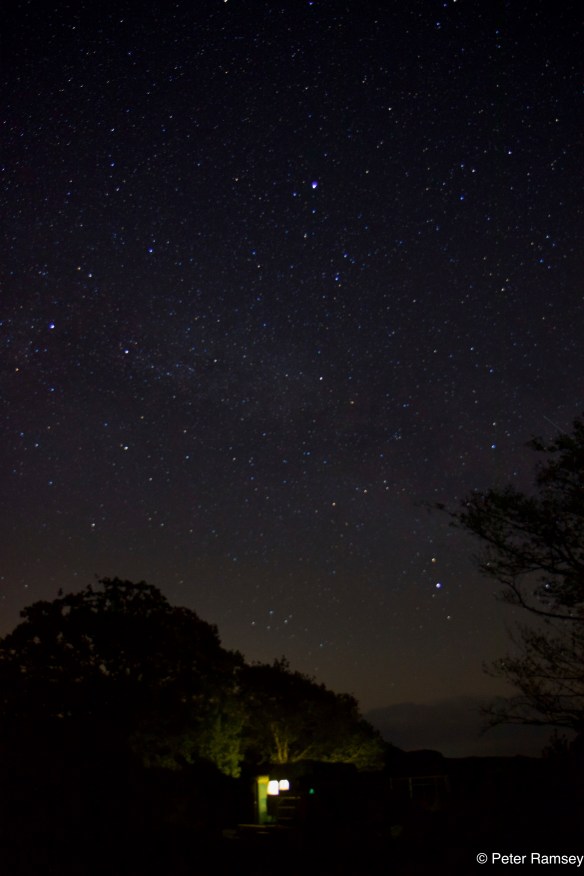
The highlight of my shift was the sky; almost cloudless, it gave me an opportunity to try a bit of star photography…

5R0A5916-1