Author Archives: daftmumblings
A conclusion to survey season
Last weekend I did my last bird survey of the breeding season, having had a busy few months of recording since the beginning of March. This year I’ve been doing surveys at two nature reserves for Cheshire Wildlife Trust, I’ve completed a Breeding Bird Survey for the British Trust for Ornithology (BTO) in a grid square near Bulkeley, I’ve taken part in the BTO’s House Martin Survey and I did a bit of surveying for the RSPB when I stayed on Ramsey Island.
The surveys for Cheshire Wildlife Trust, at its Bagmere and Blakenhall Moss reserves, were done once a month during March, April, May and June, and this year the overall bird lists for the sites increased further. Over the course of the four visits to Bagmere, 39 species were recorded and this was two less than last year. However, I also made a note of species when I spent a day there with Crewe & Nantwich Conservation Volunteers and that visit brought the total up to 45. It was disappointing not to record willow tits at Bagmere this year, a red-listed species, particularly as some nest boxes have now been put up for them; I haven’t seen them at the site since December last year. However, it was good to hear water rail on each visit and to add some new species including garden warbler and grasshopper warbler. This year I didn’t record any confirmed breeding species at Bagmere but I did record 19 probables and 12 possibles.
At Blakenhall, the transformation from woodland to wetland continues to increase the species seen at the reserve. Up until a couple of years ago there would have only been woodland species but now there is a range of both wintering and breeding wildfowl. In total, 47 species were recorded, up from 35 last year and there were five species confirmed as breeding including blue tit, great tit, Canada goose, greylag goose and treecreeper. In addition, 12 probables and 22 possibles were recorded. There were some new species at Blakenhall too including grasshopper warbler, spotted flycatcher, swallow, shoveler, tufted duck and little owl.
I’ve now completed two years’ of Winter Bird Surveys and Breeding Bird Surveys at Bagmere and Blakenhall, and these have set a baseline for the sites as they were the first surveys of birds done by the Wildlife Trust at the reserves. I’ve now recorded a total of 53 species at Bagmere and 59 at Blakenhall.
The House Martin Survey is being undertaken for one year only, to help to assess the state of the house martin population in the UK. My second visit to my allocated grid square added another nest to the one recorded during the previous visit in June. However, it was only the first one that appeared to being used, with adult birds visiting to feed chicks. Fortunately, there are more house martins in the area, with colonies just outside my grid square. It was also nice to see a good dozen or more floating around in the evening sky last night when I was at a BBQ only a couple of hundred metres from the boundary of my square.
My hopes were raised that the old house martin nest on the side of my house might still be used this year as I saw birds making fleeting visits over a couple of days and I found droppings beneath the nest when I came back from my two weeks on Ramsey Island. However, those hopes have gone as the birds’ interest didn’t last long and it’s now too late for a pair to breed in the nest. Maybe next year!
I really enjoy doing the bird surveys, not only because I’m doing something practical to support conservation efforts, but also because it’s lovely to spend a couple of early hours on spring mornings wandering around nature reserves. However, I have to say that the bird survey I helped with on my first day on Ramsey Island was the most fun and memorable of the year. The seabird survey by jet boat in warm summer sunshine was spectacular and a world away from the freezing cold March morning at Bagmere when I crunched my way around the hushed, snow coated reserve with my fingers, toes and nose being nipped by the frost.
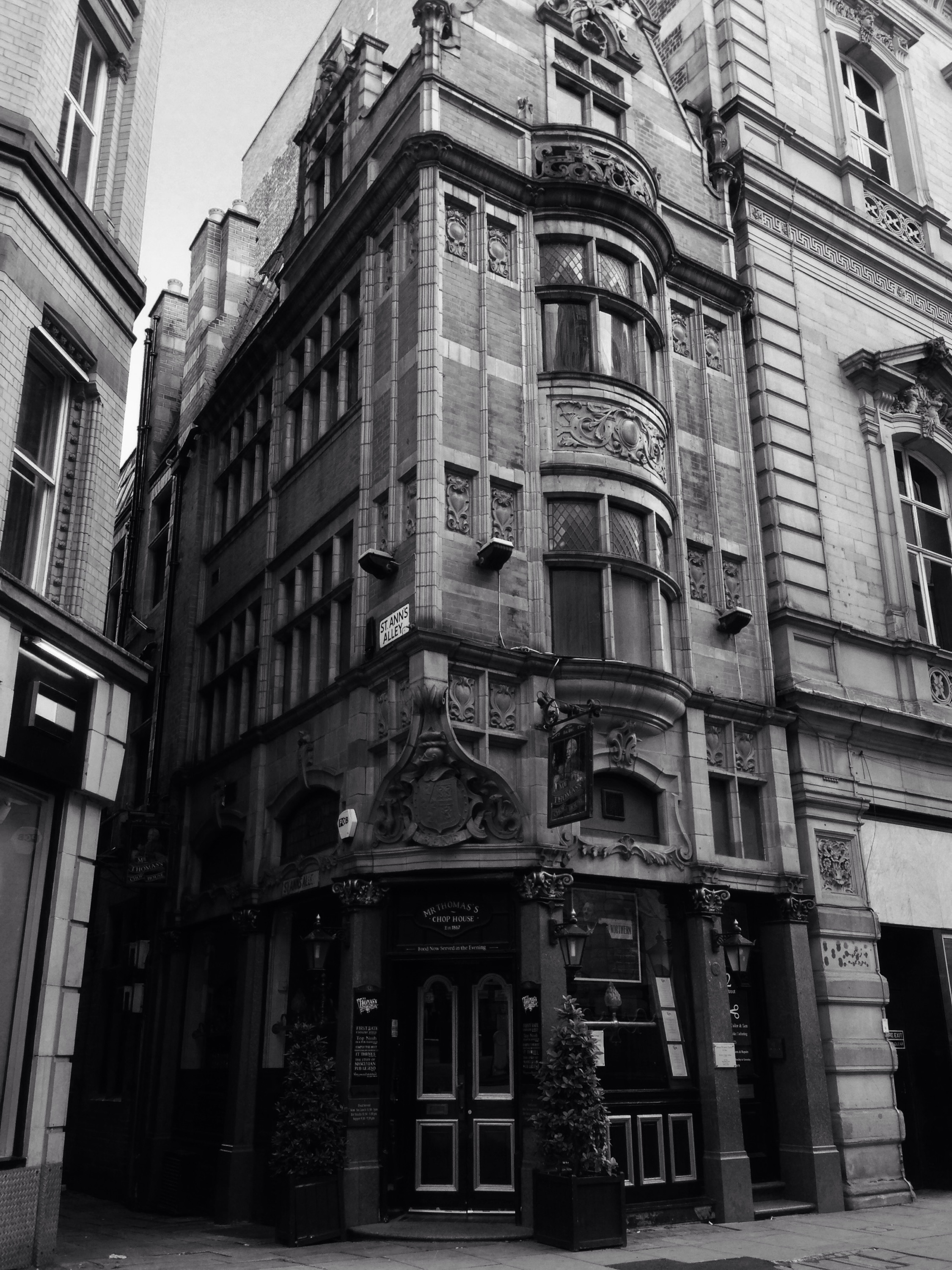
Manchester Buildings
White-winged Black Tern
Last week while working in Lincolnshire I stayed overnight near Boston. With a spare evening, I decided to take a look around RSPB Frampton Marsh, which is just south of the town.
While there I saw a nice range of wildlife including some I don’t see very often including spoonbills, avocets and little egrets. However, there was one bird that really caught my eye. I’m not a twitcher, or even a birder, more a general nature enthusiast, but I have to say I was quite excited to see a rarity while wandering around the nature reserve.
A white-winged black tern was flying back and forth over the wetlands enabling those there to get a good view of it. According to the Collins Bird Guide, there are around 40 records of these lovely birds in the UK each year, so I was pretty lucky to see it and even get (a pretty rubbish) photo of it. It’s a stunning looking bird in its summer plumage with its black body, and white and grey wings.
Wybunbury Moss in High Summer
The next four weeks or so are, on average, the warmest of the year and the summer should be at its peak. It doesn’t seem like high summer as I write this as the rain is falling and the temperatures are in the teens. However, yesterday was a bit better and I took a walk around Wybunbury Moss, something I haven’t done for quite a while.
My now regular circular walk through the woodlands and meadows around the outside of the Moss really help to give me a sense of the moving seasons and how this small bit of countryside changes as the year moves on. I got a good list of 30 birds yesterday (all recorded using the BirdTrack smartphone app, which uploads records to the British Trust Ornithology’s database) but the Moss is much quieter now than previous months. The great rush to breed is now reducing and there was less bird song to be heard; July is a time when many birds are moulting after their broods have fledged so they tend to sing much less. Whilst the birds are quieter, the wild flowers are much ‘louder’ now and there’s quite a good show at Wybunbury. Wandering around the area I saw plenty of flowers I knew and plenty I’ve yet to learn the names of but those I could identify included red campion, honeysuckle, rosebay willowherb, foxglove and common spotted orchid. In addition, the brambles aren’t just flowering, they’re starting to show the first signs of a good crop of blackberries. 


As well as birds and flowers, there were a few butterflies around to be seen including large white and spotted wood.
There were also some mammals around including rabbits and the little dexter cattle being used to manage the grassland around the outside of the Moss. They look a bit like Spanish fighting bulls but they’re quite friendly and are more like large pointy-horned dogs.
On a slightly depressing note, the autumn migration has already started with the swifts starting to make their long return journeys south. Thankfully, there’s still quite a few weeks of summer left!
Manchester Buildings
Mustn’t Grumble – a bit of sunshine in the Glaslyn Valley
I wake after another sticky night with a slightly cooler draft coming in through the windows. Opening the curtains reveals that rain has been and gone but the clouds look to hold more. Setting out from home, there is dampness in the air but no large drops and the road has already dried. As I cross the low and flat Cheshire Plain, the clouds begin to part and I, and my hopes for a continued hot spell, rise after I cross the border once more into Wales. Passing along the narrow valley roads, through a scene approaching high summer, the seasons have progressed since my last journey in these parts. The trees are now a darker shade of green, gone is the first bright flush of spring. The fields are looking drier and the long grass has recently been cropped for hay. There is colour, however, with foxgloves continuing their grand displays, although coming towards their end, and the elders are still out, their white blossom perhaps the last from the trees.
I take the moor-top route for a bit of fun but travel at a more sedate pace to avoid the wandering sheep. Dropping into the valleys, the clouds have once more gathered and the hill and mountain tops are now shrouded. As I approach the cross-roads and turn onto that wooded track, the drizzle starts to fall and my hopes for a warm, or hot, shift seem dashed. Opening my windows, the track is quieter than usual and my lights come on as I pass into the dark beneath the leaf-laden branches. The track is narrowed even more by the undergrowth, with my wing mirrors flicking young branches and bracken as I progress. The spring sounds have fallen almost silent with only a few chirps coming from the wood but the birds are still there; a startled blackbird flies off in front and a wren hops to the side.
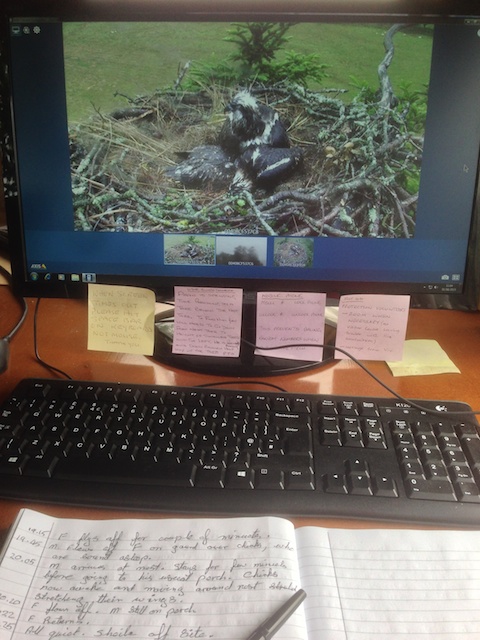
Emerging from the gloom beneath the canopy, the clouds seem to have darkened further and the drizzle turns to wind-blown rain. Leaving my car I put my jacket on, glad I’d brought it and wondering whether shorts were such a great idea. However, it’s not cold, almost muggy in fact in the shelter of the caravan. Over the ivy-covered drystone wall, across the river, past the gorse-topped bund and over the low, damp pasture, the small copse still has two large birds sat in the nest at the top of the fir trees. Nothing seems to have changed since my last view of them but as the female stands she reveals not two eggs but two chicks. An odd-looking pair they are, one larger than the other, but already much grown from their hatching and more in control of their once bobbling heads. A flat fish is fed to them, the larger one getting more than its fair share, but once filled, it takes less from its mother and the smaller chick has its turn. Comfortably fed, the female moves over them again and protects her brood from the wind and now lessening rain.
It’s been quite a few weeks since my last shift at protection and the hopes of the osprey watchers have been answered with the hatching of two healthy chicks. There was a time this spring when this seemed an unlikely event, being the sixth and seventh eggs to be laid in a season-long drama, and one of which spent some hours out of the nest cup, only to be nudged back in by the first-time father-to-be.
It was a quiet start to the shift with the female on the nest and either feeding the chicks a flounder (in several stints) or brooding them in the intervening periods. The male was present when I arrived but disappeared just after 11:00am and returned at 2:25pm with another fish (a trout, I think). He then went off again and returned with yet another catch at 3:54pm. This new male seems to have got the hang of his job!
While the male was away, the female started to mantle and looking upwards but I couldn’t see what was concerning her. There has been another female osprey in the area recently but I couldn’t see anything else around.
During the afternoon, the larger of the two chicks started to move around the nest and whilst it didn’t get too close to the edge, there were moments when I really did hope it would turn around and head back to the bowl in the middle.
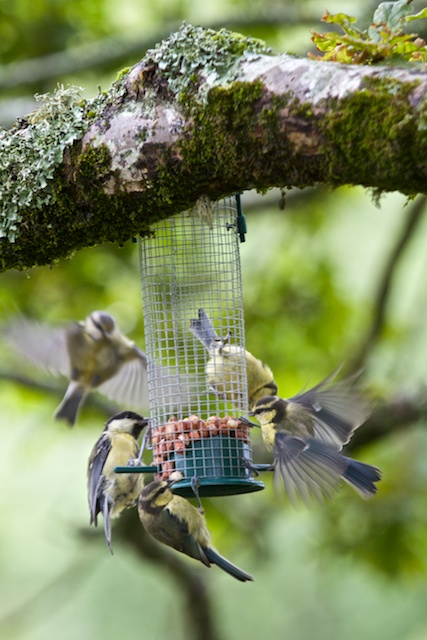
I gradually saw a few more birds during the day with swallows skimming low over the meadows, young blue and great tits using the feeders outside the protection caravan, a raven passing overhead, meadow pipits still displaying, a pied wagtail feeding on flies, a red kite gliding over the tree tops and a family of mute swans resting at the river’s edge.
At around 2:00pm, the strong wind blew away the clouds and, finally, I had some summer sunshine on an osprey shift – the first proper warmth during a shift this year. I took full advantage and went down to the river and sat on the bridge in the sun, dangling my legs over the side (remembering to tie my shoe laces first!). The sun didn’t last too long as the cloud soon came back, being driven onwards by the pesky wind and afternoon turned back to dullness.
I’ve got another shift in four weeks time and no doubt the chicks will have grown a lot by then and will be looking a bit more like their parents.