From Spring into Winter and Back Again

Out I drive, across the flatness of the Cheshire Plain and on towards the Welsh Border; the startling sun shining down, my shades reducing the glare. Up into the low hills I go, the road no less winding but certainly more undulating. The open skies and the warmth inside mask the wind on which a buzzard floats, just above the neighbouring ridge. Onwards I press, wanting an open-topped sportscar not an Autobahn saloon; maybe that’ll be another day!

As I pass Bala and its reservoir, I start to climb up into the mountains and the weather changes. There is a line, a break, between the brightness and a dark, brooding gloom. The hopes of a fine spring day soon fade as I pass under the divide and the cloud encloses the scenery. Above the lake, I take a sharp right turn and forcefully make my way up the hill, cresting the ridge and out onto the open moors, with the slim and twisting quiet road laid out in front. Finally, after turns and straights, and more turns, past sheer plunges, I drop down into the villages and then onto an open, flat plain once more.

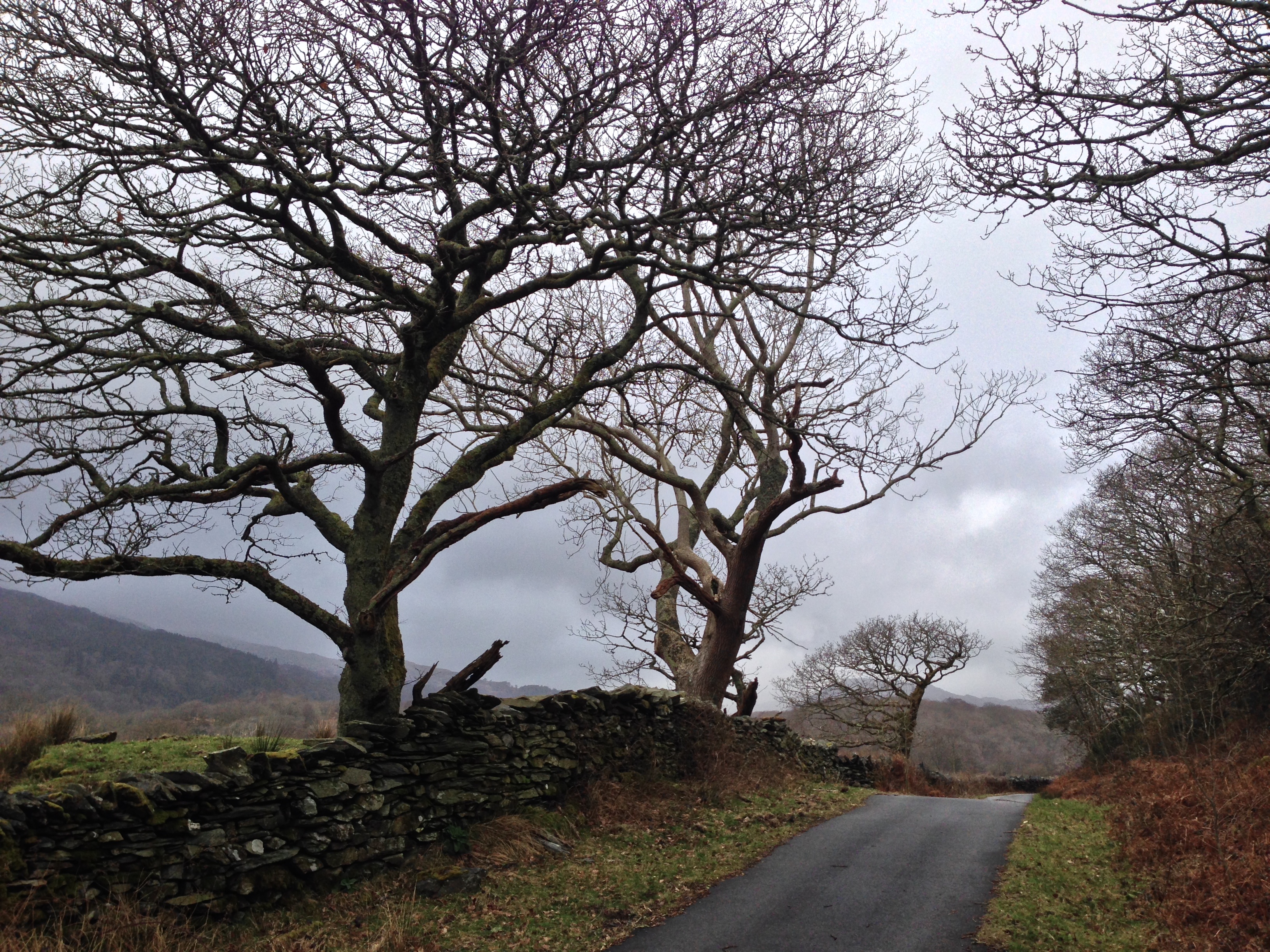
I approach a familiar junction and turn, slowing to make the car narrow enough to pass through the gateway. Onto the track I drive, passing between wall and slope to the valley bottom; there are no hints of spring here and the birds remain hushed by the lingering cold and damp. The signs of last autumn remain; leaves still cover the ground and the track is split by a line of fallen twigs and mulch. The bracken, once bright in its closing year rustiness, has withered further and is left almost colourless, like the surrounding landscape, subdued by the monochrome skies. The new season seems a long way off here and it is only the mosses coating the walls and trees that add any pigment to the otherwise washed-out scene.

Bala

The Track

Surely spring must be here now? I’ve been to the training day for the Glaslyn osprey protection volunteers! As has been the case for the past three years, the season will be dotted with shifts down in the Glaslyn Valley, helping to protect a pair of nesting ospreys, and their precious clutch of eggs, from the backward, childish, and just plain illegal, advances of collectors. Maybe, one day, the actions of a few dimwitted idiots won’t have to be stopped by a group of passionate and proactive people that truly care about the world around them…but that is a slim hope. However, I have to confess (and don’t tell anyone), but I kind of like the Glaslyn Valley, and the attentions of a few egg collectors just gives me an excuse to spend more time there. As long as these idiots continue trying to satisfy their senseless needs, there will be people ready and waiting to stop them.

The Track

Yet again, I have been truly impressed by how much a group of volunteers has achieved in such a short space of time. Just over a year ago, the RSPB passed the project to protect the Glaslyn Ospreys to a group of volunteers, who set up a public interest company. Although last year was a big learning experience, the ospreys were successfully protected and fledged three chicks. Even more hard work has been put in since the birds left in the early autumn, which has resulted in big improvements this year with a new visitor centre nearly completed. However, the project can’t be run without a large group of volunteers, either at the protection site or visitor centre, but also without monetary donations. Time given for free only goes so far and the plans in place need financial support. So, if you have a few quid lying down the back of the sofa, or in a jar by the door, perhaps you could give it to a good cause and help to generate a thriving population of Welsh ospreys (by the way, they’re not just Welsh – the offspring of the Glaslyn pair currently breed in both England and Scotland). You can donate via the Bywyd Gwyllt Glaslyn Wildlife website.

On the way home, to my surprise, the break in the weather was in exactly the same place. As I approached Bala, the gloom of the middle of the day was left behind and a bright spring day reappeared. Even better, there were some spectacular lenticular clouds to be seen on the way, making concentration on the road ahead a little more difficult than usual.

Lenticular Clouds

So a day started in spring, spent in winter, and finished in spring again – perhaps I was a little too hopeful that the season had changed…and summer is definitely a long way off!

Talking about bird song…I need to learn to love the dawn chorus again!

Whilst winter isn’t over just yet, and it’s still dark when I leave home in the morning to travel to work, spring can’t be far away as over the past week I’ve heard birds singing the dawn chorus for the first time this year. When I say birds, I really mean one species, as it has only been song thrushes so far that I have heard in these early hours, just before 6:00am.

Over course of the spring last year, I had quite a long period of poor sleep, getting less than a handful of hours a night.  Most mornings I knew it was pointless trying to get to sleep when the thrush on my roof started singing.  The song of the bird, a constantly changing pattern of two or three-times repeated calls and notes, really started to annoy me. It is actually one of the nicest songs of dawn but it can be quite sharp and piercing, and not only made me even wider awake, the pattern of the call disturbed by thoughts too.

Usually, the first calls of the dawn chorus, as winter moves into spring, would be very welcome, but when I first heard that song this week, it took me right back to those sleepless nights last year.  It’s strange how sounds (and other senses) can instantly transport the mind back to previous times.  I’ll need to shake that association from my head as the down chorus should be something wonderful not something bad. So, I’m going to force myself to get up early one weekend morning and head out into the countryside, to sit under the canopy of a wood and listen as the dawn chorus unfolds around me – that should do the trick!

Standing up for bird song…

Nearly a year ago I wrote a post about how road noise is making it more difficult to hear nature’s sounds and that instead of complaining about traffic, we should be more positive and stand up for bird song (link to post).

Well, today there was an article in The Guardian reporting on research from the US showing that we are slowly becoming deaf to nature’s sounds and that there are positive effects on people from being able to hear the natural world around them.

So I can have good ideas when walking home from the pub!

Lacking inspiration…

Maybe it’s the winter blues or the need for a bit of a change but I’ve been finding it hard to motivate myself recently when it comes to my usual interests.  However, over last weekend I did push myself out of the house to do a Winter Bird Survey at Cheshire Wildlife Trust’s Blakenhall Moss reserve and had a walk around Wybunbury Moss.

Blakenhall Moss

The survey was almost as atmospheric as the December visit to Blakenhall but the lack of sun, made the view much more dull.  The fogginess and general murk certainly made the place feel like it was at its lowest ebb of the seasons.  However, I saw one of the first signs of spring with the bluebell shoots starting to emerge from under the leaf litter; maybe a little early this year.  I was also cheered up by recording a couple of marsh tits during the survey; these are an important species for the site, are a nationally red-listed species in serious decline and are not well-recorded in Cheshire.

Bluebell shoots

Out at Wybunbury Moss, I took advantage of the new section of footpath recently designated and opened close to the church tower and behind the Swan Inn pub.  This new path enables a complete circular walk around the Moss without having to use the footway alongside the road through the village, which altogether provides a nice, quiet wander of around 45 minutes.

IMG_5622

Unlike at Blakenhall, I didn’t see any signs of spring at Wybunbury and even the birds seemed subdued.

Unlike me, it appears others have had more motivation than me recently, as I found the results of the work put in by my volunteering colleagues the previous weekend.  They (Crewe & Nantwich Conservation Volunteers) had spent the day clearing an area of small ponds and undergrowth within the woodland surrounding the Moss and had also laid more log pathway to make it easier to walk along the permissive path through the site.

With the first signs of spring starting to appear, I’m hoping the first ‘greenshoots’ of motivation and inspiration will also start to grow – I certainly need something to give me a bit of a kickstart to the year!

Falkland Islands: The Wildlife – a whole new world of avifauna (yep that’s birds!)

In a previous post about my trip to the Falklands, I wrote about the mammals of the islands (and great they are too!) but I have to write about the birds too. The Falklands, quite simply, must be one of the most amazing birdwatching locations in the world and not just because of the penguins.

IMG_9650

I have to admit here that I do keep a list of birds I see, but as part of a larger list of wildlife I encounter each year including mammals, reptiles, amphibians and butterflies. My target was to see at least 50 species that I had never seen before and I very nearly got there. I saw 52 species on the islands but these included three that we have in the UK; peregrine, house sparrow and mallard (the latter two were introduced by settlers). So 49 wasn’t a bad final total and, if added to the two species I saw on Ascension Island (common myna and yellow canary), I got just over my target (if cheating a little).

IMG_8921

In someways, the Falklands is a bit like another place I have visited for the wildlife, Iceland, as there is not a huge number of common species but the islands have a mass of individual birds to make the place spectacular. The birds are also very tame and have almost no fear of people, which makes getting up close (within limits) very easy. Being a group of small islands in the middle of the South Atlantic, you might think that seabirds would dominate but there is also a good range birds associated with freshwater and inland areas. It’s very difficult to know where to start describing all the bird species so I will mention just a few; the highlights! Geese were everywhere on the islands, and of the four species, the upland goose is the most ubiquitous (and quite tasty – I had upland goose pate a couple of times). The steamer ducks including the flightless Falkland species are also widely seen and they are part of the typical island coastal scene.

IMG_7650IMG_7835IMG_8941

There are few raptor species in the islands but those that are there can be spotted quite frequently. Turkey vultures are seen more than most and it’s common to see small groups of them circling high above the settlements while others are found alone, quartering the long grass. The variable hawks are in many places and, like buzzards, seem to like sitting on the top of high perches like telegraph poles. Peregrines are less frequently observed but I had a dusk encounter with one when I was wandering back from the rockhopper colony on Saunders Island; it circled slowly around me, checking me out, before landing a short distance away. It let me get very close before it took off and disappeared over the hill.

IMG_8667IMG_8044IMG_7898

The caracaras also have to be mentioned and no visit to the Falklands appears to be complete without being targeted by one of the striated variety, or Johnny Rooks as they are known locally. I was the focus of their unwanted attentions on a number of occasions with them usually trying to steal my sunglasses or lunch (never successfully, gladly). They are quite comical, yet cunning, and when they know they have been spotted, will act nonchalantly and pretend to be uninterested but will suddenly aim straight for you if you get distracted. They can be quite fearsome and don’t stand any nonsense from each other or, in fact, much larger birds like the impressive south giant petrel. Their screeching at each other and general commotion while quarrelling over food was a very common sound down on some of the beaches I visited.

IMG_5792IMG_4519

One of the most impressive birds around the islands is the southern giant petrel, or ‘stinker’ to the locals. These huge, dark, sinister-looking birds with great long wings (2 metre span) are carrion eaters and spend their days gliding along the coasts or across the inland moors searching for their next meal. Graceful in the air, they are awkward on the ground and look almost prehistoric, with a strange dance when they try to claim possession over a carcass.

IMG_5618IMG_8401

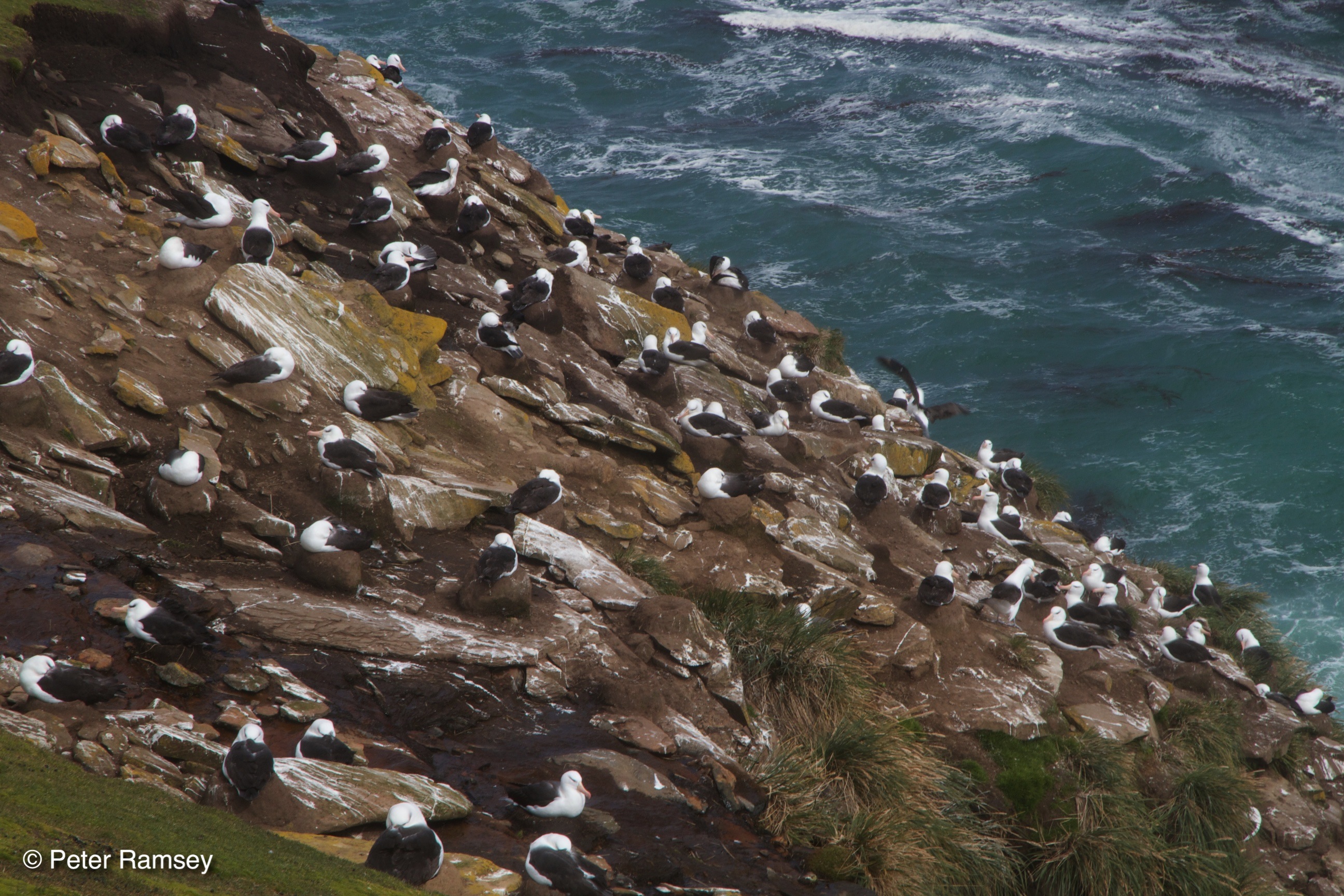
However, they are not quite as big or as the beautiful the black-browed albatross with a wingspan of up to nearly 2.5 metres. There are around 400,000 pairs in the Falklands and I saw them at two of their large colonies on West Point Island and Saunders Island. It was breathtaking to see these huge birds coming in to land against very strong headwinds and sometimes gliding just inches above my head. The sound of them calling to their mates is also one of the sounds of my trip and I could spend days sat within the colonies watching them come and go.

IMG_2085IMG_0895IMG_1730IMG_0001IMG_0370 - Version 2IMG_0598

The colony of imperial shags on Bleaker Island was one of the most impressive sights with thousands of birds tightly packed together with only pecking distance between their round nests. The constant stream of birds arriving and leaving the colony increased as dusk came and the sight of the moon rising behind them against a lavender sky is one of the most vivid memories of my trip. These birds look to be black and white but in the right light, their plumage turns to almost metallic iridescent greens and blues.

IMG_4079IMG_2313IMG_4669

Where there are large numbers of nesting birds, the Falkland skuas are sure to be found. The dumpiness of the birds on the ground belies their ferocity and they can have a go at humans as well as their usual feathered quarry. Walking around the outside of a penguin colony, the ground was usually dotted with the broken shells of the eggs stolen by the skuas.

IMG_9548

Lastly, what many people seem to come for – the penguins; you just can’t ignore them. It was great to see all five Falklands species and most in good, or even stunning numbers. The rockhoppers are the most approachable of the species and will often come to inspect you and make it hard to keep the regulation six metres away. They are also the most comical of penguins and seeing one of them sneezing must be one of the cutest sights in the animal world. There are good-sized colonies on a number of the islands I visited including Pebble, Saunders, Bleaker and Sea Lion.

IMG_9246IMG_1870IMG_2466

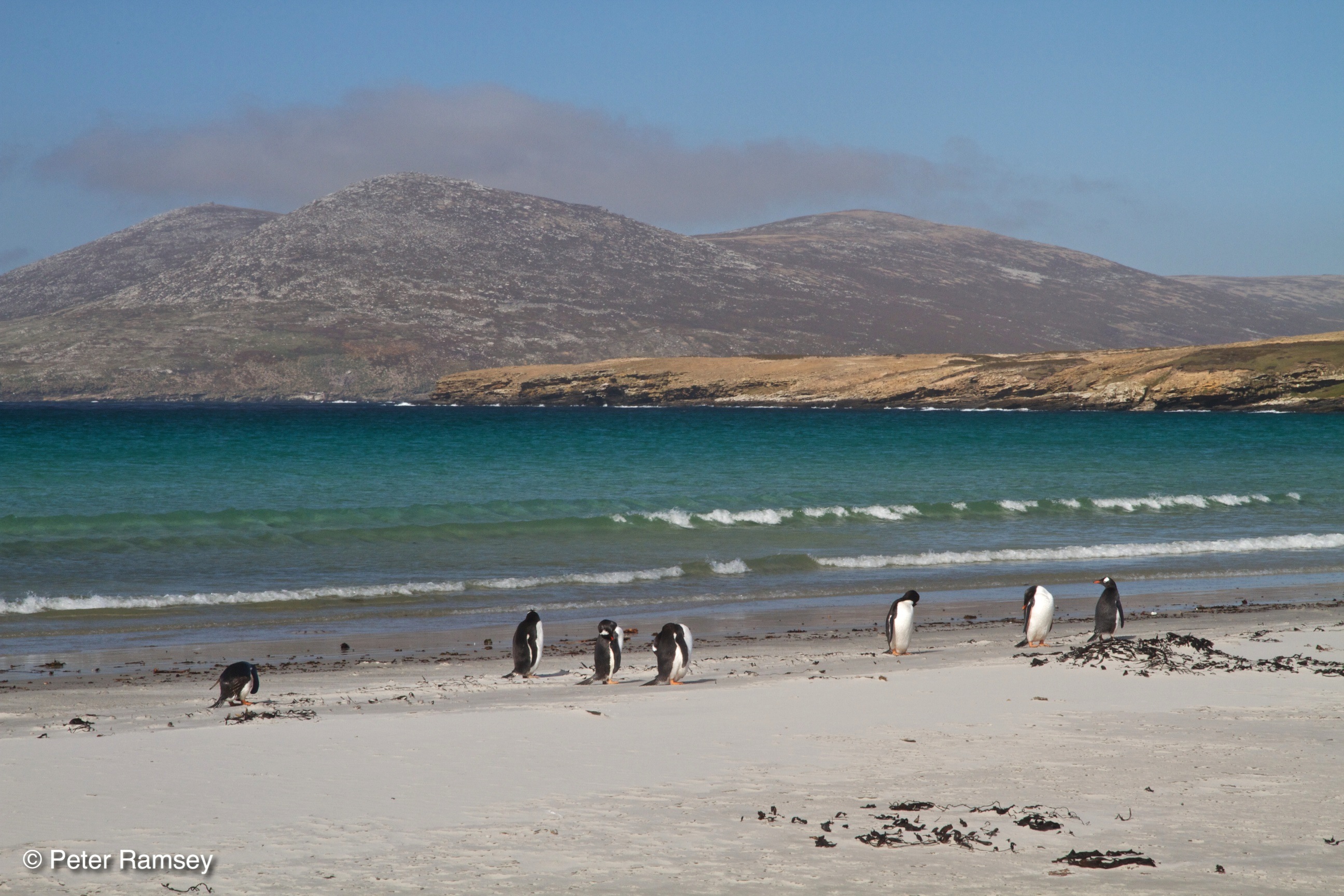
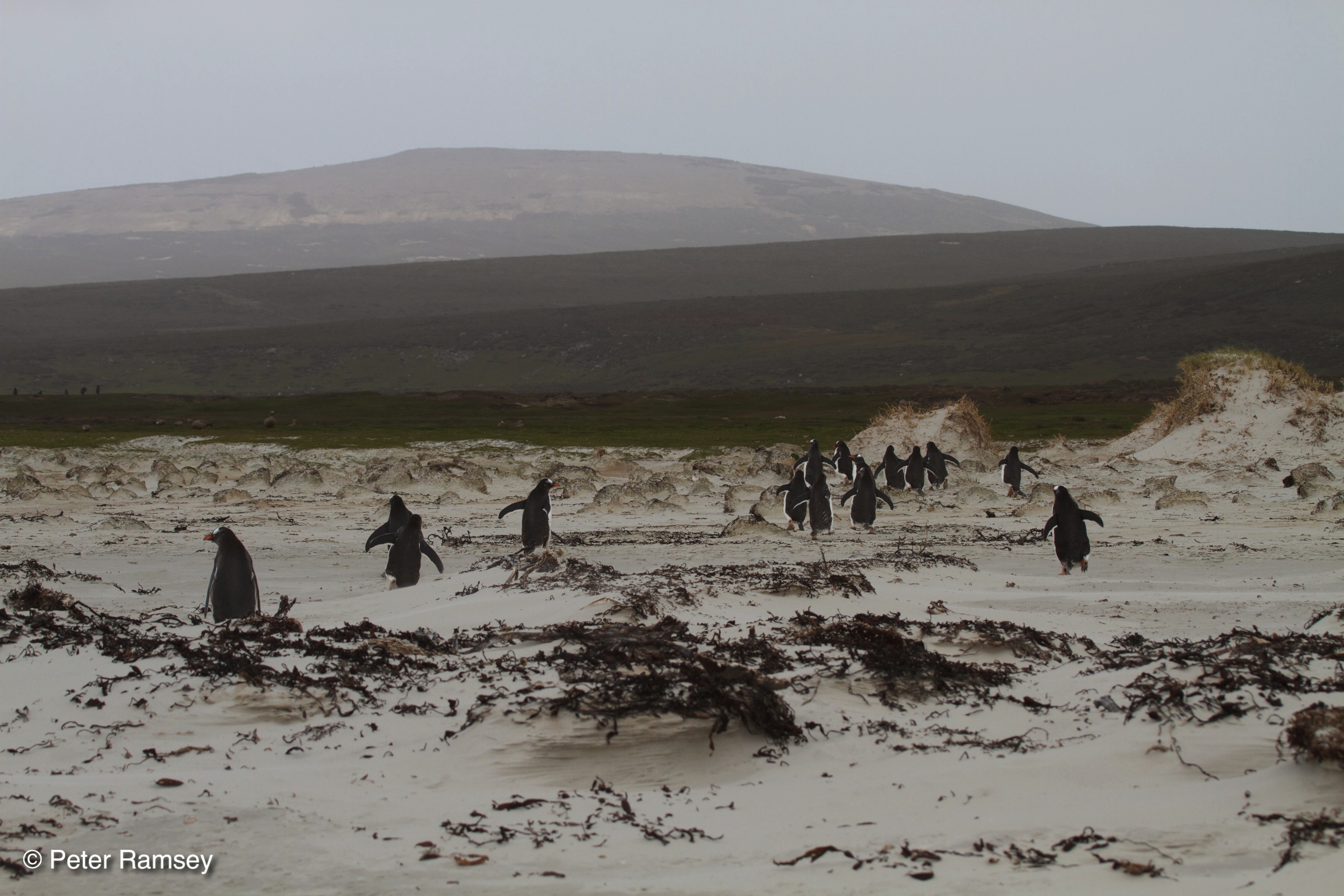
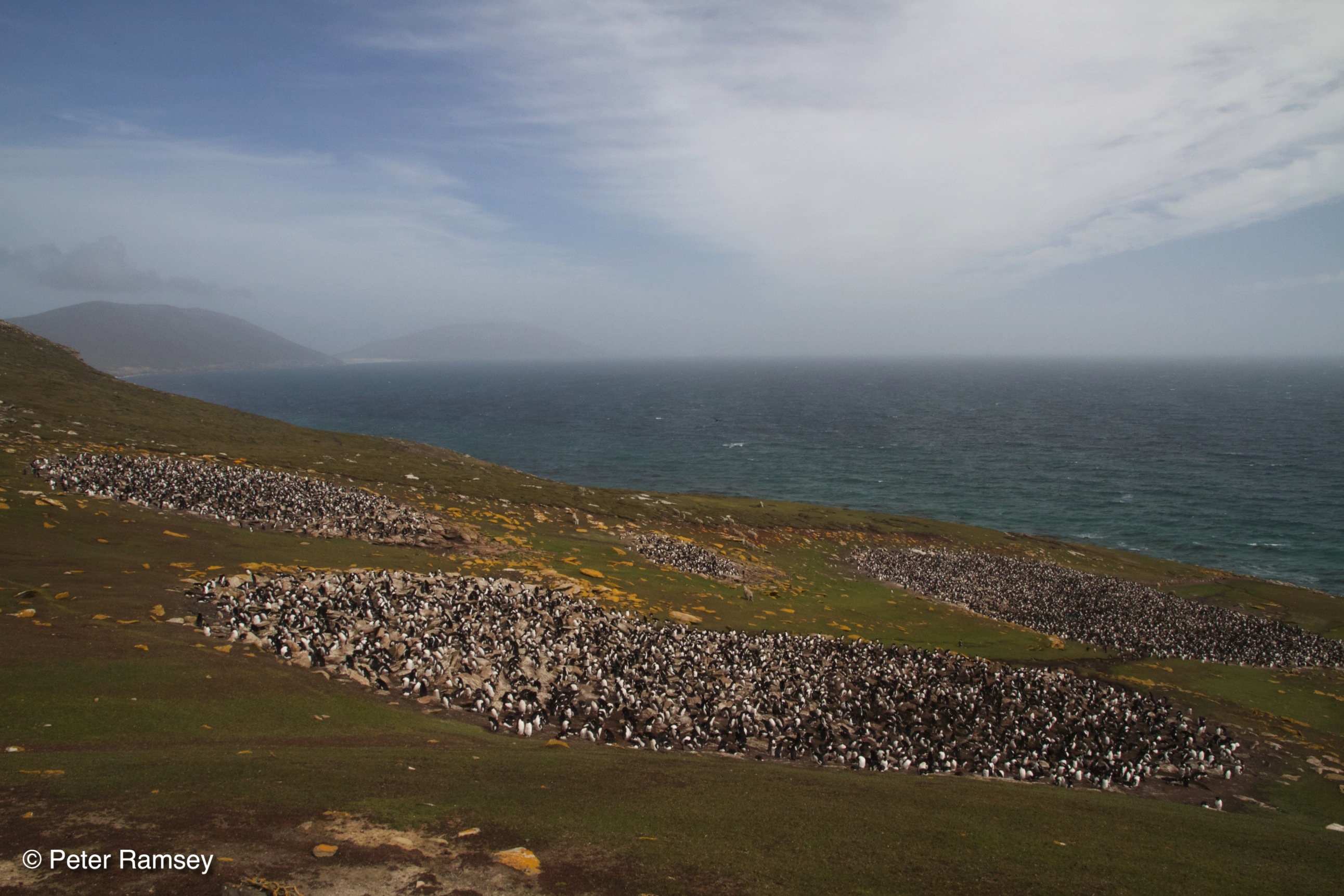
Another of the best memories of my trip was approaching the colonies at the Rookery on Saunders Island, just as dusk was falling. I walked along the hillsides above the ocean hoping that cresting the next rise would reveal where the rockhoppers were but it was the sound, then the smell, that reached me well before the sight. I could hear and smell them from at least 100 metres away and below at least two rises. As they came into sight, the huge colonies laid out in front of me, with the ocean and further coast of the island set as a backdrop; the setting sun dropping behind the hills. The macaroni penguins, which look very similar to the rockhoppers, are very limited in numbers on the islands I visited and I only saw them on Pebble Island, with them having to be pointed out to me. The magellanic and gentoo penguins are much more wary than the rockhoppers and less approachable. They tend to run off well before you get close to them but I managed to get some nice scenic shots of gentoos on some of the beaches. The gentoos and magellanics nest in smaller colonies than the rockhoppers but, again, I saw them on a number of the islands I visited including Pebble, Saunders and Bleaker.

IMG_9023IMG_8531IMG_8489

Without doubt, the king penguins are the most beautiful of the Falklands species. They are also the most difficult to find. Whilst they can be found on Saunders Island, I was staying quite a good walk away from their colony, so I made the very memorable trip from Stanley out to Volunteer Point. It takes over two hours to drive to the point, half on the dirt tracks and half off-road – getting there is an adventure in itself. However, seeing them in their colonies and on the nearby beaches is one of the must see scenes of the Falklands.

IMG_9419IMG_9288IMG_9201

There is so much more to write about the birds of the Falklands but I don’t think I quite have enough time. I might return to this subject in due course but I will also have to return to the islands to see them again! The following is the complete list of birds I saw in the Falklands:

Black-necked Swan

Flying Steamer Duck

Falkland Island Steamer Duck

Upland Goose

Kelp Goose

Ashy-headed Goose

Ruddy-headed Goose

Crested Duck

Chiloe Wigeon

Mallard

Cinnamon Teal

Speckled Teal

Silver Teal

King Penguin

Gentoo Penguin

Rockhopper Penguin

Macaroni Penguin

Magellanic Penguin

Black-browed Albatross

Southern Giant Petrel

White-tufted Grebe

Silvery Grebe

Imperial Shag

Rock Shag

Striated Caracara

Turkey-Vulture

Southern Caracara

Peregrine Falcon

Red-backed Hawk

Snowy Sheathbill

Magellanic Oystercatcher

Blackish Oystercatcher

Two-banded Plover

Rufous-chested Dotterel

Magellanic Snipe

White-rumped Sandpiper

Dolphin Gull

Kelp Gull

Brown-hooded Gull

South American Tern

Antarctic Tern

Falkland Skua

Dark-faced Ground Tyrant

Tussicbird

Falkland Grass Wren

Cobb’s Wren

Falkland Thrush

House Sparrow

Falkland Pipit

Black-chinned Siskin

Long-tailed Meadowlark

Canary-winged Finch

IMG_9552IMG_9335IMG_8399 - Version 2IMG_7882IMG_7868IMG_5854