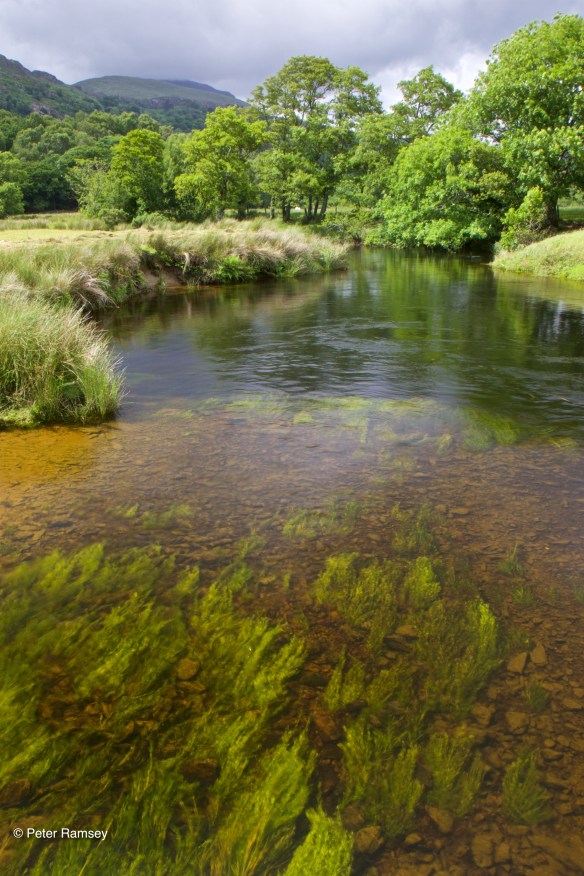
A subdued atmosphere hangs in the trees as I head down the track today, the sounds of spring have fallen away and the only noises are the thwack of bracken against the wing mirrors and the crack and crunch of twigs under my tyres. There’s a coolness in the breeze coming through the open window and a muffled light, stifled by the thick woodland cover and held back by the patchwork of passing clouds. Out onto the open valley floor, between stone walls and damp meadows, the air becomes warmer but quicker, the breeze increased to windy gusts, chilling in the gloom. The seasons have moved on here, spring prime gone and summer just beginning. The plants have grown to their full height but faded from their bright freshness to darker, fixed tones and early flowers are a distant memory, even some later blooms are starting to fall. The fruits of the dawn chorus are out in the open, young finches, tits and thrushes feed, chase and squabble in the trees and bushes, all under the eye of a waiting hawk. I get a first sight of the other young in the valley, high above the fields in the tall copse. My last visit was spent in wait for eggs to first crack but so much time has passed since then; the chicks are almost in full feather and beginning to flex their wings. It won’t be long until those wings are lifted into the summer air.
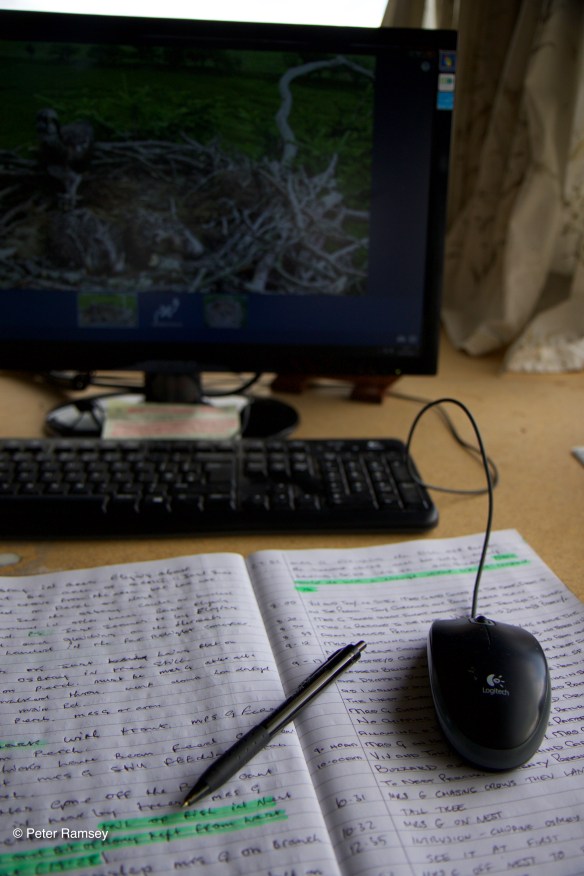
It was a quiet shift today with the chicks resting in the cup of the nest for most of it, with a bit of preening and wing flexing; there was more snuggling than arguing. They are also starting to stand properly on straightened legs, bringing them to their full height, although not yet up to their parents size. Mrs G was either sat on the perch or on the nest much of the time or occasionally chasing crows, and I didn’t see Aran until early afternoon when he returned with a trout. It all got a bit panicky for them mid-afternoon when the farmer came into the field by the nest with his dog to check on the sheep. Both adults took to the air and flew around for a while but she returned to the nest after a short time and he disappeared into the distance; the chicks seemed oblivious. He returned later with what looked like a whole sea trout (could easily be wrong as my fish ID skills are pretty poor). It got quite windy towards the end of my shift; I thought the caravan was going to lift off it’s wheels at one stage!
This slideshow requires JavaScript.
During my shift I had a strong feeling of time moving on; the seasons, the year, the years, and the subdued atmosphere I sensed on my arrival seeped into my thinking. The five weeks since my last shift has brought changes to the valley; the plants have grown, flowers bloomed and fallen, and birds fledged. I’ve missed the early stages of the osprey chicks’ growth since hatching and they don’t seem far from the size of their parents.
I had a sense that the year is moving past at speed. It doesn’t seem long since the Glaslyn training event in the dark days of late winter, spring has been and gone, and summer is already upon us (although no one has told the weather apparently!); it won’t be long until osprey parents and fledglings start their journeys south. The busiest period of my, now usual, conservation year is coming to an end with bird surveys finished, my two weeks on Ramsey Island gone and not many osprey shifts left.
I also had a sense of greater scale of time moving on. I have a significant birthday to mark soon, one I’m not altogether comfortable with but one to mark all the same. It’s strikes me that there’s only so much time in life to make a difference – whether that time be the hours in the week, the weekends in the year, or the years in a life. It’s easy to let time pass unmarked and let life drift and that risks missing chances to make an impact and a difference. It got me thinking about conservation and what contribution I make. I’ve already had my ‘midlife crisis’ moment, an early one if that’s what it was; it was now nearly five years ago when I started 12 months away from work and began my stop/start journey through conservation – including a month, altogether, with Mrs G and 11/98.
In the decades of my life so far, so much of nature has already been lost. What the new generation is beginning with, the environment, the plants, birds, insects and animals, is so diminished from what my generation started with and that in turn was much diminished from previous generations. There is a risk that the new generation may use what they inherit as the benchmark norm, to see that as what nature should be like, as others have done so before. Those benchmarks are lowering with every new generation and mine only has so much more time to lift it back up to a higher point from which our successors can take it on.
What has been lost over that time was put into sharp focus by the State of Nature report in 2013 – a copy of this sobering document can be found here. The report highlighted many frightening trends including that a group of 155 species it had data for, some of the most threatened in the UK, had declined by 77% over the last 40 years with little sign of recovery and that the UK has lost 44 million breeding birds since the late 1960s.
However, over the last five years, I’ve been involved with a range of conservation organisations and projects, some large and some small, some well established and some just starting out. Whilst what we have now is much diminished, these organisations give hope and there are good signs amongst all the bad. When I came into the world, there were barely any ospreys in the whole of the UK and none at all in Wales. Over time this has changed and not only are they thriving in Scotland, there are now growing pockets of populations in England as well as in Wales. The work of the volunteers at Glaslyn and many others like them, have helped to reverse the decline of this species and bring the growth in numbers – there just needs to be many more people making efforts to bring success to other parts of nature.
Time moves on…no one knows yet what impact recent decisions will have on conservation, with potentially so much to do, what time will be given in government to the environment and nature? What will happen to the existing legislation and policies? With these challenges, of politics, governance and available time, is the chance for this generation to repair the damage of the past slipping away?
There may be opportunities as well as problems but that’s the exciting thing about time, it keeps moving on…and not always in the direction we hope or expect.




 Daft Mumblings