…on an open fire in the fresh country air – what better way is there to spend a December afternoon?


Followed by crumpets…


…on an open fire in the fresh country air – what better way is there to spend a December afternoon?
Followed by crumpets…
Today was another spent at Wybunbury Moss with Crewe & Nantwich Conservation Volunteers. We were out in the very centre of the Moss clearing birch trees and then treating the stumps left behind. With the fair weather and no sign of rain, it was one of the first chances we’ve had to take advantage of the newly acquired skills in the group for applying herbicide. Without treating the stumps, the birch would simply regrow and we would end up with even more trees to clear in a few years time. The herbicide is painted onto stumps and is therefore very localised and only affects the individual trees rather than the wider environment.
Whilst we had fewer people than usual, we still managed to clear a good-sized area of birch but unfortunately there is a huge area to go at and we’ll not doubt be back at the task over the next few months (and probably years!).

I spent this morning with Crewe & Nantwich Conservation Volunteers (CNCV) out at Wybunbury Moss doing a task for Natural England. I missed the last task two weeks ago, and with the early weather looking sparkling, I was keen not to miss another.

The group is a frequent visitor to the Moss and we have worked in today’s particular spot a few times over the past couple of years. We were removing trees to soften the edge where the woodland meets wet pastureland on the outside of the Moss. The strip that we have cleared so far has transformed over the summer, turning from a big patch of mud to an area of lush reeds and regrowing coppice. This regrowth of the understorey plants will provide good habitats for breeding birds over the coming years but we will no doubt have to return to the cleared areas every so often to cut it back again.

Unfortunately, I could only stay for the morning – I had work to do – but at least I could go out for part of the day and enjoy the first fire of the autumn, it had been a while!
Recently I’ve had a go at Greenpeace on Twitter for pestering me to give more money per month. After recent news headlines of charities pestering people for money, I felt empowered to make a stand. I give monthly to a number of charities as well as giving quite a lot of my free time to charitable volunteering, so receiving calls from charities (Greenpeace certainly weren’t the first and won’t be the last) trying to guilt-trip me into giving more irked somewhat.
It started with one call, and then another, and another, and another. Over the past 18 months I’ve been plagued by nuisance calls by ‘companies’ trying to get me to make false claims for compensation as a result of the extremely minor and short-lived discomfort I suffered after a road accident last year. I have resorted to disconnecting my landline phone and not answering any mobile calls from a number I don’t recognise just to stop the endless harassment of these ambulance-chasers. These insurance scam companies don’t often use the same telephone number, they seem to be able to channel their calls through numbers all around the country, so when I started to receive multiple missed calls from the same number, I eventually called it back. When I did, I heard a recorded message saying it was a company working on behalf of Greenpeace and that they would be in touch again shortly. After a few more missed calls, I finally had my mobile on me when it rang from the same number and I spoke to a representative of Greenpeace. The nicely spoken young chap wanted to tell me about all the good things that Greenpeace had done recently; I instantly knew where this was going, eventually it would lead to a request for more money. At that time I was already giving more money per month to Greenpeace than any other individual charity, so I didn’t want to give any more. I said to the chap that I didn’t have time to talk and I politely ended the call. Over the following few days, I received more and more calls from the same number until I’d finally had enough. Not only was I being harassed by scam insurance companies, I was now being pestered by the charity I gave more money to per month than any other! (this is an apology, honest! Just keep on reading!).
I posted a tweet and got a tweeted apology from Greenpeace and I then sent an e-mail complaining about their behaviour and I cancelled my direct debit. I thought the only way that charities will learn will be for people affected by this behaviour to make some noise as well as stopping donations. I quite quickly got a nice e-mail in return again apologising, promising I would receive no more contact from them but saying that they hoped I would return to them sometime – ‘not I chance’ I thought! My mind was even more firmly made up when later that day I received a text from Greenpeace asking me to increase my donation to them by £10 per month. That was the last straw and I tweeted my annoyance again.
The issue of being pestered with calls from charities, which has been in the news quite a lot over the past few months, is, for me, coupled with a feeling that charities don’t always treat their staff and volunteers in the way they should. I should say here that I’m not pointing the finger at Greenpeace at all – I have no particular knowledge of their staff or volunteers’ conditions; this is a general rather than specific observation. For some time I have thought that some charities use those who want to work in their particular areas or ‘industries’, for want of a better word, by squeezing as much out of them as they can for as little investment as possible to a point where it gets close to, if not actually, exploitation. There are many charities, especially those working in areas where there is a great demand for jobs, which offer unpaid work, long term volunteering posts or internships, leaving those who want to get a foothold in those areas work without an income for months and in some cases many years.
However, these are blinkered, short-sighted views, of both the telephone calls and the employment of staff and volunteers, from a position of being comfortably off and already well into the career I set out to build. When the interests that environmental charities, for example, are up against can throw money at more frivolous activities such as the arts and sport (I’m not having a go at the hard work and dedication of sports men and women, just the elitist hangers-on) it just shows the difference in financial clout.
The hard truth is that the interests that cause the greatest damage to the earth and its environment are those with the most money. Oil companies, agri-chemical businesses, land owners or, indeed, whole groups or classes of people who have enough money and low enough scruples not to care what damage their desires have, all have huge vested interests against which environmental charities are struggling to have an impact. To be able to fight for their causes, charities rely on the contributions both in the form of money and time from the general public, and they have to account for every last penny and make the best of every hour. Few charities have products they can sell to generate millions or billions of pounds of revenue; they can only persuade the public to support them as much as they can. When those major industrial and landowning interests have such huge resources, and regularly don’t play clean, it’s no wonder that charities have to resort to sometimes less than comfortable practices to even vaguely compete.
The phone calls and the treatment of those who work and volunteer for charities is, for me, coupled with an increasing corporatisation of large charities. It’s not the local, individual charity staff who decide to make those calls, and they do not decide to squeeze budgets to such an extent that they have to turn paid jobs into voluntary posts; they have to deal with the day-to-day, the coal face, the delivery of the overall charity’s aims. It is, rather, the head offices of large charities that make those decisions, head offices in many cases staffed to a significant degree by people from the corporate world not the charitable one, people who have less interest in the charitable concerns and more thought on general finance and resources, as well that their own promotion and self-development. However, big charities need to have a corporate approach to enable them to combat the actions of the big corporates, but this can go too far. I get the general feeling that large charities, in trying to do their best for their primary goals, are actually moving away from what matters most; engaging on a human scale with those whose support they desperately need.
The sometimes hard actions of charities, whether it be nuisance phone calls or treatment of staff, do deserve inspection and frustration is at times understandable. However, these issues pale into insignificance when compared to the damage caused by the organisations and groups they are facing up to. It is right that charities have to account for the money they receive and spend, it’s the public’s money afterall, and they need to treat their staff and volunteers correctly. However, by fighting against them on these issues, we’re only making it more difficult for charities to succeed and hoping for them to succeed is why people give their money and time to them in the first place. Charities try to be whiter-than-white but this is a real struggle when they have to make the most of their resources and their opponents have enough money to liberally spray-paint their operations with white or, indeed, green-wash.
Time to give charities a break, give more money to support their campaigns, give more voluntary time in the hope they can provide more paid jobs and give them some leeway when they get it a bit wrong.
Sorry, Greenpeace!
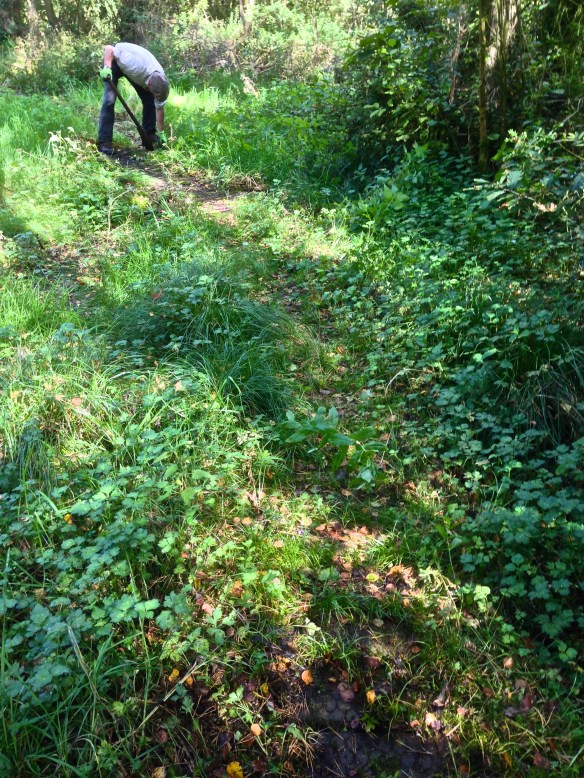
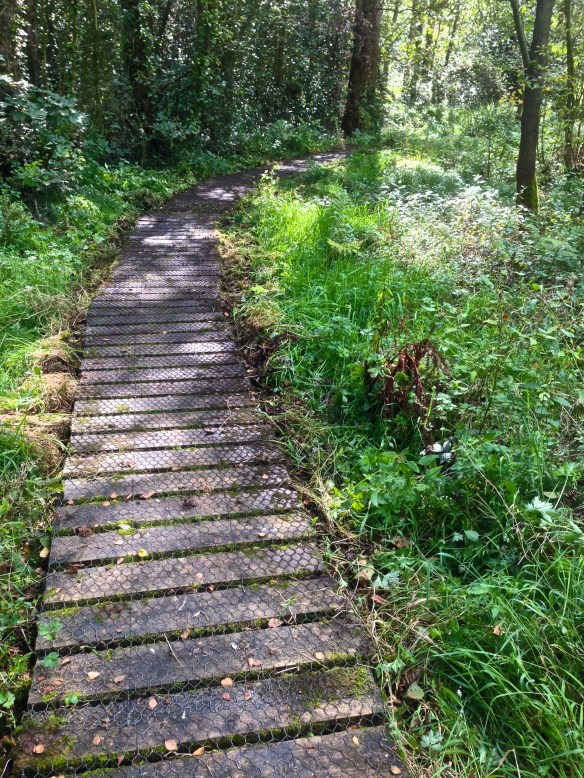
I spent today with Crewe & Nantwich Conservation Volunteers at Wybunbury Moss working for Natural England. The Moss is one of the group’s usual haunts and this visit was the first for a while. Soon it will be time for bonfires but today we spent our task clearing undergrowth that had encroached on the boardwalks around the outside of the Moss.
Before…
After…
The weather was perfect with bright blue skies and warm sun making the approaching autumn seem a long way off. In fact, with a chiffchaff singing in the woodland, it seemed more like late spring than late summer.
Whilst we often volunteer at the Moss, we usually don’t spend much time out on the central part of the Moss itself. It’s out-of-bounds to the public due to the danger of falling through the thin peat surface into the lake below. Today, however, we had a walk around this part of the nature reserve and it doesn’t stop giving the feeling of being in the wilderness miles from anywhere. Despite being close to the village and overlooked by one or two houses, the Moss has an atmosphere of the northern wildernesses – all that’s missing is a bear or moose.
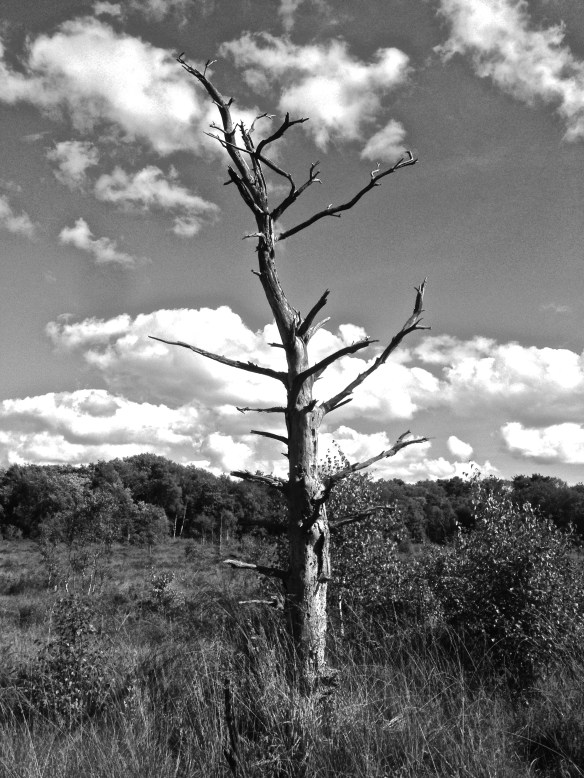
When the trees growing on the Moss get to a certain weight, their roots fall through the peat layer into the lake and they drown. This action has left a number of standing dead trees and they make wonderful photographic subjects (although the shot below isn’t all that great).
Shorts seemed to be the order of the day as I left home but I became more uncertain about that decision as my journey wore on. All the signs of the season at its height were there; all apart from the sunshine of the previous few days. Even in the early morning, holiday-makers were on their way west into Wales; caravans being towed, people carriers packed to their limits and all manner of sporting kit piled onto roofs or hanging off bootlids. The hedge-bordered roads were slower than usual, giving more time to take in the scenes. The lambs have grown almost as big as the ewes, getting fat on the lush deep-green grass given strength by the heavy rain showers and strong sun. In other meadows, the farmers were cutting hay into long lines ready to be gathered into bales and stored away for the winter. The roadside flowers are less plentiful than on previous journeys but there are flushes of rosebay willow herb, the occasional foxglove still blooming, and brambles showing that there may be a good blackberry crop to come.
Turning onto the track, heading down to protection, the space for vehicles has become even more confined with bracken and bramble ever further encroaching into the way. In some places the farmer has cut the verges but in others the car flicks the vegetation as it passes. All sounds of spring have gone and there is silence on the way towards the meadows. Parking the car, it’s a muddy walk, the cows having made a mess of the gap between the fields and the rains having made it worse. As I approach the site, there are small birds aplenty on the abundance of feeders, blue and great tits, nuthatches and chaffinches, accompanied by a couple of great spotted woodpeckers.
Inside the caravan there is anticipation and excitement as the long wait for the second chick to fledge is coming to an end. As I step in W8 lifts from the nest and a bird is seen circling around the trees beneath but it’s W7 confusing things and W8 was only momentarily airborne and still within the confines of the nest – the wait goes on into the hours of my shift.
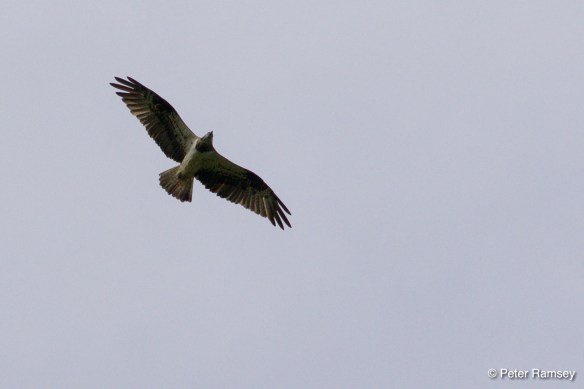
It was a busy and tense shift compared to the last few and as a last shift of the year, one to provide memories to take away. The will-he-won’t-he? question remained unanswered until almost the very end of my time. W7 having fledged two days previously, W8 was expected to make his maiden flight away from the nest at any time. After confusion when I first arrived, he ‘helicoptered’ above the nest a few times and transitioned between nest and perch and back again but seemed very hesitant to make the big step and leap away from his natal home.
There were intrusions into the parent-protected airspace around the nest with up to three intruders at one time, and the parents giving chase and entering into dog-fights, stooping and rising to ward off the unwelcome visitors.


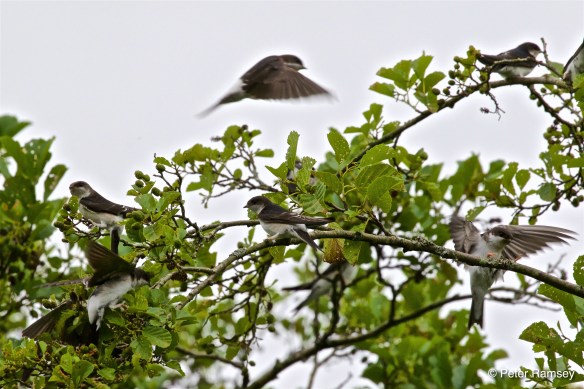
As I was about to give up hope, there was a cheer from the forward hide. My attention had been taken off the live stream and I had been watching a crowd of house martins circling and landing on a nearby tree but I rushed back into the caravan to see an empty nest. Grabbing my camera, I had a distant view of a madly flapping W8 flying around the tree and coming into land back in the nest, almost on top of his sister.
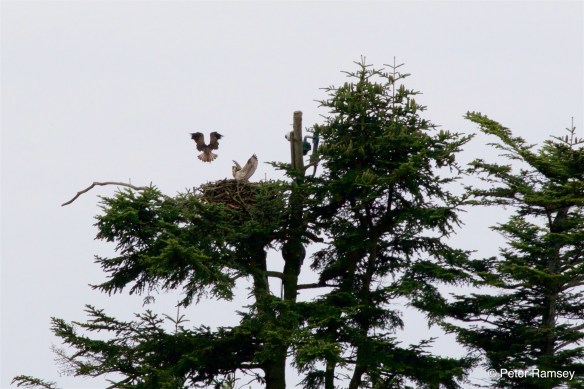
My last shift of the year ended on a high and as a drove back up the wooded track for the last time, windows open to take in the last of the valley air for another osprey season, there were two successfully fledged chicks sat in that high up nest. It will only be a matter of weeks until they make the journey south – but hopefully to be seen again in two or three years’ time.
For a Sunday, I woke unusually early this morning, so I took advantage of the opportunity and went out to do the first Breeding Bird Survey of the year at Cheshire Wildlife Trust’s Blakenhall Moss reserve.
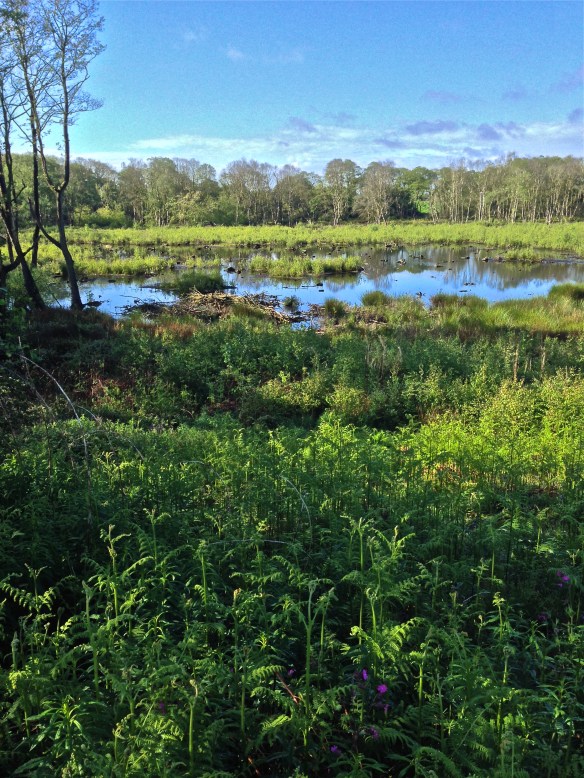
Unlike other Wildlife Trust reserves, including the Bagmere site I also survey, the methodology hasn’t changed for Blakenhall this year, so it was out to do a familiar route, recording the bird species seen and the most ‘breeding-like’ behaviour observed.
The morning was bright and almost cloudless, with a strong sun but not quite as warm as it looked. However, I soon warmed up as the route is a bit of a struggle in places, either wading through water or pushing through undergrowth. The work by Cheshire Wildlife Trust to return the Moss to a raised lowland bog has left the site much wetter (intentionally) and where water isn’t lying, the woodland understory it much thicker than it was. However, it was less tough than I thought it was going to be and after an hour or so I completed the survey and sat for a while on an old tree trunk, taking in the sun and watching the wildlife.


The birdlife was much as I expected, 29 species recorded in all, but there were a couple of new ones for the site, reed bunting and oystercatcher. Overall, that’s 62 species recorded at the reserve since I did the first reserve survey in early 2014. I also saw my first spotted flycatchers of the year, three in all; these are one of my favourite of our summer visitors.
Walking around the Moss, there were signs that spring is moving on; the blue bells have nearly finished and the hawthorn is out in blossom, showing that summer can’t be far away.
Sat in the shelter of the caravan, the rain beats down heavily on the roof. The drops from the overshadowing trees drum the loudest as the wind cascades them off the soaked leaves. The bolt hole rocks as the breeze picks up and the gloom deepens with ever darker clouds moving quickly across the view out of the plastic windows.
Above the noise of the downpour, other sounds break through; the sheep out in the wet meadows, a cuckoo in the distance and a chaffinch on top of the drystone wall. The river is rising, fed by the water running off the hills and mountains, the peak of its flow yet to come and its height uncertain. The screen shows a miserable sight; an osprey sat in a large, slowly swaying nest, protecting two speckled eggs from the shower, rain running off its soggy feathers; a picture of dejection.
The slackening of the rain and then its halting, brings some relief and hope that a flood won’t come. Despite the rain and breeze, it’s not cold; what occasional light shines from between the clouds warms through the windows. As the weather begins to clear, there’s more activity, with swallows and house martins darting across the fields and a woodpecker constantly moving from nest tree to feeders and back again, some eggs have already hatched.
Back inside the caravan, watch is kept, notes are scribbled, a sandwich is eaten, time is marked, the waiting goes on…
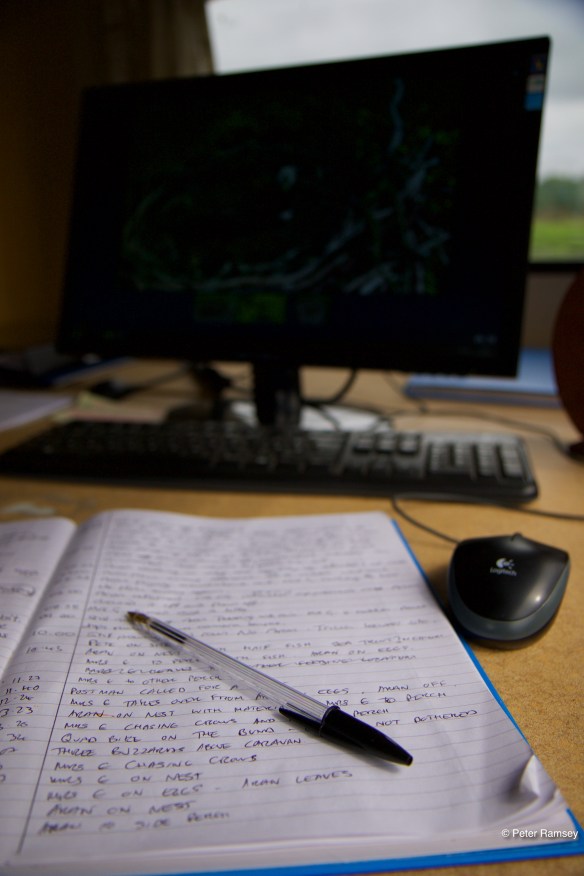
Slowly but surely the time for the osprey eggs to hatch is getting closer but there are still many hours of sitting and waiting in the protection caravan or out in the forward hide before there is a first sight of this year’s chicks. There are still many night hours to come, in the dark watching for the movement of an egg collector in the shadows. There are even more daylight hours to come, sitting inside away from the rain, or walking in the growing warmth of sunnier periods. All hours, however, are spent surrounded by nature, its sights, sounds and scents.
I was given two unusually close views of Aran today; first he landed in a tree on the caravan side of the river, a perch much nearer to the caravan than I have ever seen before, and then he flew past even closer with some nesting material a minute or so later.


Apart from the close views, it was a quiet shift today, just as I like them. There was no drama of intruding ospreys or other unwanted visitors, just a day spent in the valley looking at the spring views and listening to nature all around. As my hours came to an end, I wandered down to the bridge over the swollen and faster-moving river; my favourite spot not quite as comfortable as I like it with the strong breeze still present despite the passing of the rain.


Looking from the darkened shelter, out across the drying wet meadows, there is clear, striking blue above reflected by the softer blue haze beneath the trees. The branches are no longer bare, with an electric green wash having transformed the wooded valley and hillsides. A robin sings softly from the gorse with flowers now fading and a bee bumbles past in search of fresh blooms. The sheep are out on the low clipped grass amongst the taller and thicker stands of dark rush; the lambs quietly graze at the fresh shoots while the ewes lie lazily in the warming sun. A pied wagtail wanders it erratic way along the ditchside while dangly-legged flies hover above. A crow wafts past as the furthest views take on a liquid state in the growing shimmer of the midday heat.
The spring sounds are all around; not the eruption of the dawn chorus but business of the progressing season at the height of the day. Swallows chat quickly as they chase low across the meadowland floor and a blackbird makes a quick passage between bushes in flight from the searching hawk. Through the edge of trees a willow warbler descends its notes and the chaffinch tumbles its song, both supported by a broader orchestra of avian musicians. Percussion is played by the drumming woodpecker while the distant cuckoo calls out through the wood in the wind. A song thrush adds a tunefulness to the setting whilst its mistle cousin rattles on its flight from stand to stand. Above the hill tops ravens cronk their conversational tones and then float down towards the valley and past on the strengthening breeze.
In the distance, contrails mark out the sky as jets head west towards the sea and ocean beyond. A buzzard pair begin to climb on the up rushing thermals, crying out as they make turn after turn, they suddenly stoop together, grappling and parting, to rise back up again.
The buzzards are joined in their effortless ascent by another pair of wings making use of the lift. It stands out larger than the pair and makes shorter, higher pitched cries as it gains height. Further calls come from the small copse out across the fields; calls of protective alarm and maternal concern. Up in the high nest is a clutch speckled eggs, under the gaze of the rising winged intruder, now gliding up towards the sun and disappearing into the dazzling brightness.
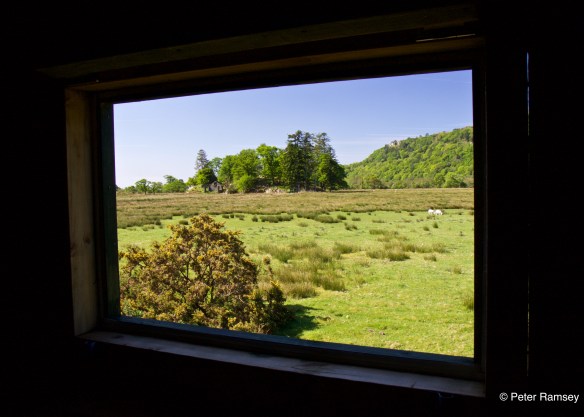
I’m not the most emotional of osprey observers but even I let out a few gasps last night watching the antics of Blue 2R on the video stream. I was sure she had stood on an egg while clumsily marching around the nest, open-taloned and occasionally aggressive. When I woke this morning, I had to check the live feed before setting out on my way to my favourite wooded valley. Fortunately things seemed to have calmed down somewhat but Blue 2R was still around when I turned up. Soon after I sat myself down in the forward hide, she lifted up from the nest and ascended high up into the sky and eventually disappearing into the glare of the sun. Aran soon returned with a fish and it was hungrily taken by Mrs G – peace restored but for how long?
I spent the first half of my shift out in the hide; oddly over the past five springs I have spent very little time out there but today I made up for it. Under a near cloudless sky, I sat in silence, listening and watching the scenes of spring unfold in front of me, all in surround sound and the most vivid of colours. This little spot has almost no intrusion from manmade sounds with the exception of the occasional car and passing plane, so it’s a perfect spot to really sink yourself into the sights and sounds of springtime.


I love this time of year, when the colours are at their freshest and the wildlife is most active. The green of the trees is indescribably bright and intense, the freshly emerged leaves yet to be dulled by the sun and weather. The bluebells on route were just as bright and the track to protection is painted more blue than I can remember from previous years.
It wasn’t perfect weather though (I’m so hard to please) as the easterly breeze brought a coolness to the day that deceived the views under the strong sun and clear sky. I should however just be grateful that I didn’t have to write another post of how my journey here started off dry and ended up drenched. If my shift next week is as lovely as this one was, I’ll be very happy!
My favourite summer migrants have returned – the swallows, house martins, sand martins and swifts. I’m fortunate that three of these species (not sand martins) breed in the area where I live and I can usually see them flying in the sky above my house. I’m even more fortunate that there’s usually a house martin nest on under my eaves; I say usually but in fact there has been at least one nest for the past 15 summers than I have lived here. I thought the unbroken record was going to come to an end last summer when the house martins failed to return around their usual time. There was no sign of them for most of the spring and summer until I retuned home from work in late August to find droppings on the driveway beneath the nest, which was still up there from the previous year. That seemed very late for a first brood particularly compared to the usual May or June in previous year.
The chicks fledged in late September and it wasn’t clear if this was by accident or design. I worked from home one day and in the afternoon there seemed to be lots of comings and goings from the nest. It was only when I left the house later on that I noticed the nest on the driveway and the fledgelings flying up to the point when it used to cling to the eaves. The next day they were all gone and I didn’t see any more house martins around my home again last year.
Over the years I have sporadically kept a record of when the house martins first arrived back at the nest and most records show it was around mid to late April. When the month changed into May, I started to suspect there would be another late return this year. However, when I was cooking my evening meal yesterday I had a spare moment and popped my head out of the kitchen and popped my head round the corner of my house and looked upwards. Up at the apex of the eaves was the ring of mud, all that remained of the nest, but there was something else up there too. At first it looked like a bit of black plastic blown up there by the wind but after I shaded by eyes from the evening sun, the shape was clearly a house martin and there was another flying around just above the roof.

House martins are ‘amber listed’ in the Birds of Conservation Concern listings and numbers have been in rapid decline. I’m sure that when first moved into my house, another pair nested under next door’s eaves and there were other nests in the area. Now there is mine and very few others. However, the pattern of decline isn’t uniform. Ramsey Island for example (the RSPB reserve where I volunteer for a couple of weeks each year), didn’t have any house martins before a first nest in 2014 and it had eight nests last year (extra emergency artificial nests had to be shipped across!). Something is certainly happening to house martins but fortunately it’s been noticed and hopefully before it’s too late to reverse the overall declines.
Last year I took part in the British Trust for Ornithology’s (BTO) House Martin Nest Survey. I was given an Ordnance Survey grid square, luckily for me the one immediately nest to the one in which I live, and I made several visits to record the number of nests on buildings and the amount of activity. This year there’s another house martin survey for the BTO. The House Martin Nest Study 2016 requires surveyors to choose a nest/nests and record the activity over the course of the spring and summer. The survey can be done with varying levels of detail and I hope to do as much monitoring as I can, doing daily records of activity whenever possible (holidays allowing). Now that house martins have returned to my home, I’m going to have a very convenient nest to monitor!
The chortling house martin chicks wafting in through my landing window on warm summer evenings as I lie in bed really is one of my favourite things about the season and I’m hopeful that it won’t be long until I hear those sounds once again. By doing the survey this year, I hope that I can make a small contribution to helping to ensure this will always be a sound of summer.
 Daft Mumblings