While I was away…

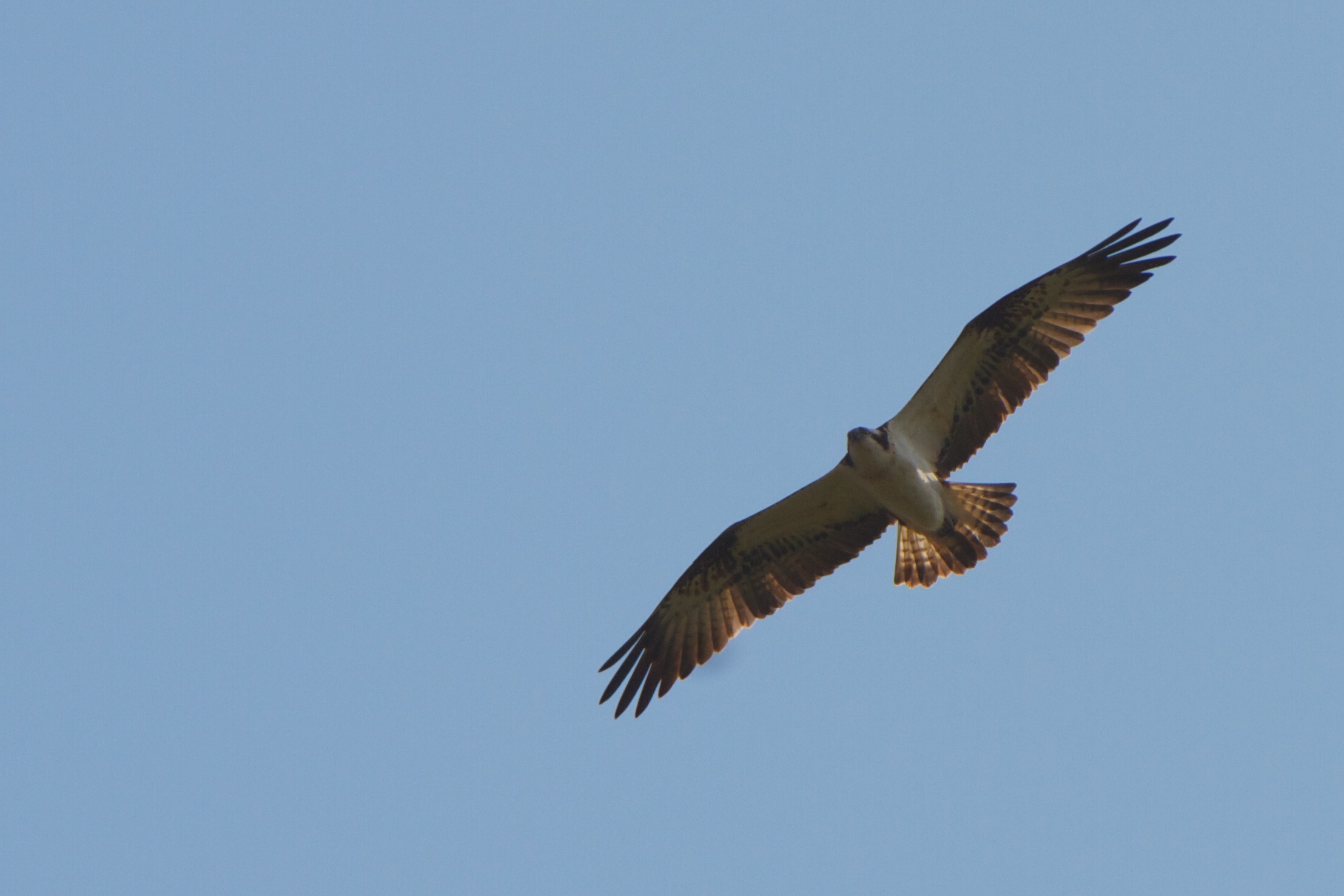
The wooded way is now in the shadow of a vibrant green cloak; the oak trees are out in full leaf. The damp track still has a scattering of the fallen leaves of last autumn but their replacements have brought a richness to the valley, yet to fade to their deep green of summer. A blackbird rushes off in front as I drive down through the woodland; the bluebells are now past their finest and the bracken is starting to take ascendency across the floor. There are a few rain drops in the air but it is not cold and the sun makes a fleeting appearance as I break cover across the wet pastureland. The clouds above make promises of downpours to come and it may be another day in the caravan or forward hide, sheltering away from the worst. While the bluebell bloom may be subsiding, there are other flowers here, with the fox glove and iris taking to the stage. The ospreys are still where I left them but there are now five, not two. The parents are stood alert by their sides as the three growing chicks rest in the cradling bowl of the nest. They have already grown so much; I’ve missed their early days and weeks but with more visits, I hope to see them thrive, from gawkiness into splendour.

There have been significant changes down at the osprey protection site since my last shift back in April. The biggest change of all being that the three eggs have turned into chicks, and they are starting to lose their down and show early signs of producing feathers. There are obvious differences in size between them and the largest seems to take precedence at feeding time but the smallest, and downiest (if that’s a real word) gives as good as it gets during the sibling squabbles.

Image

There has also been some construction work down at the protection site. The old frame that held the solar panels (powering the camera and equipment) has gone and been replaced by a larger and more sturdy structure, with space for additional panels. The ospreys have also been doing some building work but not necessarily to our benefit – with constant adding to the nest, there’s now a stick, upright, obstructing the view of the chicks. Hopefully, the ever tinkering parents will move it soon.

Something that hasn’t changed is the weather, at least not for my visits anyway. There have been some nice spells since my last visit, but as usual, my shift featured heavy rain – please, please, please, can I have nice, warm weather for my next shift?

Also unchanged from my previous visits were the never-ending battles with the local crows, with the female frequently leaving the nest to chase them off, and this time one crow dive-bombing the nest while she was away chasing others.

Towards the end of my stint, the male brought in another fish; the third since the start of my shift at 10:00am. For the first time, I saw the female and male feeding the chicks together. When I say both, I mean she was and he was trying to. The chicks seemed to ignore him, even when he was trying to press food into their mouths and they would turn away and face the female. Eventually, after some persistence, and eating the fish himself, he managed to get one of the chicks to take food from him and seemed to finally get the hang of it. He’s an old hand at this fathering lark, having been breeding in the Glaslyn Valley since 2004; I’d have thought he’d have worked it out by now!

Image

Osprey images courtesy of Bywyd Gwyllt Glaslyn Wildlife – thank you!

A Day with the Ospreys

Trundling down a woodland track, past the stone cottage and old barn, I splash through rainfall streams crossing the path. Winding round the rocky hillside, a wren flits across the way in the darkness under the enclosing trees. Emerging from cover, the landscape opens up from the old moss-covered oaks into wide damp pastureland bounded by water channels and stone walls. Across the river and the sheep fields, sits a tumbledown building, long past its best and beyond use. In the quietness of its surroundings, silence broken only by the low bleating of sheep and the occasional steam train whistle, it stands alone. Within a neighbouring copse, high up in a fir tree, watched over by Snowdon, is a large, jumbled collection of branches, twigs and turf – a cradle for a precious clutch of Welsh osprey eggs.

ImageThe nest isn’t only watched over by the mountain; it also stays observed by a dedicated group of volunteers putting in hours and days to ensure that no one disturbs the birds or steals their eggs. The rarity of these eggs is what makes them so valuable to collectors. A display of Welsh osprey eggs would enhance any collection, but this would not require the theft of one clutch but two. For whatever reason, egg thieves must have five eggs to display, and at up to three eggs a clutch, it takes two nests to fulfil this requirement. However, the value of these eggs is even greater to those who give their time to protect them and there is a growing band of people willing to put up with rain, cold and discomfort to prevent any attempts to take the clutch.

On Saturday morning I got up at 6:30am to travel to the Glaslyn Osprey protection site near Porthmadog, north Wales. It takes just over two hours to get there from home driving via a choice of scenic roads across the hills and moors or via the fast coast route. My first shift of the year started at 10:00am and as I settled down for a long eight-hour guard duty, tinkering with the new camera equipment, the female started to shuffle on the nest. As she stood up and stepped to one side, there beneath her was the first white and speckled egg of the year, her thirtieth and hopefully one of three to come. As the first to see the egg, I let Elfyn, the organiser of volunteers, know what I had seen, and within a few minutes the news was out. Quite a start to the shift!

Image

With the rain coming down from the start, the caravan with the monitoring equipment (Osprey Protection Spy Cave) seemed the best place to stay but eventually I went out to the forward hide, where the volunteers get closer to the nest and have a chance of better views. The hide gives a clear sight of the nest and tree and any one approaching them would be seen easily, even at night.

The quietness and natural beauty of the valley is one of the bonuses of volunteering there. While the rain, wind and cold can make it an uncomfortable existence for a few hours, we are rewarded with views across Snowdonia and the sights and sounds of wildlife, both birds and mammals.

After my shift I checked-in at a local hotel and then decided to really get into the Osprey way of living and try some water from the Glaslyn Valley and Porthmadog fish for my tea (pictured below!)

 7  8


The ospreys return for another year!

After spending the winter in sub-saharan Africa, the Glaslyn osprey pair have returned to their nest site.  For the last two years I have helped the RSPB to protect the nest during breeding season, reducing the chance of disturbance from walkers and stopping collectors getting their pathetic mitts on the eggs.

Bywyd Gwyllt Glaslyn Wildlife, a Community Interest Company run by volunteers, has taken over the operation of both the protection and visitor sites and I have put my name down to do some more shifts over a few weekends, once the eggs have been laid.

http://www.glaslynwildlife.co.uk

I can’t wait to get back to the osprey protection spy cave!

Glaslyn Ospreys

During the last two Springs I’ve volunteered with the RSPB at their Glaslyn site, near Porthmadog in north Wales, protecting an osprey nest.  Last September, the charity handed over the project to Bywyd Gwyllt Glaslyn Wildlife, a Community Interest Company.

The Glaslyn Male

Today they launched their new website: http://www.glaslynwildlife.co.uk