Ecuador’s Amazonia – Napo Wildlife Center

The last part of our two-week trip to Ecuador in November 2024 was a four night stay in the Amazon Basin at the Napo Wildlife Center. It sounds a bit like a charity for re-homing injured sloths but it was actually one of the most amazing places I’ve ever stayed. This was my first visit to a rainforest and the part of the trip I was most looking forward to; it didn’t let me down.

After spending the previous ten nights at high altitude in the Andes, it was a slight relief that we returned to more usual levels for UK residents. The drive from our accommodation for the previous two nights at San Isidro Lodge took us from the foothillls down to the Amazon Basin, dropping from 6,700 feet above sea level to just 1,000 feet. The winding roads through the cloud forests provided a gradual descent that provided great views of the rainforest laid out in front of us. The long journey eventually took us to our gateway to Amazonia; the city of Coca, officially named Puerto Francisco de Orellana. The city sits at the confluence of the Coca and Napo Rivers, the latter which feeds directly into the Amazon River some 550 miles (as the macaw flies) away to the east.

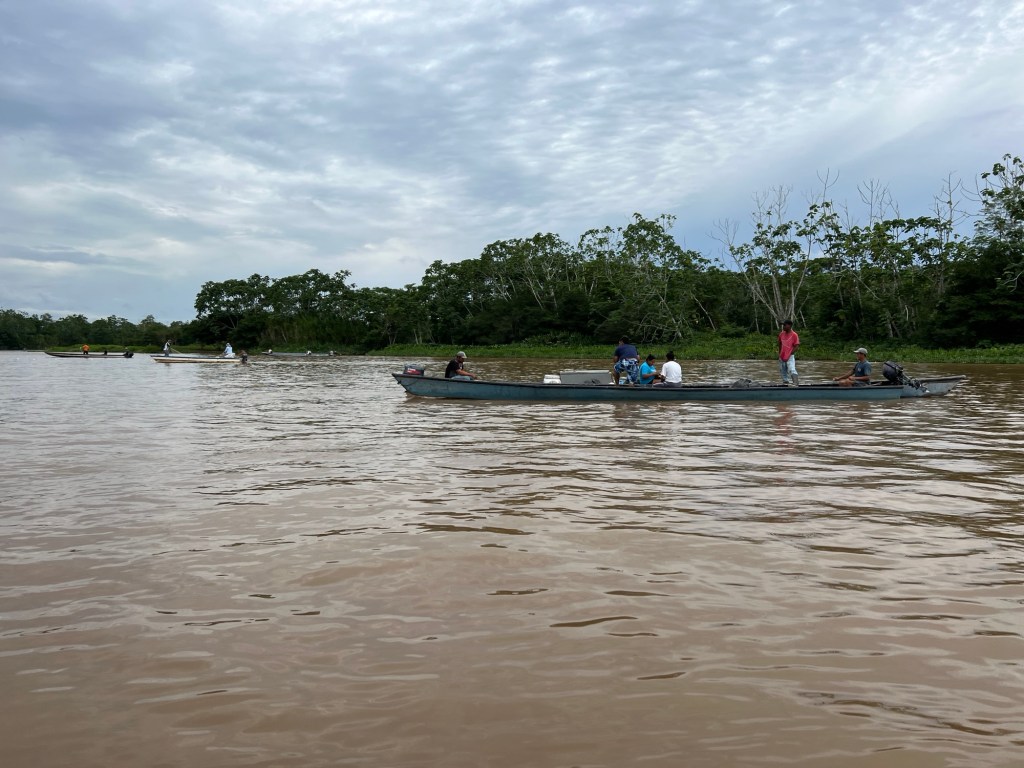
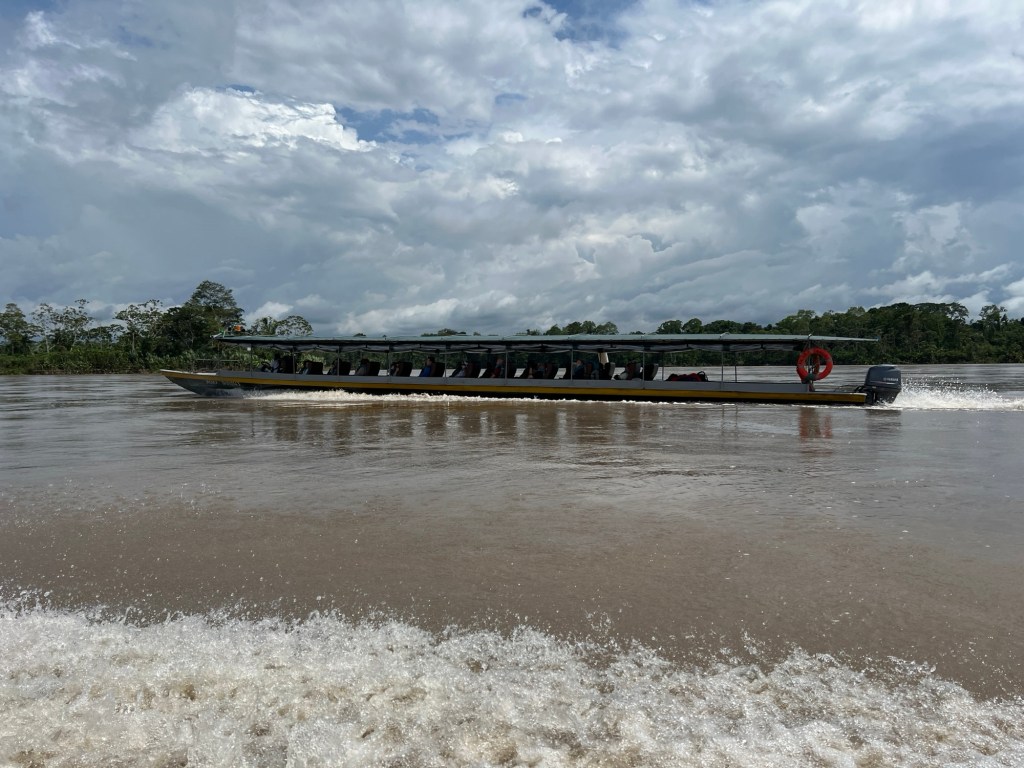
On the bank of the Coca River we boarded our long motorised canoe; this was a substantial craft with rows of coach seats, one seat either side of the central gangway, and a roof covering the passengers. We left the port slowly as we had to navigate around a number of hand-paddled canoes and the long fishing nets that floated downstream from each. After passing the fishers, we turned onto the Napo and the engines roared to pick-up speed and head down river. The journey took 2.5 hours, weaving a meandering line to keep to the deeper river away from large sandbanks and avoid trees floating or stuck in the river, as well as navigating around other craft.

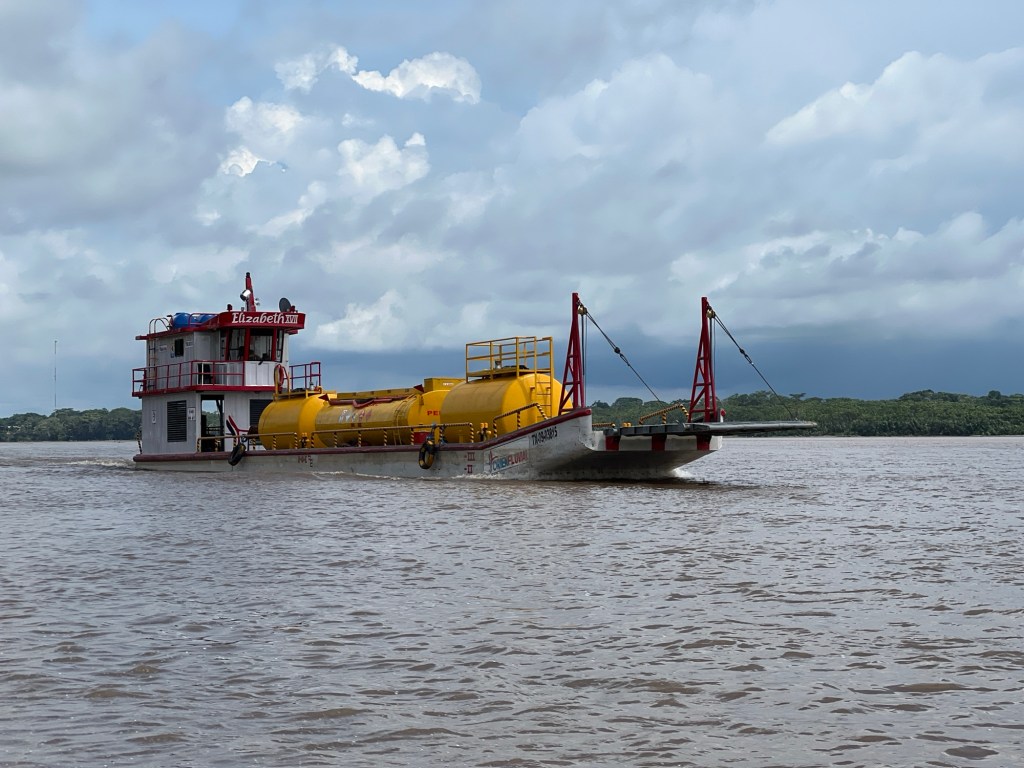
Leaving Coca, we quickly saw the rainforest cloak the river banks but there remained many signs of habitation and industry as we travelled onwards. The Amazonian oil extraction on which much of Ecuador’s economy relies was clear to see with larger boats taking oil tanker lorries up and down the river and we saw at least one large flame burning off gas from the drilling process. Thankfully, we left most of this behind as we approached the end of this stage of the journey. It had rained for a short while on the motorised canoe but not enough to get any one wet under the cover of the roof but this was an ominous sign of things to come.

We eventually turned off the Napo River onto Añangu Creek, coming to a little harbour where we changed from horse power to human power. As we got out of the large craft the heavens opened and we raced to cover to avoid being drenched. Our large bags were put into a ‘freight’ canoe to head off separately while we prepared ourselves for the canoe journey by putting our hand luggage into thick bin bags while getting our binoculars and cameras ready for anything we might see. The rain relented and the canoe teams dried off the seats for us before we headed up stream.

Our final leg of the day was two hours being paddled up the narrow creek under the rainforest canopy. For a short moment, as we set off the sun came out but then the rain returned. We all put our ponchos on and tried our best to keep ourselves dry but it became impossible against the scale of rain I don’t think I’ve ever experienced before; we soon understood just why this is called the ‘rainforest’. When we arrived at the Napo Wildlife Center (Napo) we were all pretty much drenched. Most of us had UK-sourced ponchos which didn’t stand a chance; those that were available from the canoes were so much better. It could possibly have been worse as the rain started to fill up the canoe and we eventually had to start bailing the water out to ensure our feet stayed dry(ish) and the canoe didn’t get too low in the water for the creek to start coming in over the top.

Despite the rain, the last leg had two real high points. Firstly, we spotted a Three-toed Sloth high up in the trees. It was making its way through the canopy at a much faster speed than most would usually expect, probably to find somewhere better to shelter from the heavy rain. This would be first and only slighting of a sloth for the whole trip, which was a bit of a disappointment but as you will read, we saw a lot more wildlife over the next four days.

The second high point was meeting a family of Giant River Otters. As seems to be normal, we could hear them before we saw them; the loud squeaks and squeals giving their location away before their heads popped up almost alongside us. They swam parallel to us for about 30 seconds before turning away up a side stream. We momentarily forget about the rain and I managed to get the following video from under my poncho.

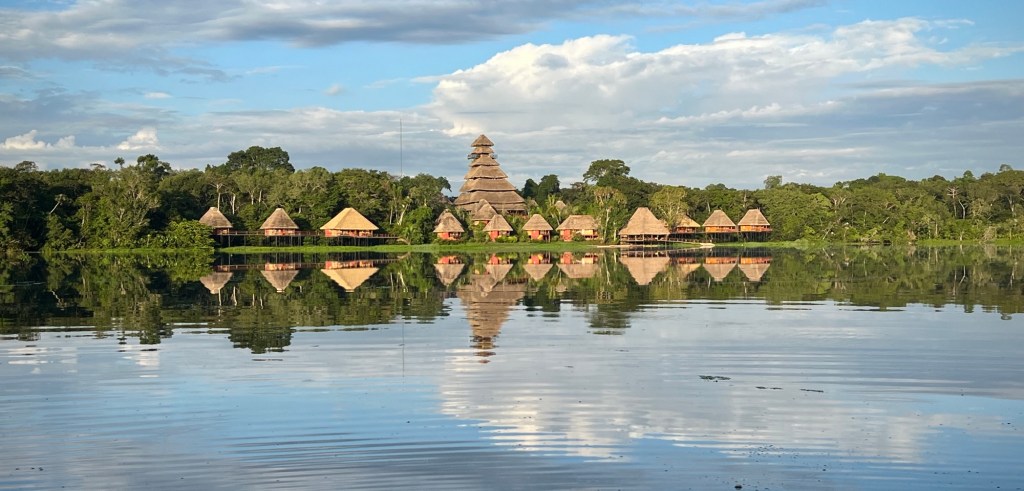
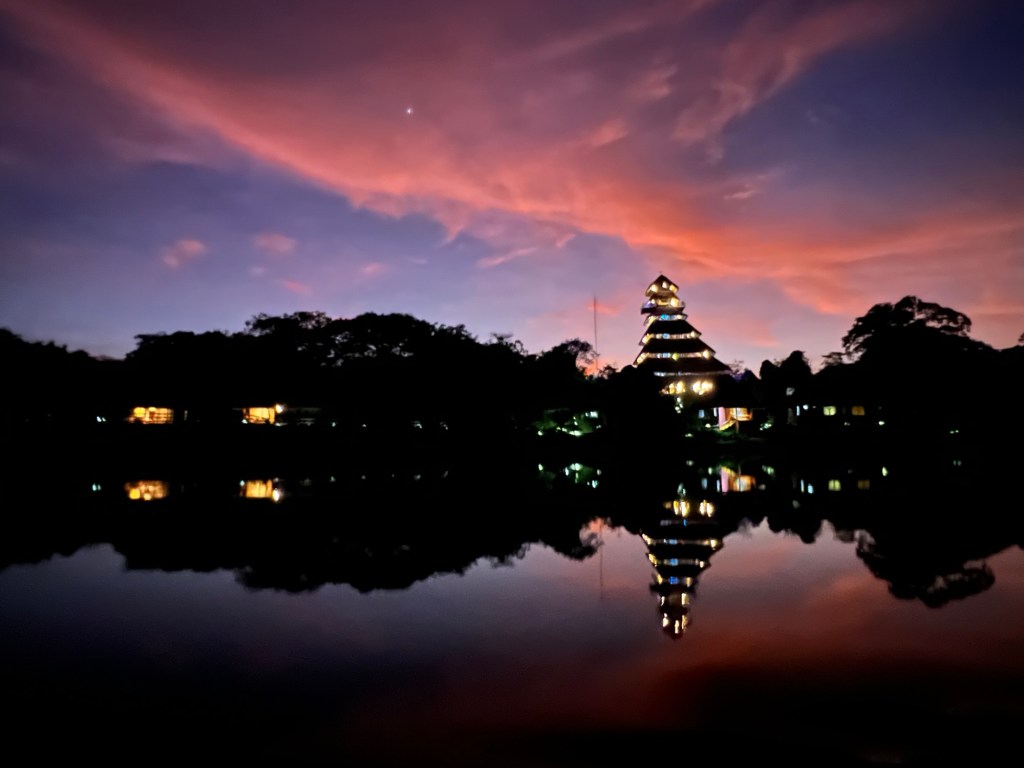
The creek eventually widened and opened up into a lake, across the far side of which stood Napo. The thatch-roofed cabins on the shoreline we dominated from behind by a seven storey observation tower. As we arrived, there were steps up onto a pier which led to an open-sided reception hut which finally gave us respite from the last two hours of rain. We were given our keys and directions to our own individual cabins which would be our ensuite bedrooms for the next four nights.

Napo is located in Yasuní National Park, a region renowned for its rich biodiversity. Established in 2004 by the Kichwa Añangu community, the center was created as a means to safeguard their ancestral land while promoting sustainable tourism. Nestled by Añangucocha Lake, the eco-lodge includes 12 standard cabins and eight suites, all fitted with modern comforts.

Napo is fully owned and run by the Kichwa Añangu community, who act as guides and hosts (and excellent canoeists!). They collaborate with organizations such as the Tropical Nature Conservation System to ensure the preservation of the rainforest. As we found, the community’s extensive knowledge of the area’s flora and fauna enables them to provide visitors with an immersive and educational experience.

With the loss of altitude, after leaving the Andes behind, came the gain of both temperature and humidity. We experienced this from the moment we arrived at Añangu Creek, once the cooling effect of the high speed boat has gone. With temperatures in the low to mid-30s and humidity hovering around 100% at times, our stay was usually pretty sticky but never too uncomfortably so.

We settled into a similar routine we had been living with for the earlier stages of the trip; we got up very early while it was still dark, between 4:30am and 5:00am and we usually went to bed before 9:00pm. Living this way actually meant that we never really settled into normal Ecuadorian time (-5hrs GMT); we were living some odd mid-Atlantic time instead.

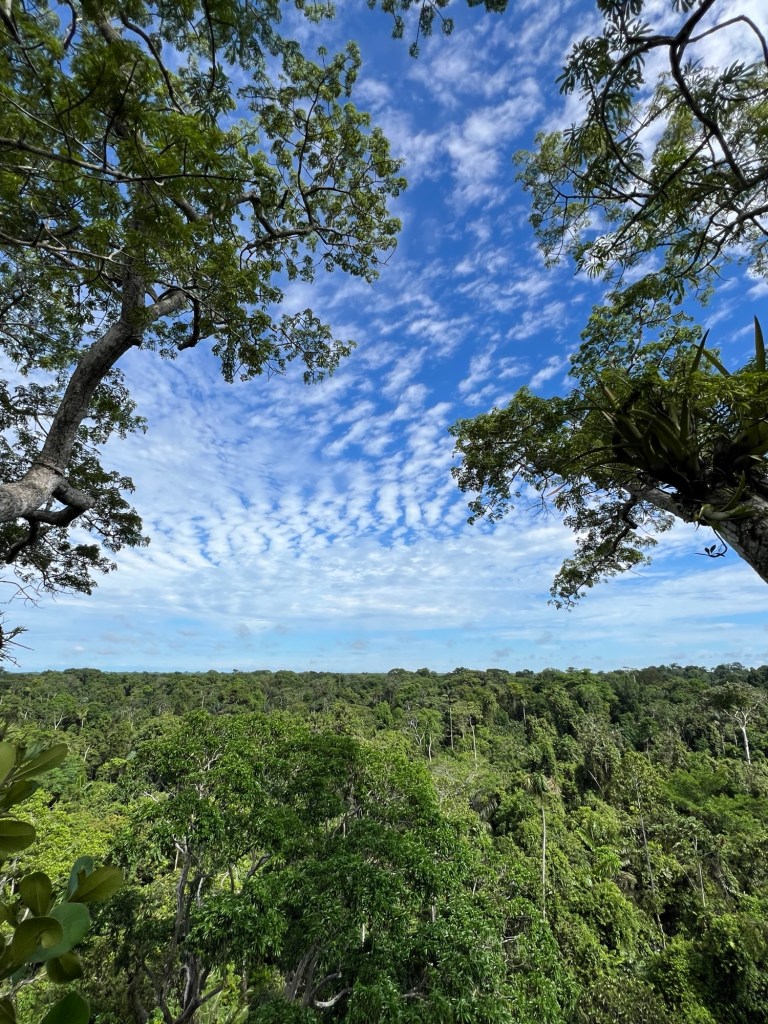
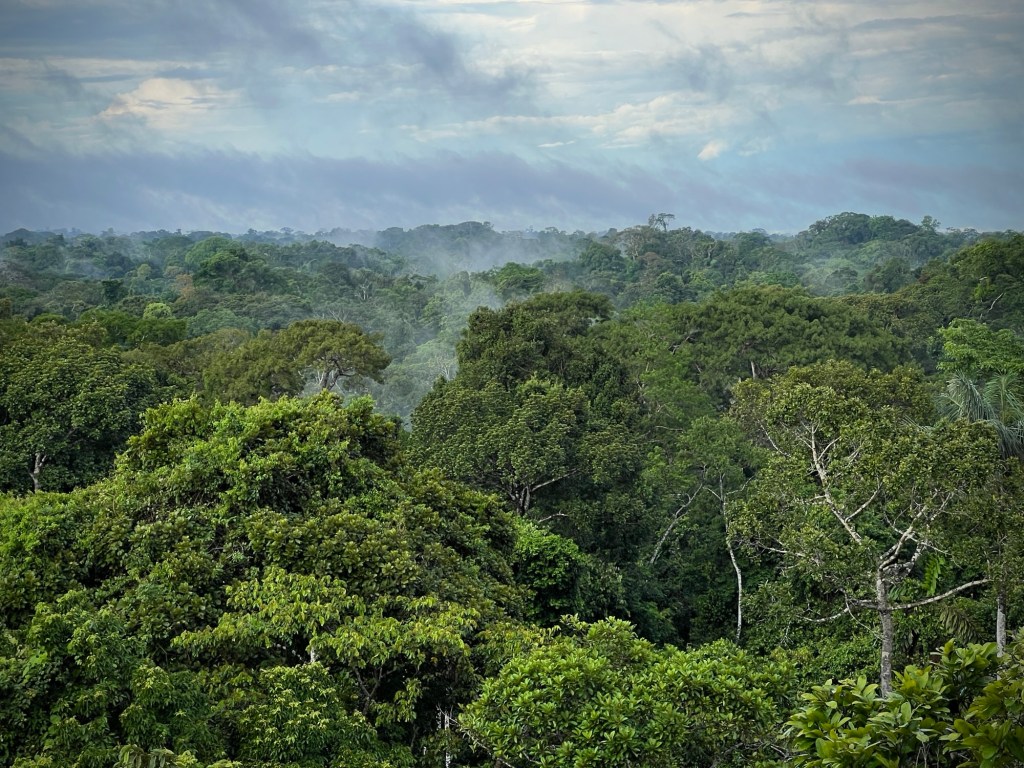
On the first morning of the three full days at Napo, we canoed out from the Center across the lake and landed at a jetty from where we walked 30 minutes into the forest. We arrived at the base of a 100ft observation tower and made the ascent from the dark, hot and humid ground up to bright and cooler platform in the crown of a tall tree. From this point, we had a 360 degree panorama across the top of the rainforest, perhaps one of the most spectacular views I’ve ever had. Staying up there for several hours we were treated to views of howler and spider monkeys, macaws and parrots flying by, as well as toucans and vultures and a range of smaller birds. Eventually, the heat started to build and we made our way down to the floor again. Our walk back to the canoe gave us encounters with insects including leaf-cutter ants and stunning dragonflies.

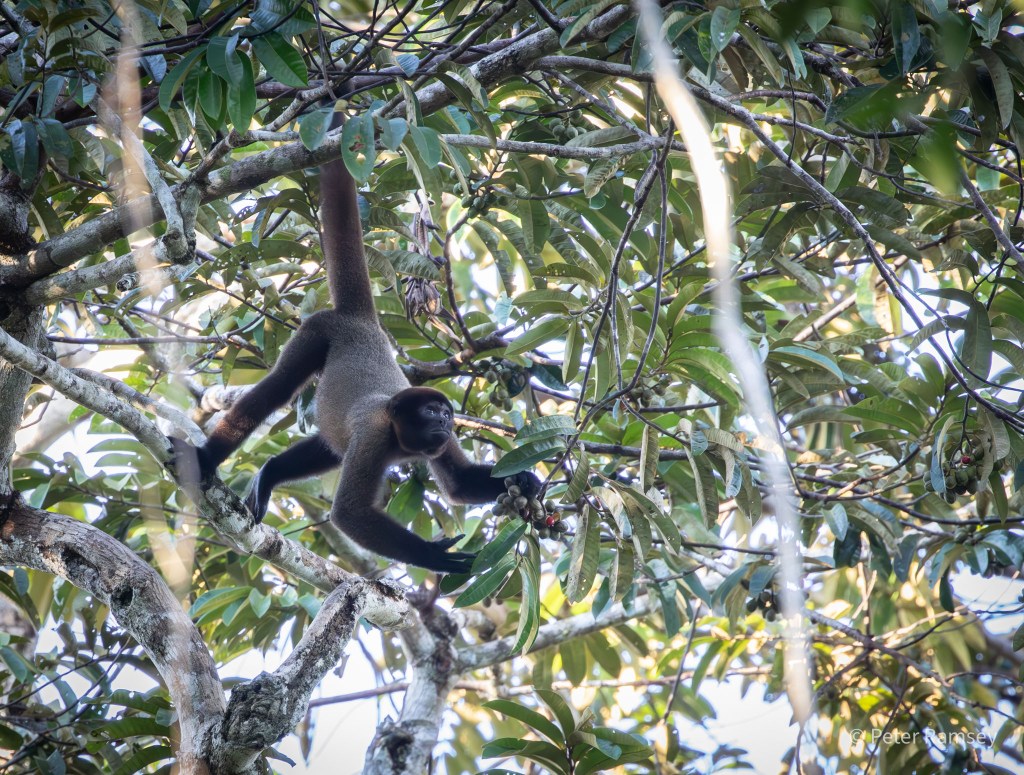
After lunch and a rest from the hottest part of the day, we headed out in the late afternoon to canoe one of the other creeks that links into the lake. We almost immediately heard the sounds of giant river otters again, not far beyond the mouth of the creek. The calls and splashing easily gave them away but they were hidden behind vegetation at first before eventually three came into view and swam close by before heading back into cover again. Whilst we could still hear them, they didn’t reappear and we moved on further along the river. We then came across a small group of Napo Saki Monkeys high up in a tree and mostly obscured behind branches and leaves. We did manage to get good views of these slightly odd looking creatures and some decent photos too. Shortly afterwards we also had good views of Woolly Monkeys above our heads, hanging by their tailed as they moved through the trees. This was followed by groups of parrots and a pair of Blue & Yellow Macaws high up in the forest.

Returning to the lake, the sun was starting to set with huge white clouds lit up orange in the quickly dying light. Before returning to the shore, we went down the main Añangu Creek and enclosed by darkness under the forest canopy, the sounds of insects rose as the evening descended on us. Here we saw bats flying low over the water and fire flies in amongst the riverside reeds. As we emerged back onto the lake a huge cayman lay floating motionless in the creek entrance.

The second full day at Napo started with the unforgettable and slightly unsettling sounds of Howler Monkeys calling into the darkness. They were in a tree just behind our room, roaring out their territorial claim to other families in the surrounding forest. This was the start of what was to be a day surrounded by monkeys of many shapes and sizes.

Our early morning canoe transfer took us back down Añangu Creek to a jetty from which we wandered down a long, raised walkway into the forest. Almost immediately we came across another group of Howlers calling from the trees and stayed to watch them for a while. We then wandered onwards seeing groups of capuchin, squirrel, woolly and spider monkeys moving through the forest.

A three-hour walk become hot and sticky as the sun rose higher. After a break at the far end, we returned to the canoe more more quickly than expected; our gentle wandering hadn’t taken us as far as we thought. On the return canoe journey we saw more howlers and some distant spider and capuchin monkeys. We had one final stop and left the canoe at the river bank for a short walk to see some Spix’s night monkeys. High in their hole, in the fork of a large tree, three small but big-eyed faces stared out at us as we looked up at them.

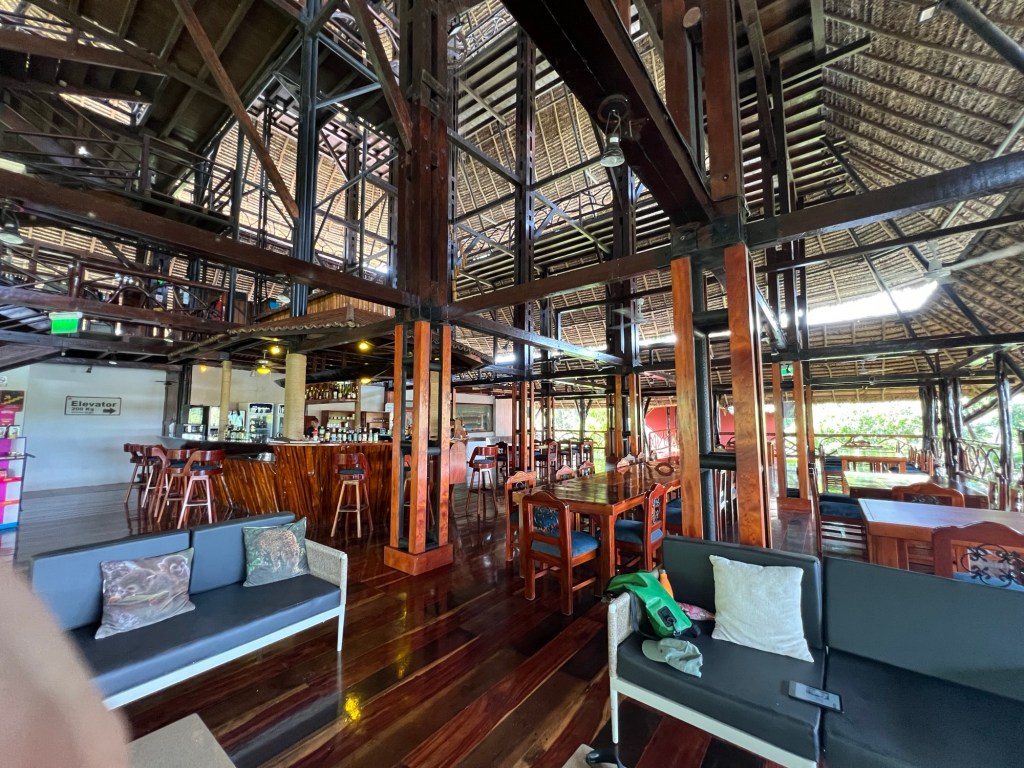
Our afternoon was spent up the very impressive observation tower at the heart of Napo. This seven-storey 60 foot tower matches the huts it dominates having thatched roofs at each level but that hides the huge steel structure beneath. Not only does it provide views out across the rainforest, it also provides the main social space for the Center with the dining room, bar and lounge on its ground floor, a shop on the first floor and other sitting areas on the further floors above.

From the top of the tower we watched the wildlife for several hours including both birds and monkeys. The Russet-backed Oropendolas were particularly busy bringing building materials for their nests hanging from the trees amongst the Center’s cabins.

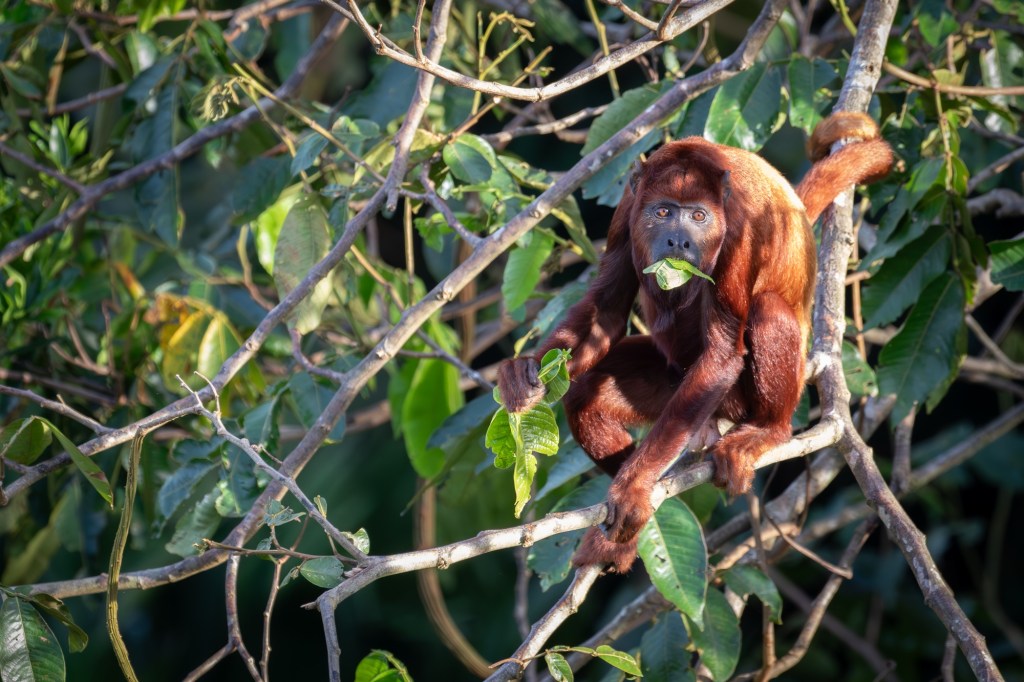
We could hear two groups of Howler Monkeys calling at each other in the distance but slowly one group came closer. A large male climbed across into a tree just by the tower and started to eat. Having left our cameras in our room, we quickly rushed down to get them. On the way back up we realised that we would be at eye level with the monkey if we stayed on the fourth floor. There we stopped and couldn’t believe quite how close we were. In one of the photos below, zooming into the monkey’s eyes you can see the triangular silhouette of the tower.

After dinner, the final action of the day was a night walk through the jungle. We spent 45 minutes wandering along the tracks behind the Center looking for wildlife. It was all a bit quiet until we caught some bats in my detector and found a tarantula just at the rear of the tower.

Earlier that evening we had seen a distant thunderstorm with forks of lightning firing out form the large clouds but it seemed to have passed up by. At midnight we were woken by a huge thunderstorm passing directly overhead, the like of which I’m not sure I’ve ever experienced before. I had to jump out of bed and get a few videos out on the shelter of the veranda but they were taken once the worst of the thunder and lightning had passed.

The morning of the last full day at Napo was a slow-starter despite getting up at 4:30. The rain didn’t relent until later in the morning so we delayed our trip until 8:00. We headed out all the way down the Añangu Creek back to where we changed canoes on the way in, seeing Golden Mantled Tamarins on the way. From there we walked 30 minutes to a ‘parrot lick’ where we waited for macaws and parrots to arrive. The birds come from miles around to obtain vital nutrients that they can’t get from their food elsewhere.

After a bit of a wait, we were lucky to see scarlet macaws coming in to feed. At first they seemed reluctant to drop down from the trees but after one was brave enough, they came in small groups. They squabbled over space amongst the rocks providing the chance for some lovely pictures despite the low light conditions.

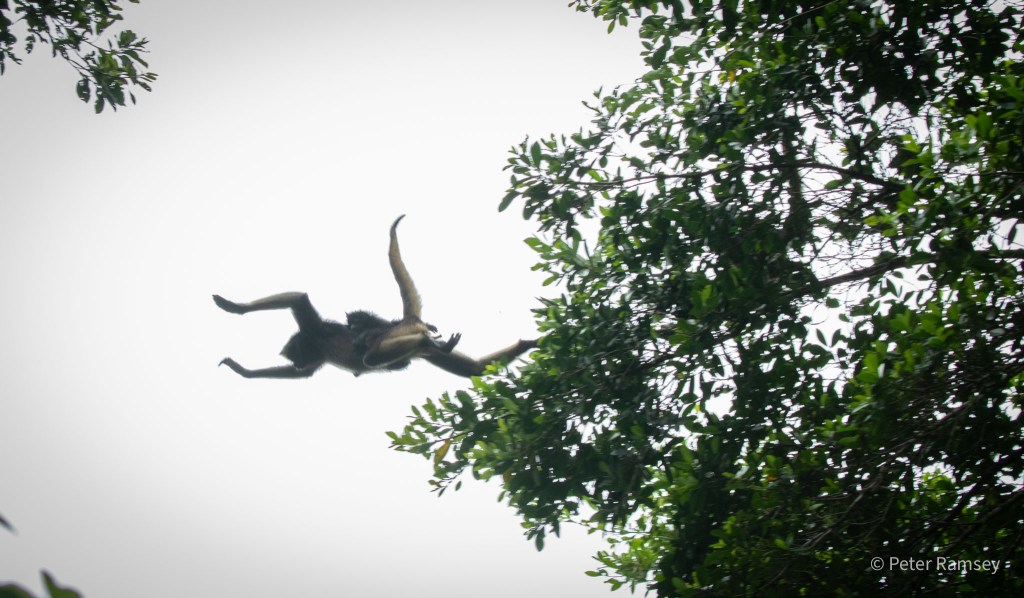
On the way back we had brilliant views of spider, squirrel and capuchin monkeys with some of them being very close to the water while others jumped across the river at tree-top level.

After these amazing days at Napo we spent the last afternoon high up in the observation tower having a look at the wildlife from above.

The final morning of our stay in Ecuador was the earliest of them all; we were up at 3:15 and being paddled away from Napo at 4:30. Setting off in the dark we felt a few spots of rain, so we donned the canoe’s ponchos, hoping not to have the same torrential downpours we experienced on the way in. While the rain didn’t come in the end we quite soon came across a different problem. A tree had fallen overnight and was straddling the river from one side to the other, completely blocking our way. However, we need not have had the worries that immediately came to us. The canoe team leapt to action, along with those of two other canoes that joined us. They cleared with machetes an area of vegetation on the bank for all the passengers and luggage to wait on. Another canoe soon appeared and wedged itself under the tree levering it high enough for the other empty canoes to pass through. We and our luggage were then put back into the canoes and we were off again down the creek in around 30 minutes.

Waiting on the bank in the early morning light

Our change over to the motorised canoe was quick and dry, and we headed back up river for the 2.5 hour journey to Coca.

After four nights in the Amazon our arrival back into Coca seemed like a return to normal in the hustle and bustle of urban life. It was made to feel even more so by the quick transfer to the nearby airport, and what appears to be a modern terminal, and boarding a Boeing 737 for the very short flight back to Quito.

The stay as Napo wasn’t just the highlight of our trip to Ecuador, it was one of the best wildlife experiences of my life. My first visit to a rainforest was spectacular and a time spent in nature that will be hard to top.

A note on the accommodation. Our ensuite room was the best we had on our trip (the others were pretty great too, I have to add); the cabin was spacious with very high ceilings beneath its conical roof. Our bed was huge, with an enveloping fly net, and was turned down for us every evening. There was a ceiling fan as well as one standing on the floor, which helped the air to circulate around the room. The cabin wasn’t sealed as the windows were fly screens but there were curtains for privacy.

The food served was buffet style, which came as a bit of a relief given the huge portions we had been given at most of the places we ate. The quality of the food was great and the choice quite wide, with three courses for lunch and dinner (if you wanted them).

Napo Wildlife Center can host up to 40 guests at one time, accommodated in 20 cabins. Generally, guests all ate at the same time (but not always), but the dining area, lounges and bar never felt crowded and once away from the Center, different groups rarely bumped into each other.

This may have been a stay deep into the Amazonian Rainforest but it was a long way from being a basic existence and much more like a luxury safari lodge.

Continue reading

Ecuador’s Mammals Trip Report: The best bits

I’ve got a very long trip report in the making but here’s a shorter post about the best bits of our trip to Ecuador in November 2024.

This was a 15 night guided trip with Naturetrek, led by a local Ecuadorean guide, Roberto. We arrived a day early to acclimatise, staying in the lovely Puembo Birding Garden, and had an afternoon guided trip around the historic part of the capital, Quito. After a second night, this time in a city centre hotel, we started the big trip itself. We headed out to the western slope of the Andes staying at the Bellavista Cloud Forest Lodge for two nights. The next four nights were to the east of Quito at the Termas Papallacta Hotel, high up in the Andes at 3,250m. We had two nights at the San Isidro Lodge further to the east, and the final four nights were further east still, in the Amazonian Basin at the Napo Wildlife Center.

As the title indicates, this was a trip prioritising mammals as the main focus. However, watching mammals in South America is quite different to a typical African safari; in Ecuador there are no great open plains populated by huge herds of herbivores hunted by the ensemble of hungry carnivores. Instead, there are the hills and mountains with cloud forest and high paramo grassland, and the lowland Amazonian Basin. These are much lighter populated by wild mammals and they are accordingly much harder to find…but find them we did. Alongside the mammals, but far more plentiful, are hundreds of species of bird, and when not looking for the mammals, we spent a lot of time watching the amazing diversity of birds.

We crammed a lot into the thirteen full days of the main trip with a very wide range of wildlife and scenery seen (and heard, so summarising it is quite a difficult task. However, here is a top ten of the highlights (in chronological order):

1. Hummingbirds

Almost everywhere we went, the ‘hummers’ were in abundance, from the first morning until leaving the Andes behind. In total, we saw 52 species and countless individuals, from the largest to some of the very smallest. Everywhere we stayed up in the mountains, as well as some of the lunch spots and other places we stopped, there were hummingbird feeders and we spent a lot of time watching them. Not only are they spectacularly pretty, they’re also very feisty, constantly squabbling and chasing each other around. Of all the hummingbirds, the Long-tailed Sylph was my favourite, partly due to how obligingly one sat still on a branch long enough for me to get more than a few photos; most of the time it was complete luck whether the would be in the same spot by he time I brought my camera up to get a shot.

I’ll write more about these amazing birds in another post.  

2. Cock-of-the-Rock

Before we left for the trip, this was one of the star species we wanted to see but for a time it seemed like our luck might not be in. On our first morning at the Bellavista Cloud Forest Lodge we got a very fleeting view of a silhouetted bird that Roberto told us was a Cock-of-the-Rock, but it flew through the trees so quickly that no one got a good view. Later that day, as dusk came, we when down to a lekking spot to find them but, while we saw plenty of other birds, including a mass of swifts in the distance, there were no lekking males around (or females for that matter). The next morning, after a very early departure from the lodge, we had a short walk from the minibus to another lekking ground. As soon as arrived, we could hear the harsh, loud calls (harsher and louder than a Eurasian Jay) echoing around the woodland and then spotted three of the males chasing each other around the trees. We watched the large red, black and grey cocks for about 20 minutes before they disappeared from sight (but not from hearing) into another area of the woodland.

3. Spectacled Bear (aka Paddington)

During our stay at Papallacta, one day we headed back towards Quito and then looped up into the mountains to the Antisana National Park (named after the huge volcano at its centre). Climbing up to the high plateau, the scenery turned from farmland into wild paramo grassland and in amongst the dense vegetation we came across perhaps the star species of mammal for the trip. At first we saw one Spectacled Bear feeding on a bromeliad. It was quite distant across the other side of a steep valley, so we moved on round a corner in the road for a better view. After a while of scanning the hillside, we found it again but realised there were two. We had good views of one through our binoculars and a couple of scopes but the other only occasionally appeared. As is always the case, we had to move on to other things and leave the bears behind, not to see them or others again (although we have just seen the new Paddington movie – although set in Peru, he is the same species of bear as those in Ecuador).

4. Andean Condor

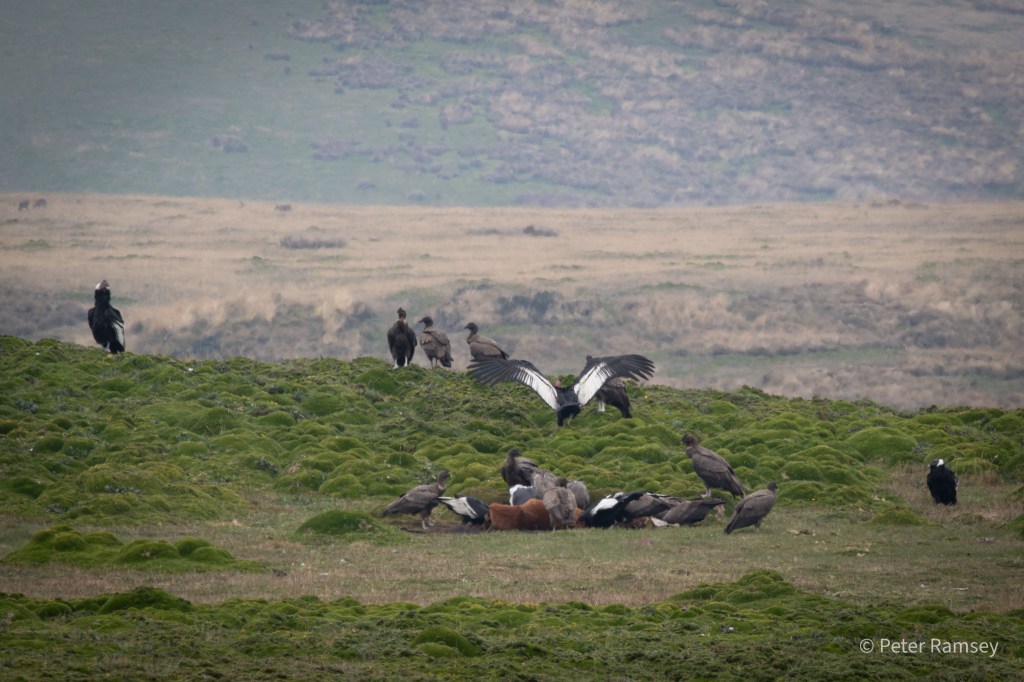
Moving on from the bears gave us another great moment on the trip, and one that was as memorable for Roberto as it was for the seven guests. We had seen four distant Andean Condors flying above the valley in which we saw the bears but they weren’t great views, silhouetted against an overcast sky. As we entered the Antisana National Park, one flew low over our heads but the best was yet to come. Rising up further onto a great plateau, we saw some more on the high edge of a valley but we were then amazed to see a mass of both adults and juveniles at a congregation around a dead horse. This group of 20 was the largest Roberto had even seen in one place, after many years of guiding; of course, it was the most for the rest of us too. We stayed a respectable distance from them and watch as the squabbled over the huge meal. 

Of all the birds that were possible to see on the trip, with was the top of my list. I’ve wanted to see them for a very long time after watching them on TV as a child. They have the longest wingspan of any land-based bird and use them for soaring high above the Andes in search of carrion. Obviously, on this day many had done just that and spotted the horse. In all, we saw 32 individuals, quite a feat considering that this species is becoming very rare.

5. On top of the Andes

We hadn’t finished with the high altitude and the next day went to the highest point accessible to us (without actually climbing a mountain, which we weren’t equipped to do). We turned off the Quito to Papallacta road and joined a track up to a peak covered in radio antennas. From the top (of the peak, not one of the antennas), we had spectacular 360 degree views across the Andes, with ourselves standing at 14,000 feet (over 4,030 metres). We could see several volcanoes (including Antisana again) as well as other peaks spread out over many, many miles. I now realise, first hand, why climbing at these altitudes is so difficult. I consider myself quite fit for my age but even walking a short distance at this height left me quite breathless; we were only 3,000 feet below the level of Mount Everest Base Camp.

img_3773-1

6. Giant otter

Our arrival into the Amazonian Basin demonstrated exactly why this ecosystem is called a ‘rainforest’. Leaving the town of Coca behind, our gateway to the Amazon region, we had a 2.5 hour motorised canoe ride down the Napo River. We then swapped horse power for human arm power as we were paddled for two-hours to the Nap Wildlife Center. As we arrived at the place to swap boats, the heavens opened and the rain would have drenched us if it hadn’t been for the sheltered we hid under. The rain didn’t last long and as we started off on the last leg of the journey, the cloud parted momentarily. However, it was only a short reprieve and an even heavier downpour came over and lasted for almost the entire two hours of the canoe trip. Even with ponchos, we were all soaked.

Despite the rain, the journey had a real highlight for me, first we saw a Three-toed Sloth high up in a tree, actually moving rather than just hanging around. This was followed by the sighting of a family group of Giant River Otters swimming almost alongside us. Their squeals and squeaks were heard first but then they broke the water’s surface along side us and swam in view for 30 seconds of so, before disappearing up a side stream. We were to see or hear them again another couple of times over the following few days but this was the best view of all.

7. Tree-top tower

One morning at Napo, we headed out very early (all mornings on the trip were very early, to be honest) and went to tree canopy tower. 100 foot up in the air, with a platform in a huge tree, we had a great 360 degree view over the rainforest canopy. We spent several hours up there in the growing morning light, watching both monkeys and birdlife surrounding us and listening to the sounds of the Amazon.

8. Thunderstorm

Being in the Amazonian rainforest was a highlight in itself, a place I had never been to before and truly spectacular (I’ve purposely used that word a lot in this post!). However, apart from the wildlife, the most memorable part of the spending time there was the huge thunderstorm that rolled across the area one night. We first saw some fork lightning in the distance as we arrived back at the Center after darkness had fallen. The storm reached us not long after might with thunder and lightning the like of I’ve not experienced before. I simply had to get out of bed and video it from under the shelter of our cabin’s roof. By the time I shot the video the largest rolls of thunder had moved off but the rain persisted well into the early morning, altering our plans for the day.

Over the two months before our trip, Ecuador had been hit by a major drought, leaving water levels very low and many areas struggling with electricity blackouts. The Ecuadorian electricity system is reliant to a very large extent on hydro systems such as dams, so the reduction in water has had a very big impact on the amount of energy that can be produced. We didn’t feel the effects of the enforced electricity blackouts (we were asleep during one in Puembo) but we did see plenty of shops and restaurants with petrol generators working. Rain over the week before we entered the rainforest increased water levels substantially, meaning we could paddle in where previously guests had to walk to the Center.

9. Six monkeys in a day

The monkeys were major highlight during our trip, particularly in the rainforest. On one day we saw six different species and had amazing views of many of them, both from land and the canoes. On one day we saw White-fronted Capuchin, Humbloldt’s Squirrel Monkey, Spix’s Night Monkey, Red Howler Monkey, White-bellied Spider Monkey and Silvery Woolly Monkey. On other days we also saw Black-mantled Tamarin, Golden-mantled Tamarin and Napo Saki.

One particular canoe trip gave us very close views of spider monkeys swinging through the trees and leaping over of us between the tops of trees, with capuchins and squirrel monkeys not far away and much closer to us, just above the water. This was accompanied by the calls of unseen howler monkeys in the nearby forest.

10. Howler monkey

The best views of any mammals were of the howler monkeys at the Napo Wildlife Centre. We woke one morning to the sound of them howling into the dark from trees just behind our cabin – a very unusual and slightly disconcerting call to wake to. There’s a video below from inside the fly netting around of bed – you’ll need to turn the volume up! 

That morning we went for a walk through the rainforest and came across a different group of these big monkeys howling away in the trees and a further group on the way back in the canoe. However, the best sighting was at the end of the afternoon. We had all gone up to the top of the spectacular seven-floor observation tower that sits at the heart of the Center. We first heard two groups of howler monkeys calling at each other in the distance but we then saw one group coming closer. One particular monkey came to a tree right next to the tower. Having left our cameras in our cabin, we raced down to get them. On the way back up the tower, we realised the monkey was still in the tree and that it was at eye level on the fourth floor. We stopped our ascent and spent time watching and photographing this big male as he ate in the tree just a few metres away.

What else?

A top ten of the highlights was actually quite difficult to come up with; there were so many great experiences in this trip and many things I could have included in the list such as:

  • The afternoon guided wander around the ‘old town’ part of Quito
  • Setting a tayra (very large weasel) at the feeding station at Bellavista the moment we arrived
  • The antpitta ‘theme park’ – not really a theme park at all but a nature reserve set up by a family to conserve antpittas and introduce them to guests
  • The volcanically-heated hot (and one very cold) spa pools outside our room at Papallacta
  • Night-time canoe trips and the 10 new species of bat we saw or recorded with my bat detector across the trip as a whole
  • The trip to the macaw and parrot salt lick near Napo and the lovely pictures of the scarlet macaws.

There will be more blog posts about this trip with more details on some of the things I’ve mentioned in this post and many of other experiences and moments.

Sweden: A wild world less diminished

Our annual trip to Sweden has come to a close again and as usual it provided a stark reminder of just how nature-depleted the UK is. A thought I’ve had since I returned was how glad I am to be living in a rural village rather than a city; the contrast would be even greater and my gloominess about the state of nature in the UK even worse.

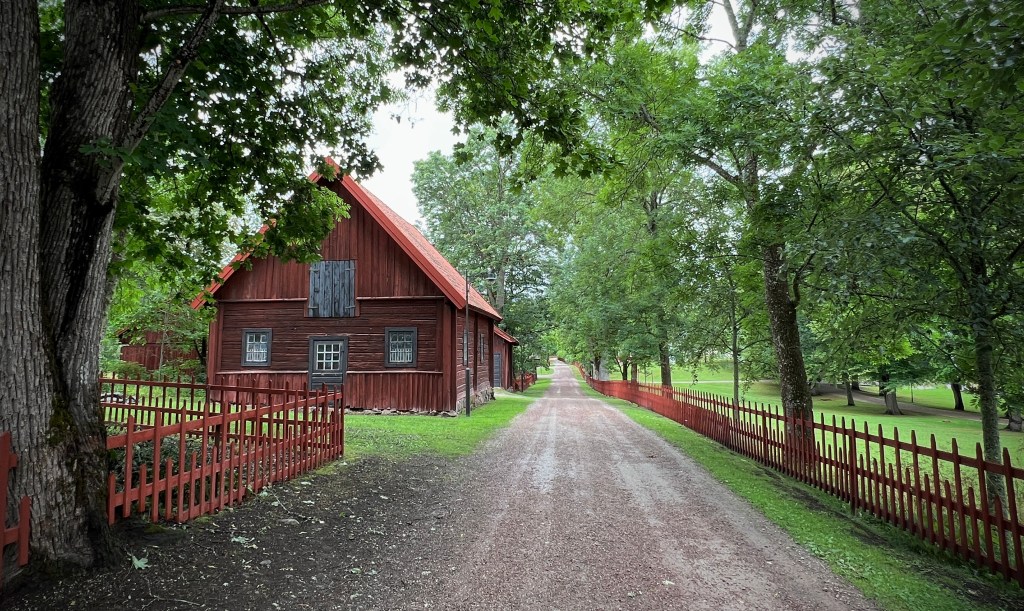
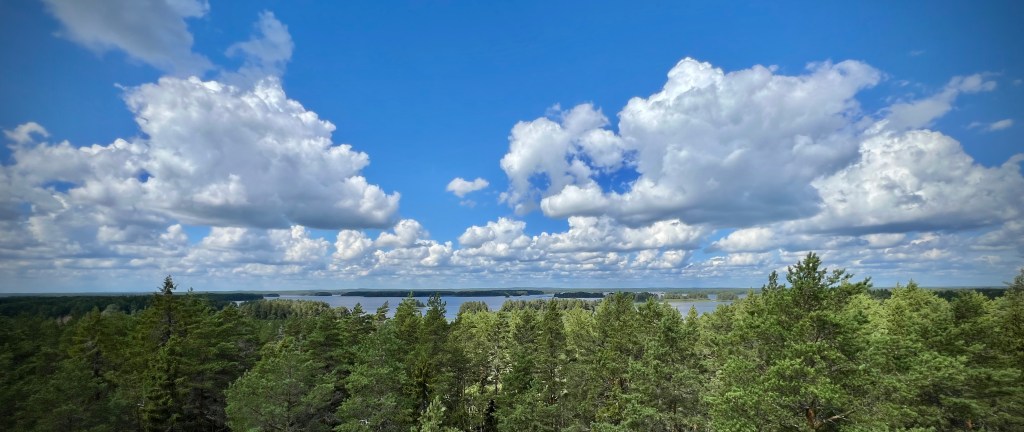
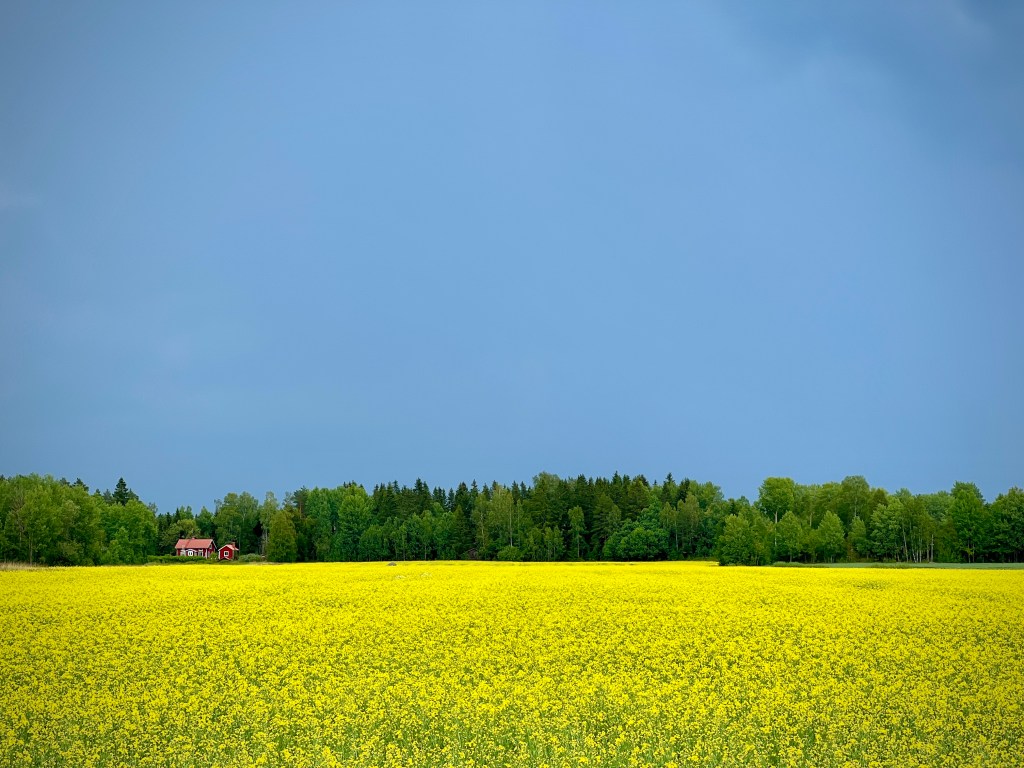
We are fortunate to be able to stay in a very lovely Swedish summer house out amongst the forests, meadows and lakes of central Sweden, about 125km north-west of Stockholm. The location is on the break between southern and northern Sweden; just a little further south, the landscape opens up into large arable fields and further north the forest cover is much greater. Our home for a week or two each year, feels a little softer where the influence of agriculture is lighter and the wild a little more, without being deep wilderness. 

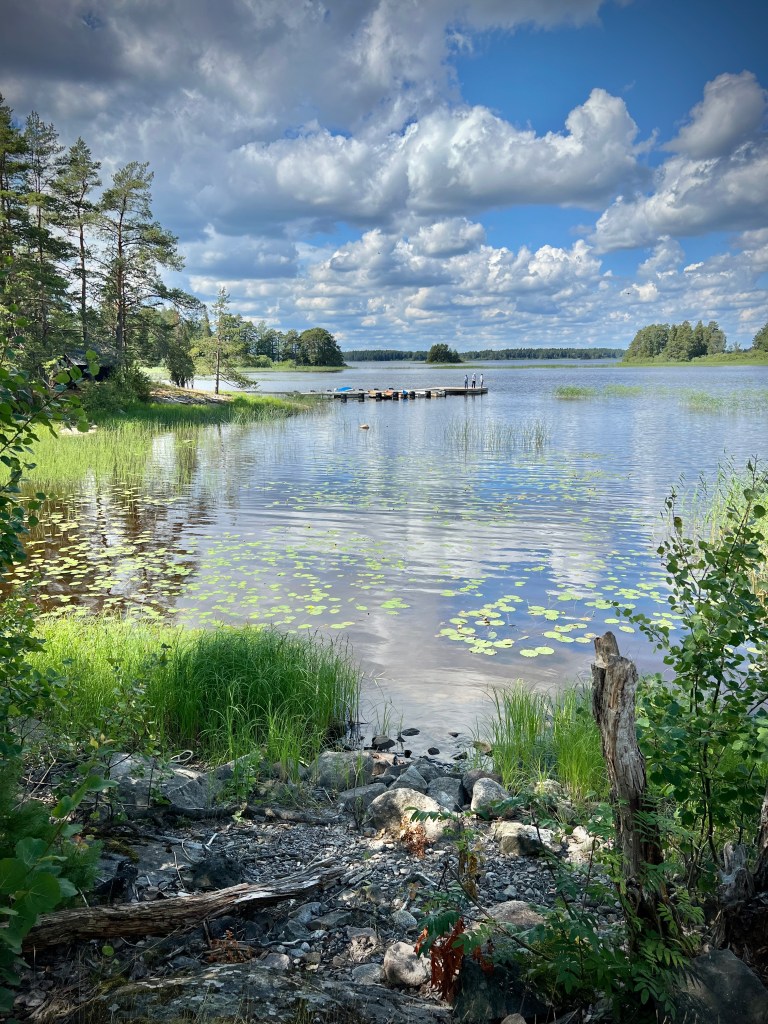
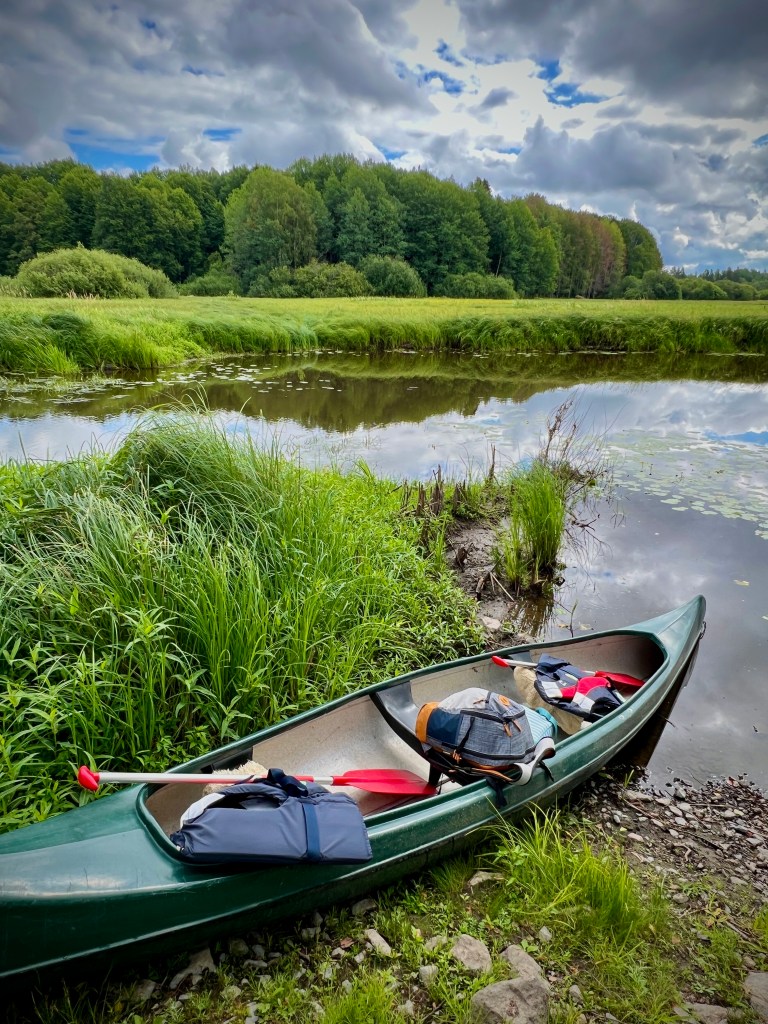
Over the course of the week, we went canoeing on a nearby river, went swimming on the local lake just a short amble from the summer house and we visited the national park an hour to the north. Each of these activities was accompanied by wildlife but even just sitting on the deck at the from on the house brought wildlife sights and sounds.

Whilst the birdlife in this year’s trip wasn’t as plentiful as last year – two weeks in June being more productive than one week in July – the birds around the house still provided some little stars including marsh tit, willow tit and the very lovely crested tit, and on a few evenings we saw roding woodcock on an aerial ‘racetrack’ above the tall treetops. 

As shown in a previous post, the mammals in the garden included brown hare, badger and fox but this year we missed seeing any red squirrels and we didn’t spot the beavers down on the lake. We did see plenty of roe deer, including one doe with two fawns, as we drove through the countryside but we weren’t as fortunate as my sister-in-law who saw a cow and calf European Elk as she drove home from work on our last day.

Out on our canoeing trip, the raptors were the stars of the show with a distant and very high white-tailed eagle, a hobby exploding from a reedbed, a honey-buzzard drifting slowly past and two ospreys circling above us as we paddled across a lake.

Swimming in the warm waters of the lake has quickly become my favourite activity of a Swedish holiday (after only learning to swim well in the last few years). In turn, my favourite part of that is to float on my back and watch the swifts chasing around the skies above and the dragonflies hawking over the water’s surface.

Our stay wasn’t all birds and mammals though as we had a very good view of a sunbathing adder as we walked through a lovely bit of forest after we had cooked sausages on an open fire in front of one of the wind shelters that are dotted around the countryside. The wildflowers seems more plentiful than at home in Northamptonshire, the roadside verges packed with flowers of many kinds although the lovely, but invasive, lupins were mostly well past their best.

All this nature, that was so easy to find, is in stark contrast to nature at home. To be fair, Sweden is a much bigger country and one fifth (or so) of our population, so the human footprint is always likely to be bigger in the UK. However, the tolerance of larger wild animals is much greater (albeit not without its debates), the use of chemicals in farming appears less and the almost unstoppable desire for ‘tidiness’ in the countryside does not seem to be present. Overall, the balance of human control over natural processes seems far less and as a result wildlife and wider nature are far better for it.

I wrote a post a few years back about my ‘yearning for nature’ and each trip I take to Sweden makes that yearning for wild places and an abundance of wildlife even greater.

Just to make a bit of a mockery of this post, most of this post was written sitting in my sunny back garden, on a warm summer afternoon, when a fox jumped onto and walked along the top of wall opposite, swifts, swallows and buzzards were in the sky above and I could hear green woodpecker calling from a nearby tree and a red kite crying in the distance. It’s not all bad in the UK and my little corner of Northamptonshire has quite a lot of wildlife, but it’s just not as rich as I wish it was.

Isle of May: Another island I could fall in love with

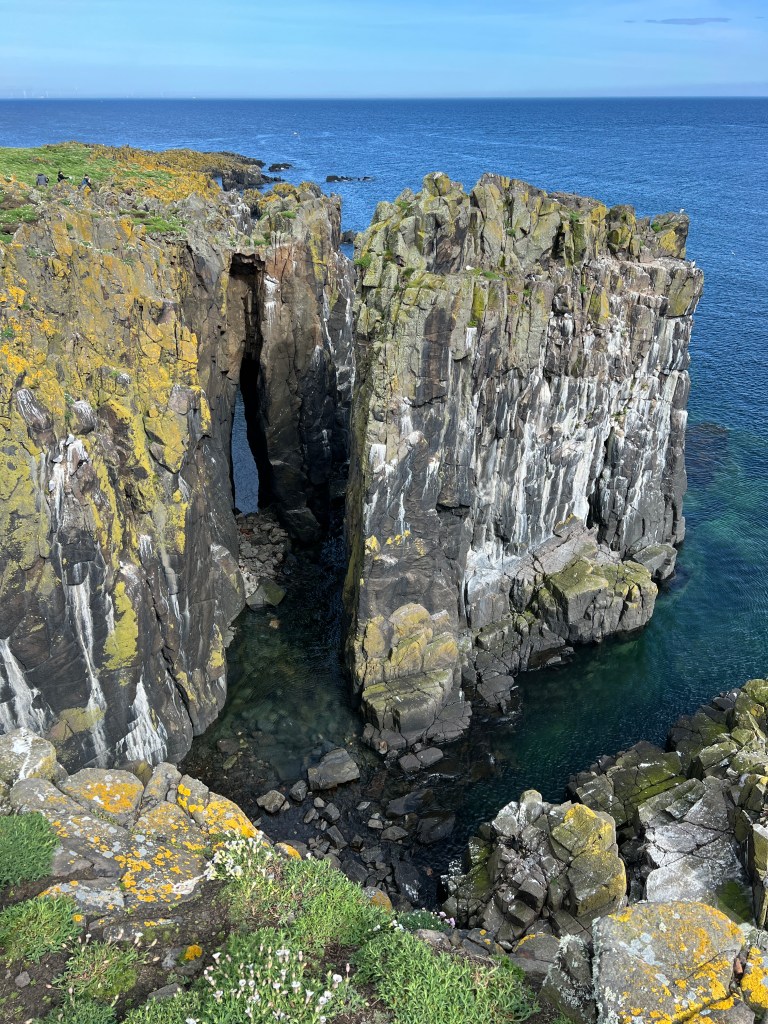
Anyone who has scrolled through the pages of my blog will know I spend time each year on Ramsey Island, the RSPB reserve off the northern coast of Pembrokeshire in Wales, and I have grown very fond with it. However, I have a general love of islands, both large and small, and will take most opportunities to visit them when I can. Earlier this month we had a week-long holiday on the Northumberland coast, which presented a couple of such opportunities; the Farnes and the Isle of May. This post focuses on the latter.

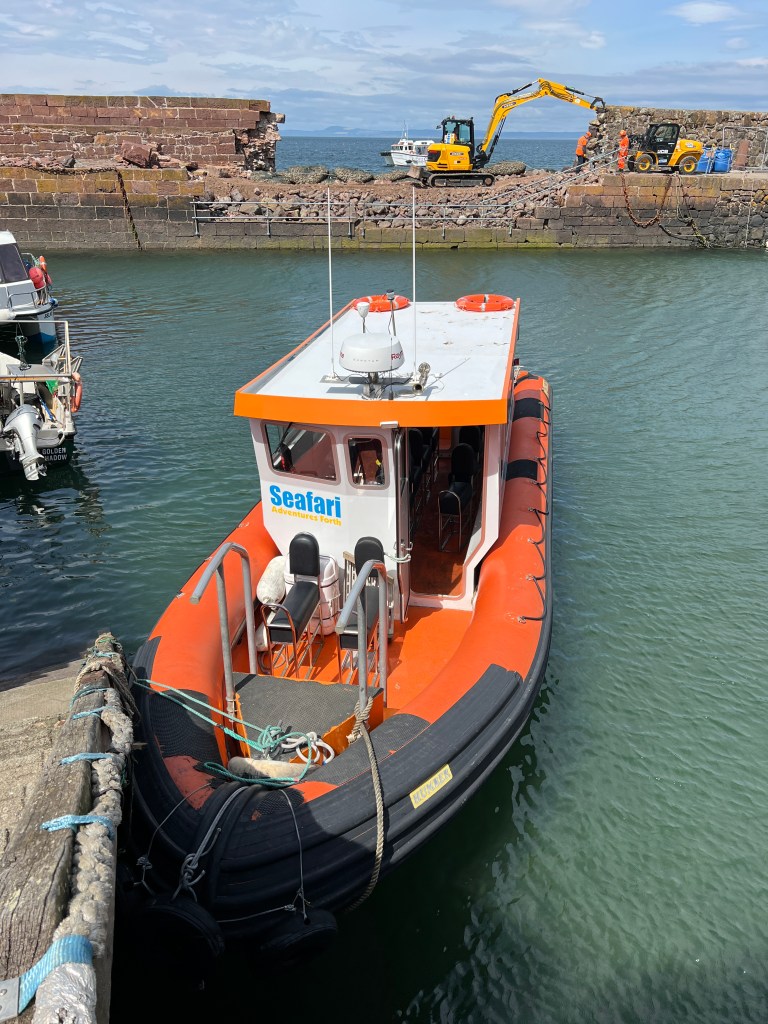
Our trip started at North Berwick, on the southern shore of the Firth of Forth, with a fast RIB (rigid inflatable boat) ride booked through the Scottish Seabird Centre. The town was a nice bonus to our day; an old town with narrow streets lying behind two long sandy beaches split by a rocky outcrop build out further by the sheltered harbour. We arrived early and spent some time wandering the quiet streets and along one of the beaches in the increasingly lovely, sunny weather.

We headed out on the RIB after lunch. Partially enclosed, it provided a lot more weather protection to the passengers (and crew) than other, open RIBs I’ve been on before. Sitting at the back, I did get a little damp on the trip across but not enough to be at all bothered. The sea was relatively calm and with a following wind and waves flowing with us, the journey was pretty bump-free.

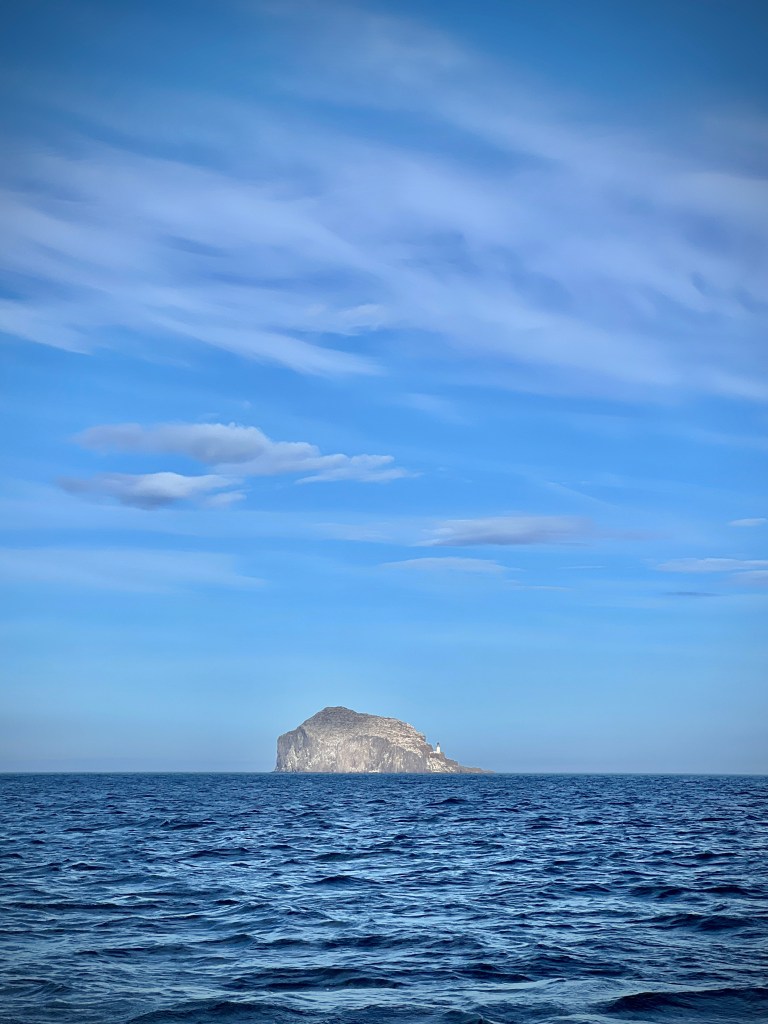
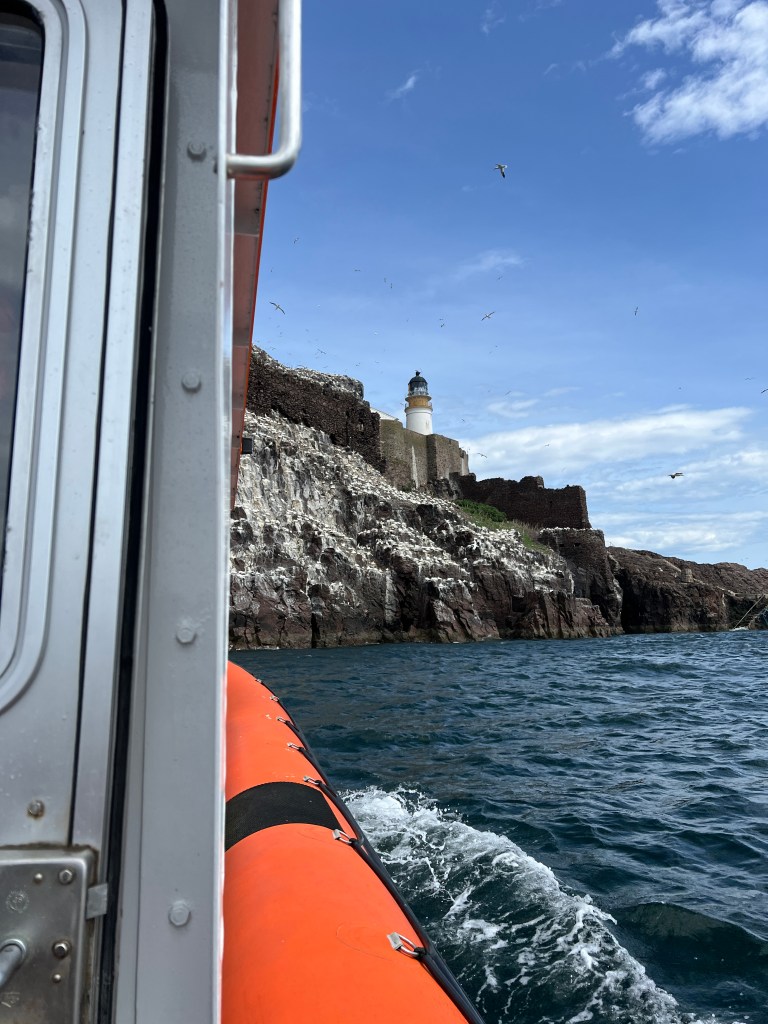
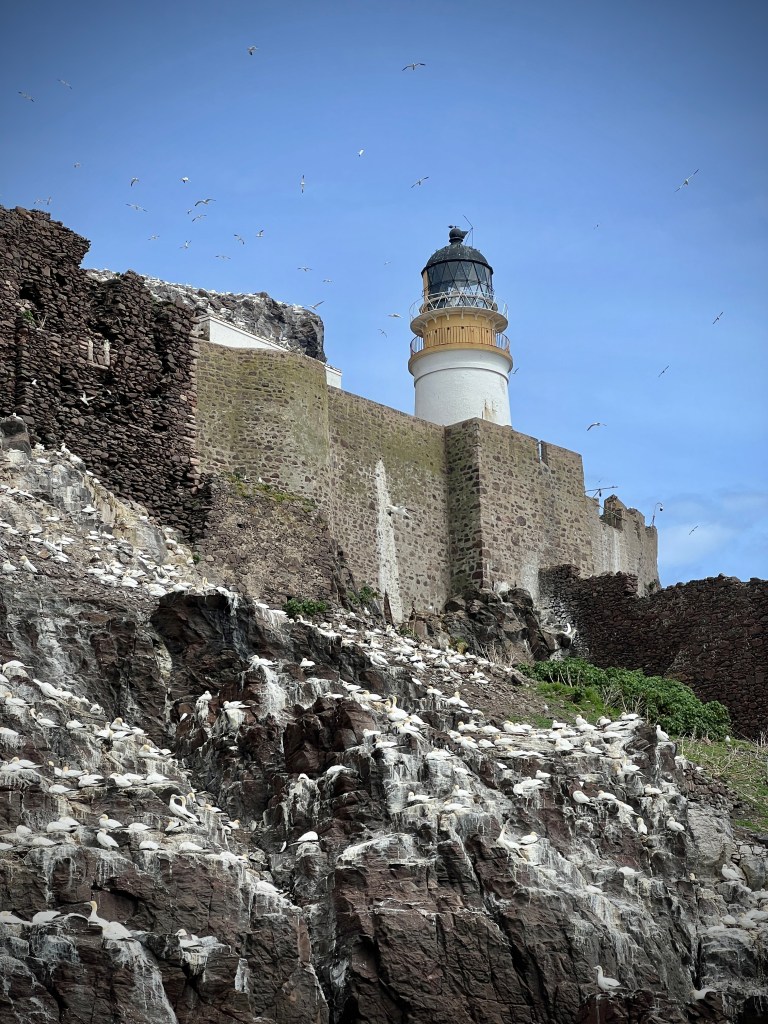
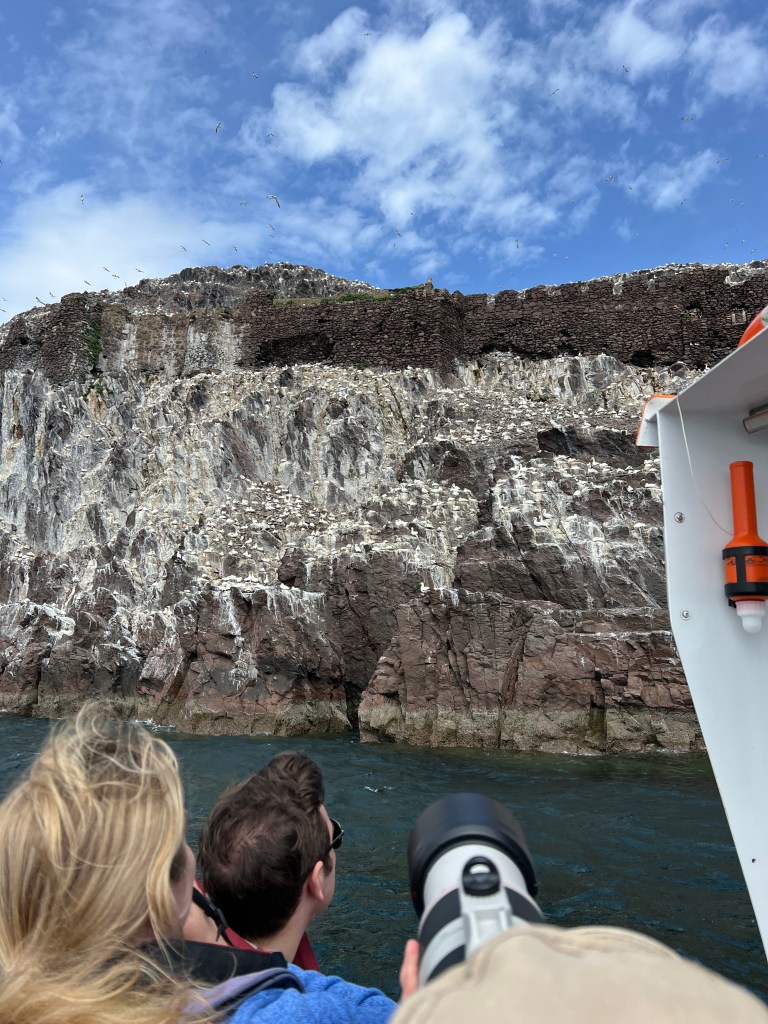
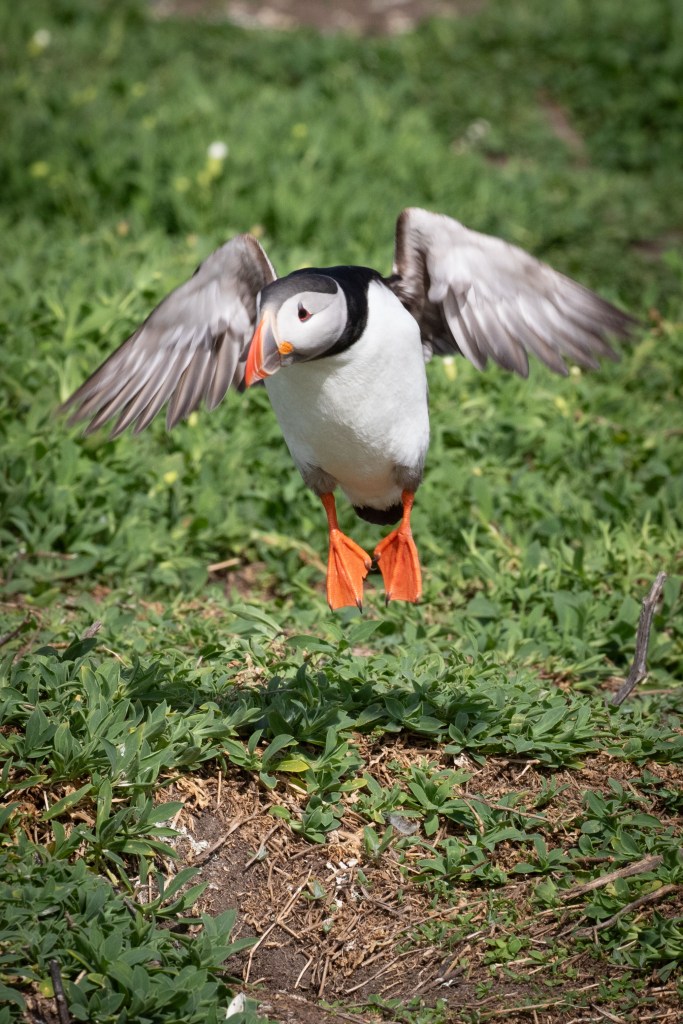
Before we arrived at our destination for the afternoon, we had an exciting stop on the way. Whilst on dry land, as we drove to North Berwick on our route to the coast, we started to get glimpses of a large mound in the distance. Eventually our view across the rolling countryside opened up and we could see the looming mass of Bass Rock. The 100m sheer cliffs stand abruptly in the sea, seemingly more cliff than island. On approaching the vertical sides in the boat, the Rock is a mix of light grey and white, the latter coming from its most famous inhabitants; the gannets belonging the the largest colony in the world. Before last year, ‘The Bass’ hosted more than 150,000 northern gannets but like so many of seabird colonies the population has been hugely hit by avian influenza and gannet numbers have dropped by around quarter in the past couple of years. However, the rock and its gannets still remain an impressive and unforgettable sight, especially as we peered up the looming cliffs from the boat below. There were gannets all around, those on the rock itself, others circling high above or coming into land, and some in and on the water around us. The noise was incredible with the thousands of birds raucous above our heads; pairs greeting each other amongst squabbles over nesting space. After a short stop floating by the gannets, we made our way to our main destination at the end of a 45 minute trip from North Berwick.

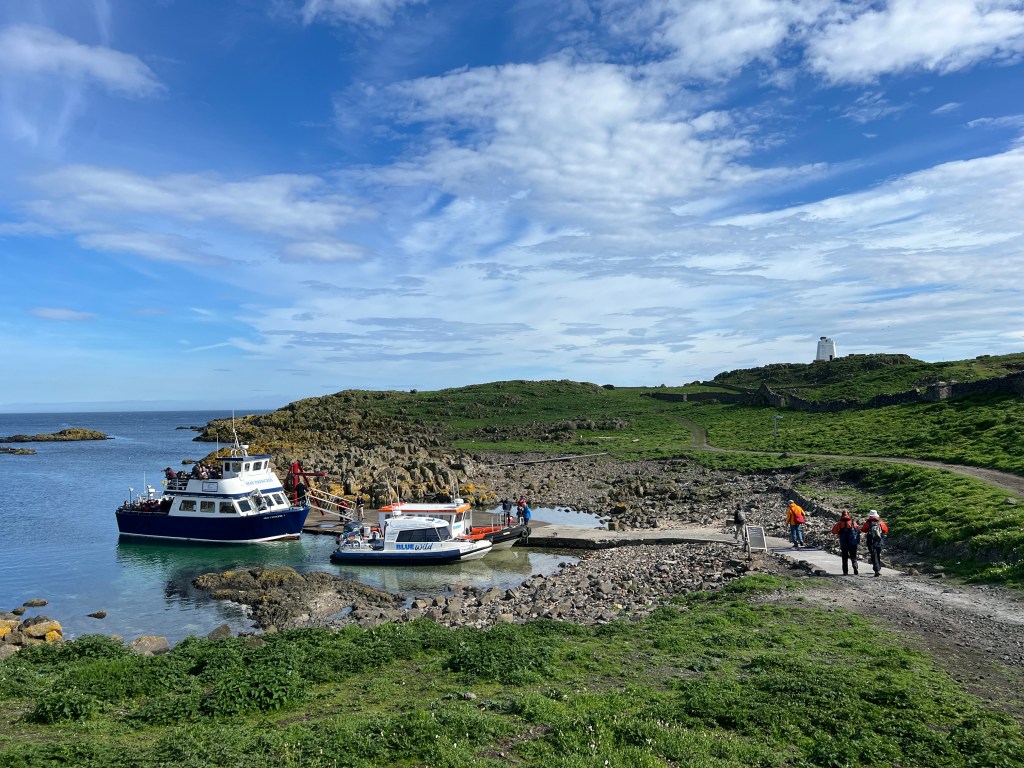
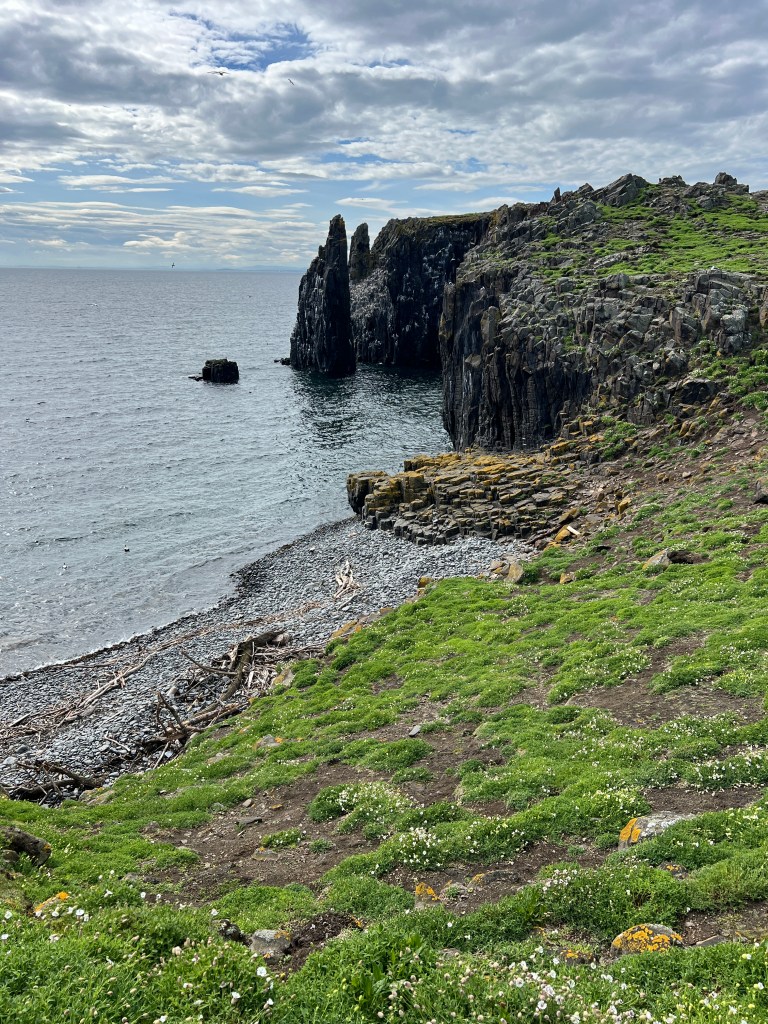
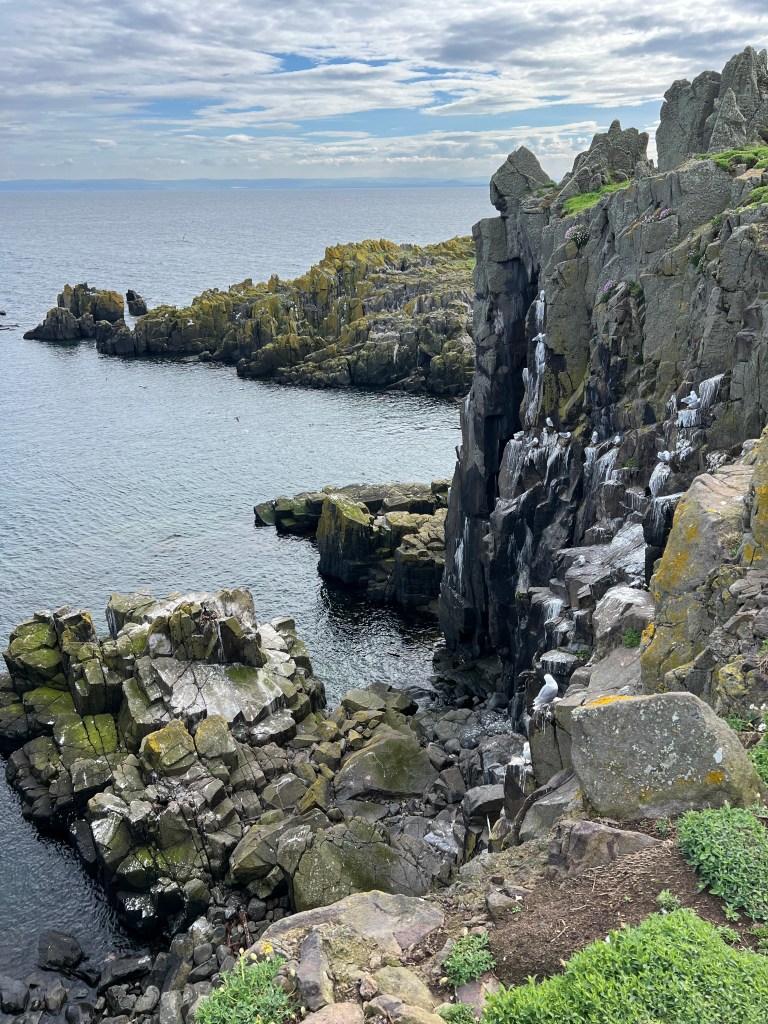
Lying towards the northern side of the Firth of Forth’s opening mouth, from a distance the Isle of May sits low in the water. It is a long, thin island, which is less than 2km in length, with the attached island of Rona, and less than 500m in width, running at an angle from broadly north-west to south-east. The 57 hectares aren’t flat with the land rising from the sea to a height of 50 metres. There are cliffs around much of the coast but the rise is more shallow on the western site from the beach and harbour. The island is a mix of grass on shallow soil, large areas of rock and jumbles of boulders, similar to so many exposed small islands at the edge of the UK.

As we landed, two more boats accompanied us, one of similar size to our RIB as well as a much larger boat carrying around 100 passengers, in all bringing around 120 people to the island for just under three hours. 

We were welcomed by two of the island team, giving us a very brief safety message; keep to the paths, don’t stand on the puffins (or their burrows), keep away from the edge of cliffs and don’t step over the ropes, and, most importantly, don’t forget to return in time for the boat home!

Our trip came with a guide and as we hadn’t been to the Isle of May before we decided to take a trip with him and our other passengers around the paths of the island and up to the large central lighthouse.

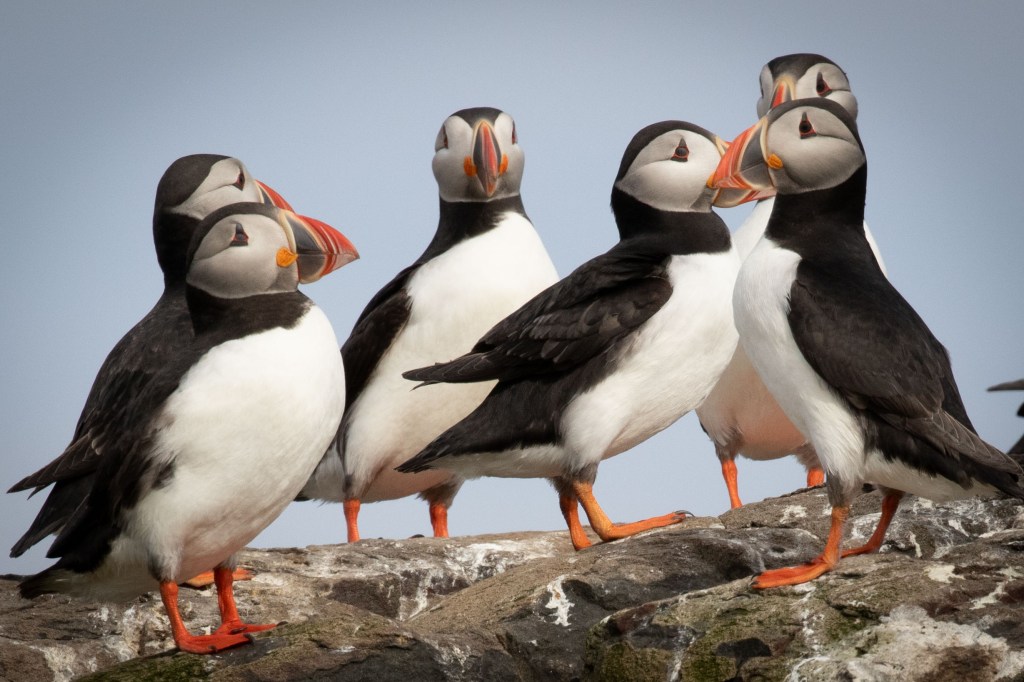
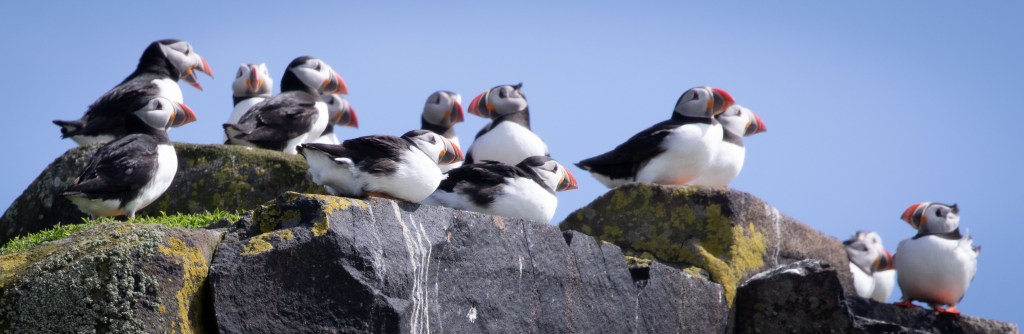
The main reason to visit the Isle of May was for its seabirds and we had a brutal introduction with one of the first sights being a huge great black-backed gull, with blood around its bill, tucking into one of other residents, a puffin. As we moved on we found many of the other inhabitants including other gulls including kittiwakes, razorbills, guillemots, shags and plenty of nesting eiders. Out at the cliffs we had great views of all of the seabirds on their nest sites and they didn’t at all seem bothered by the human onlookers quite close by. 

Like a number of other islands around our coasts, the Isle of May hosts a bird observatory. It was Scotland’s first and is celebrating its 90th birthday in 2024. Particularly during spring and autumn migration they and their fellow observatories record the passage of birds north and south and are some of the best places to seen rarities. We saw the Heligoland traps they use for humanely catching and then ringing the birds but unfortunately it was a quiet day for the migration.

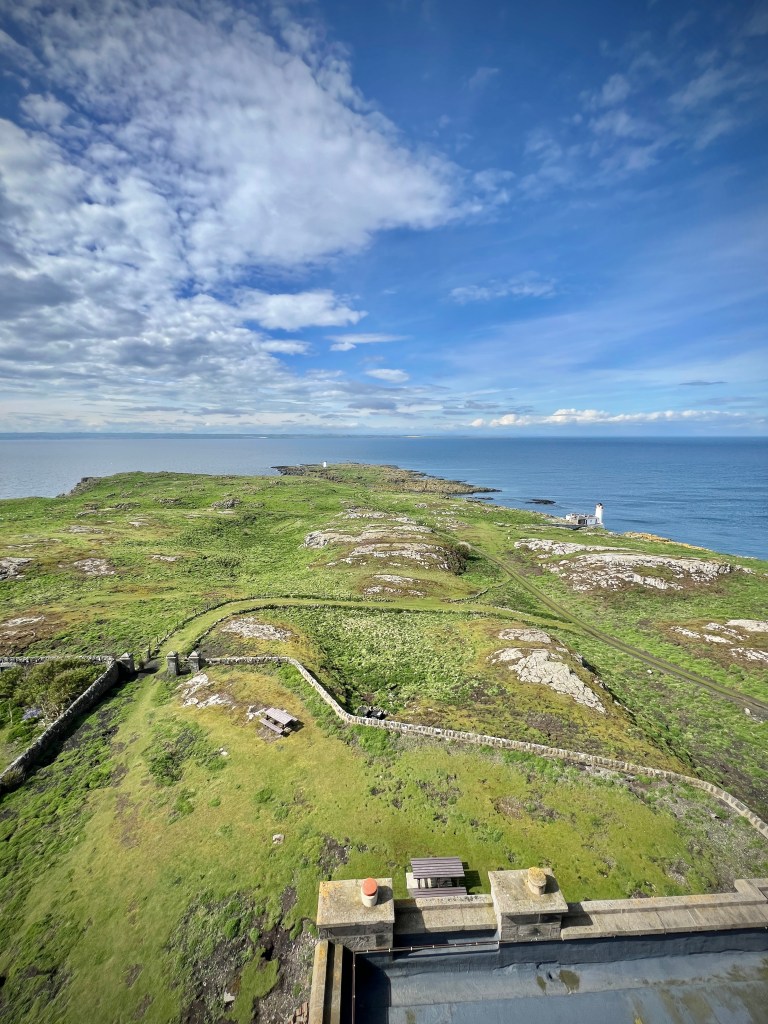
There is interesting human history on the island, surrounding its monastic, royal, military and nautical past. Of most interest to me were its series of lighthouses including the currently operational one sitting centrally. As we finished the guided part of our walk around the island we were allowed up this Robert Stevenson-designed gothic marvel from 1816. It is so different from many of the lighthouses I’ve visited. No slender white cone of a structure but an unpainted stone, almost castle-like block with a square tower upon which the light itself sits. We went all the way to the top of the tower, up several floors via the open spiral staircase and then a steep ladder at the end. From the top, the view over the island and across the Firth was spectacular, a 360 degree vista of the Scottish coast of East Lothian and Fife, towards Edinburgh and out into the North Sea. With the weather so clear and bright, I could have stayed up there for hours.

We concluded our visit with a walk back south and more seabird cliffs with steep drops down to the rocks and sea beneath. There were more puffins, razorbills, guillemots, shags and kittiwakes, and again, very obliging in their general nonchalance towards visitors. 

As always with an island visit, there is never enough time and it was soon the moment to step back onto the RIB for the fast 35 minute trip back to North Berwick. I would very much like to spend more time on the Isle of May and the guide did suggest learning more about the volunteering opportunities with team of conservationists. For me to volunteer there, I would have to give up my Ramsey Island volunteering week, and I not quite sure I ready to do that! However, the Isle of May really does have its attractions; the birds and other wildlife, the lighthouses, the history, the landscape and the views, and I definitely would like to return, and spending a week there would be incredible. I could easily see myself loving the Isle of May as much as I do Ramsey (well, almost, maybe).

Wildlife holidays – a look back on a life-changing first trip

Next month it will be 15 years since I had a holiday that, with no exaggeration, changed the course of my life.

In 2009, I was in my eleventh year of my career and settled into a routine of working long hours and doing far too little with my time away from the office. I had long held an interest in nature but was doing absolutely nothing about it apart from some cycling in the local countryside and occasionally thumbing through the pages of BBC Wildlife Magazine. Essentially, an interest I had held since childhood was a barely burning ember of what could have been a passion. 

However, a spark from the ember had been floating in the air for sometime, wafted by the pages of that magazine, in particular the pages showing adverts for wildlife holidays. Every once in a while I had noticed one of those adverts and had a cursory look at the linked website. On one such visit to those pages I came across a holiday that would eventually catch that spark and ignite it.

From being a child, I always felt a calling of the northern forests – probably after seeing pretty rubbish 1970s American TV movies about families surviving in the wilderness either after a shipwreck or heading out to escape the rat race. After very little Googling, I found the one I remember most, called ‘Sea Gypsies’. There were more including ‘The Wilderness Family’, with the father of the family seemingly always played by Robert Logan. 

The holiday I had noticed was to just such forests, but those of central Sweden and the Bergslagen Forest in particular. It seemed a good trip on which to test whether liked such holidays; it was only a short distance from where some of my family live and, so I could see them while also having a few days in nature.

Having already arrived in Sweden a few days earlier, I was given a lift to the local airport at Västerås where I met the guide and the four other guests, before we headed out for the one hour drive to our venue for the first three of the next four nights. We were staying at the basic but very comfortable hostel-type accommodation of Grimsö Wildlife Research Station, which is part of the Swedish agricultural university. Here, amongst other things, they research the interaction of the country’s wildlife with farming.

That first evening, after we had settled in, we headed out in the minibus to search for European elk (älg in Sweden and Moose in American). The sun was dropping slowly, occasionally blinding us as we headed towards it amongst the roadside forest. It had rained not long before leaving Grimsö and the last of the springtime warmth from the early May sunshine was evaporating the lying water and steaming off the road’s surface with mist forming down at the bottom of the shallow valley meadows. We turned off the quiet main road and onto unmade dirt tracks, slowing down to a crawl as we rounded bends and came across each meadow amongst the thick pine forest. We drew a few blanks at first but eventually, standing at the edge of the trees, we saw two dark shapes emerge and there were two adult elk quietly grazing the long, damp grass. They after a little while sloped off into the forest but we were to come across more as we continued along the tracks, finding 17 in all over a couple of hours. In some ways these creatures were the stars of the trip, not just because they are the ‘kings of the forest’ but because we saw a lot of them. Quite often on such trips you get fleeting glimpses of an animal’s hind quarters as it disappears into dense undergrowth but in this case they were very easy to see feeding at dusk in numerous forest clearings.

Before returning to Grimsö, we stopped the minibus at the base of a walking track and hiked the short distance up to a rocky clearing high above the valleys. It was here that we would have our first attempt at trying to converse with the local wolf packs. With a bit of instruction, we cupped  our hands around mouths and howled out chilly evening air over the hills and forest. After 10 or 20 seconds, we stopped to hear if we had a reply. Unfortunately, there no howls coming back and after another failed attempt, we headed back down to the waiting minibus. We were told that the wolves could have heard us much further away that we could have heard them, so I liked to think that they had indeed called back but just out of earshot.

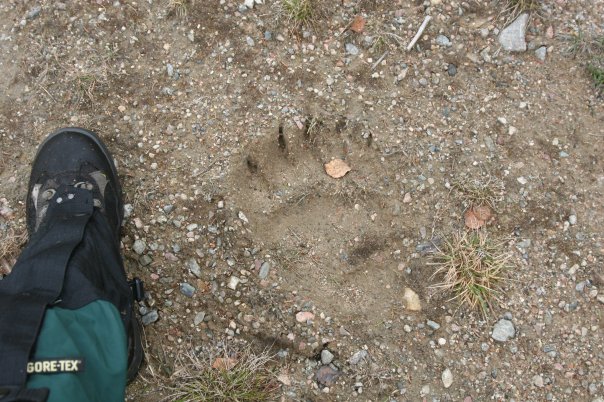
The next morning, after being out late, we had a walk through the forest looking generally for wildlife and experiencing the Swedish wilderness. The evening before was the first time I had ever been in a wolf territory and it stirred something visceral inside me, a true sense of wildness and some trepidation. Even walking in daylight in a group of people, I felt the presence of wolves and a deep feeling of the wild and untamed. Walking across the uneven, moss and rock covered ground amongst the birch and pines, we found wolf prints, scat (droppings) and the very old remains of a wolf-killed elk with only fur remaining. That walk, rather than the attempt at howling the evening before, triggered a yearning to see wolves in the wild that has never left me and it has led to more trips in search of them in several more European countries.

The evening was spent focusing on beavers with a canoe trip on a quiet and slow-moving river. We were picked up by another guide and made our way to a nearby river bank where we unloaded three large Canadian-style canoes and launched them into the river. At dusk we moved off and paddled calming up stream, hearing the slowly quietening birdlife and the rippling of the water against the side of the canoes. Our patience was tested with a long wait and we had seen no sign of the animals by the time we turned back to our launch site. However, almost as we were about to give up hope, we came across a dark lump floating around in the water. A brief glimpse ended with a loud slap of its tail and it dived beneath the water and permanently out of our sight. We returned to minibus with only that short sighting of the beaver and with a little disappointment we headed back to Grimsö for the night. Little did I know that years later, in a lake only a few miles away, I would regularly see both adult and young beavers during annual stays at a family summerhouse in the forest.

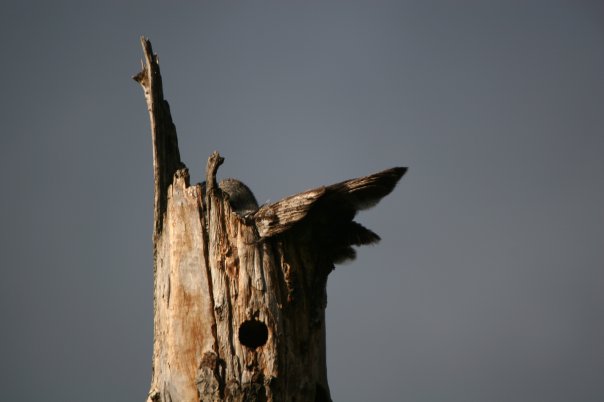
The second full day started with some free time and I took a walk around the area close by the research station. Our guide had heard there was a very special nest that we could possibly go to see and we headed out to find it. After more walking over the uneven forest ground, we came across a tall tree stump with a shattered top. At the very top, at first hard to see, was a nesting great grey owl, sitting very still on a clutch of eggs. It seemed almost oblivious to our presence apart from an occasional glimpse in our direction but we soon reversed away so not to disturb this amazing bird from its nest.

Later that evening we again headed out into the forest in search of wolves in hope of hearing them howl. We had our evening meal out in the open as we sat around a warming campfire, which kept the cooling effects of the damp spring air at bay. As we sat around the first, the tour guide’s small dog walked to the edge of the huddled group and growled out towards the darkness. A shiver shot down my spine; ‘could there be a wolf out there watching us?’ I thought to myself, a sense of both fear and excitement coursing through me. A spotlight was shone out into the surrounding woods, going from point to point, pausing and moving on, trying to pick up movement or the shining retinas of staring eyes but there was nothing looking back at us. 

Afterwards, we had another couple of attempts, at different locations, to howl out into the forest in hope that wolves in the darkness would howl back in return. Unfortunately, it wasn’t to be and we headed back to the research station with perhaps the biggest hope of the trip dashed for a final time.

The last full day started with a long drive north. We may our way to a small lakeside homestead and then out into the surrounding forest. Eventually we arrived at a wooden shelter at the edge of a clearing. Set up with desk chairs, bunk beds and a toilet, we settled in for a long night as we waited for brown bears to appear. We had seen their paw prints on route to the hide but that was the closest we got to them. As it became too dark to see beyond the small viewing slots, we all headed to our bunks and in the morning the view was still empty apart from a cawing raven or two. The ravens called out a range of different sounds, varying significantly over the course of our stay in the hide. We were told that they have distinct calls when a bear is nearby and each time they made a different noise there was a little jump in expectation but each time the hope ebbed away again. We reluctantly and sadly made our way back to the homestead for a very good breakfast, but only after very gingerly opening the door to the hide, just in case the bears were waiting for us behind it.

With another long and uneventful drive back south away from the unseen bears, that was it, my first wildlife trip was over. The only notable moment on the journey was when we were driving along a particularly long and straight road and we saw a car heading towards on the wrong side of the road (for Sweden). It only moved back to the correct side at the last moment and we had slowed down to avoid it. Very kindly, I was dropped off at the home of my Swedish family and said goodbye to the rest of the group as they went onwards to the airport for the flight home.

What had I learned from the trip? Well, it showed me that wildlife holidays can be deeply immersive experiences, spending time in nature with people who know so much about it or, like me, want to learn and share it with others. I also found that you can’t guarantee seeing the wildlife but just being in the places they inhabit can be almost as good, even if you don’t see the species you really want to. I’ve come to value finding the breath of nature in the places I visit, the true experience isn’t always seeing a particular animal but being in locations that have so much wealth in their ecosystems that we simply don’t have in the UK. Overall, that trip really did reignite my love of nature and I returned enthused and energised to actually do something with that passion I had found.

That holiday changed so much. Within 18 months, I’d been on three further wildlife holidays with the same tour company, to the Scottish islands of Islay and Jura that autumn, to Iceland in the following late winter and to Spain, to look for wolves again, the following autumn. The Sweden trip also put the idea of wildlife volunteering into my head and I started to look for local opportunities close to home, although I didn’t do anything about it immediately. However, the idea was firmly planted and it was to become a central part of my life away from work.

In 2011, two years after that first trip, I had no more wildlife holidays planned and work was particularly busy and not very happy. Despite those trips, I hadn’t made any further changes to my life to grow that interest in nature. However, not being happy at work and frustration with my home life led to the biggest decision of my life to that date; to take a year off. 

Over that year, I spent many weekdays and Sundays volunteering locally, nine weeks residential volunteering for the RSPB at three sites across Scotland and Wales, I went on wildlife holidays to Speyside, Norfolk, Mull and Iceland (again) and had 11 weeks in Sweden over course of four visits. This intense period focusing on watching and photographing wildlife, and volunteering, transformed my life after I returned to work, ensuring I was infinitely happier in both my work life and home life.

When I returned to work, I continued to volunteer both locally and more widely; with a local group in Cheshire, with an osprey project in North Wales and on RSPB Ramsey Island, with the latter culminating in a three-month stay in 2019. I also continued to take wildlife holidays including, up to now, another trip to Spain to find wolves (which I did), and others to the Falkland Islands, Finland (successfully finding bears), Botswana (twice), Poland and Zambia plus various self-guided trips in England, to the Inner and Outer Hebrides, and Orkney. 

That trip to Sweden, eventually, via a very winding route, led me to take that second trip to Botswana, to the Kalahari, was where I met my wife, Sarah. So, finally deciding to actually do something about my wildlife interest, rather than occasionally imaging that I should, has changed my life way beyond anything my imagination could have come up with when I was thumbing those pages of the wildlife magazine and glancing at the wildlife holiday adverts.