Looked for wildlife on my train journey to work.

Wildlife included woodpigeon, carrion crow, jackdaw, mute swan, mallard, coot, herring gull, Canada goose, starling and rabbit. I also noticed the hawthorn and elder still in flower.

Looked for wildlife on my train journey to work.
Wildlife included woodpigeon, carrion crow, jackdaw, mute swan, mallard, coot, herring gull, Canada goose, starling and rabbit. I also noticed the hawthorn and elder still in flower.
The Wildlife Trusts are running their 30 Days Wild event again this year. This is a month-long challenge for people to do something during each day of June to bring themselves closer to nature. Over 20,000 people have signed up so far and this year, that includes me.
I’ve got a few ideas on what I’m going to do each day, after all I do wild things quite often, and I’ll be helped somewhat by being on RSPB Ramsey Island for half the month (I don’t quite think that counts as cheating – every little helps!).
For a Sunday, I woke unusually early this morning, so I took advantage of the opportunity and went out to do the first Breeding Bird Survey of the year at Cheshire Wildlife Trust’s Blakenhall Moss reserve.
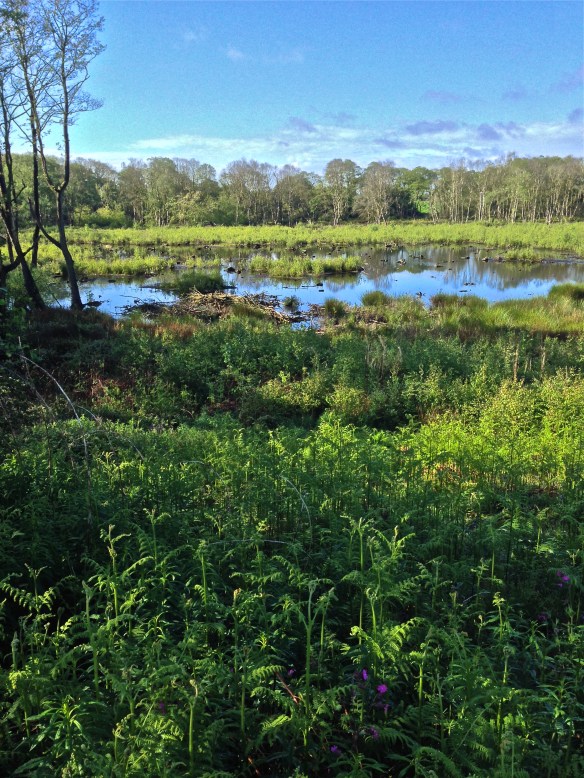
Unlike other Wildlife Trust reserves, including the Bagmere site I also survey, the methodology hasn’t changed for Blakenhall this year, so it was out to do a familiar route, recording the bird species seen and the most ‘breeding-like’ behaviour observed.
The morning was bright and almost cloudless, with a strong sun but not quite as warm as it looked. However, I soon warmed up as the route is a bit of a struggle in places, either wading through water or pushing through undergrowth. The work by Cheshire Wildlife Trust to return the Moss to a raised lowland bog has left the site much wetter (intentionally) and where water isn’t lying, the woodland understory it much thicker than it was. However, it was less tough than I thought it was going to be and after an hour or so I completed the survey and sat for a while on an old tree trunk, taking in the sun and watching the wildlife.


The birdlife was much as I expected, 29 species recorded in all, but there were a couple of new ones for the site, reed bunting and oystercatcher. Overall, that’s 62 species recorded at the reserve since I did the first reserve survey in early 2014. I also saw my first spotted flycatchers of the year, three in all; these are one of my favourite of our summer visitors.
Walking around the Moss, there were signs that spring is moving on; the blue bells have nearly finished and the hawthorn is out in blossom, showing that summer can’t be far away.
Sat in the shelter of the caravan, the rain beats down heavily on the roof. The drops from the overshadowing trees drum the loudest as the wind cascades them off the soaked leaves. The bolt hole rocks as the breeze picks up and the gloom deepens with ever darker clouds moving quickly across the view out of the plastic windows.
Above the noise of the downpour, other sounds break through; the sheep out in the wet meadows, a cuckoo in the distance and a chaffinch on top of the drystone wall. The river is rising, fed by the water running off the hills and mountains, the peak of its flow yet to come and its height uncertain. The screen shows a miserable sight; an osprey sat in a large, slowly swaying nest, protecting two speckled eggs from the shower, rain running off its soggy feathers; a picture of dejection.
The slackening of the rain and then its halting, brings some relief and hope that a flood won’t come. Despite the rain and breeze, it’s not cold; what occasional light shines from between the clouds warms through the windows. As the weather begins to clear, there’s more activity, with swallows and house martins darting across the fields and a woodpecker constantly moving from nest tree to feeders and back again, some eggs have already hatched.
Back inside the caravan, watch is kept, notes are scribbled, a sandwich is eaten, time is marked, the waiting goes on…

Slowly but surely the time for the osprey eggs to hatch is getting closer but there are still many hours of sitting and waiting in the protection caravan or out in the forward hide before there is a first sight of this year’s chicks. There are still many night hours to come, in the dark watching for the movement of an egg collector in the shadows. There are even more daylight hours to come, sitting inside away from the rain, or walking in the growing warmth of sunnier periods. All hours, however, are spent surrounded by nature, its sights, sounds and scents.
I was given two unusually close views of Aran today; first he landed in a tree on the caravan side of the river, a perch much nearer to the caravan than I have ever seen before, and then he flew past even closer with some nesting material a minute or so later.


Apart from the close views, it was a quiet shift today, just as I like them. There was no drama of intruding ospreys or other unwanted visitors, just a day spent in the valley looking at the spring views and listening to nature all around. As my hours came to an end, I wandered down to the bridge over the swollen and faster-moving river; my favourite spot not quite as comfortable as I like it with the strong breeze still present despite the passing of the rain.


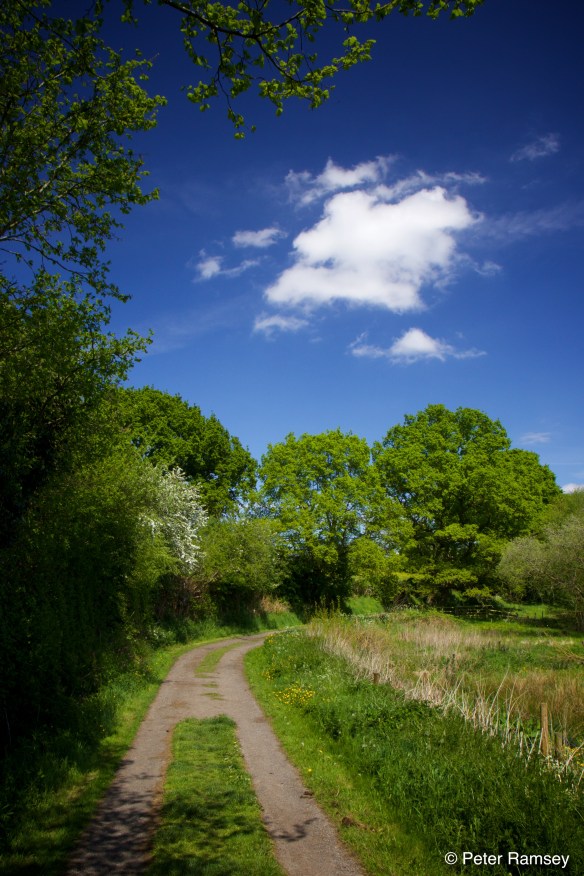
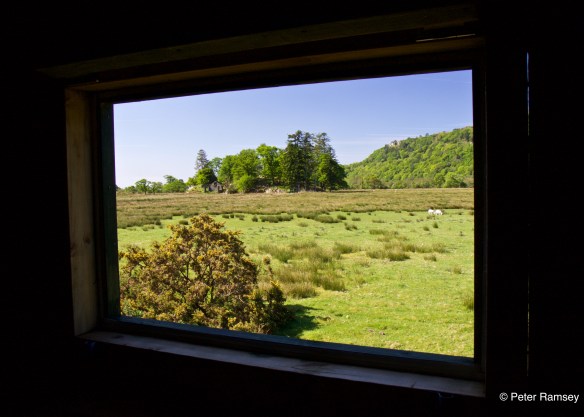
Looking from the darkened shelter, out across the drying wet meadows, there is clear, striking blue above reflected by the softer blue haze beneath the trees. The branches are no longer bare, with an electric green wash having transformed the wooded valley and hillsides. A robin sings softly from the gorse with flowers now fading and a bee bumbles past in search of fresh blooms. The sheep are out on the low clipped grass amongst the taller and thicker stands of dark rush; the lambs quietly graze at the fresh shoots while the ewes lie lazily in the warming sun. A pied wagtail wanders it erratic way along the ditchside while dangly-legged flies hover above. A crow wafts past as the furthest views take on a liquid state in the growing shimmer of the midday heat.
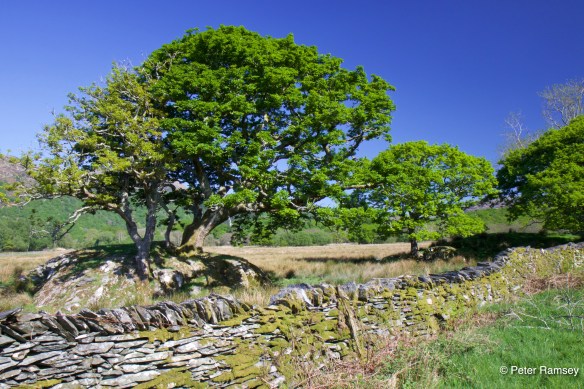
The spring sounds are all around; not the eruption of the dawn chorus but business of the progressing season at the height of the day. Swallows chat quickly as they chase low across the meadowland floor and a blackbird makes a quick passage between bushes in flight from the searching hawk. Through the edge of trees a willow warbler descends its notes and the chaffinch tumbles its song, both supported by a broader orchestra of avian musicians. Percussion is played by the drumming woodpecker while the distant cuckoo calls out through the wood in the wind. A song thrush adds a tunefulness to the setting whilst its mistle cousin rattles on its flight from stand to stand. Above the hill tops ravens cronk their conversational tones and then float down towards the valley and past on the strengthening breeze.
In the distance, contrails mark out the sky as jets head west towards the sea and ocean beyond. A buzzard pair begin to climb on the up rushing thermals, crying out as they make turn after turn, they suddenly stoop together, grappling and parting, to rise back up again.
The buzzards are joined in their effortless ascent by another pair of wings making use of the lift. It stands out larger than the pair and makes shorter, higher pitched cries as it gains height. Further calls come from the small copse out across the fields; calls of protective alarm and maternal concern. Up in the high nest is a clutch speckled eggs, under the gaze of the rising winged intruder, now gliding up towards the sun and disappearing into the dazzling brightness.
I’m not the most emotional of osprey observers but even I let out a few gasps last night watching the antics of Blue 2R on the video stream. I was sure she had stood on an egg while clumsily marching around the nest, open-taloned and occasionally aggressive. When I woke this morning, I had to check the live feed before setting out on my way to my favourite wooded valley. Fortunately things seemed to have calmed down somewhat but Blue 2R was still around when I turned up. Soon after I sat myself down in the forward hide, she lifted up from the nest and ascended high up into the sky and eventually disappearing into the glare of the sun. Aran soon returned with a fish and it was hungrily taken by Mrs G – peace restored but for how long?
I spent the first half of my shift out in the hide; oddly over the past five springs I have spent very little time out there but today I made up for it. Under a near cloudless sky, I sat in silence, listening and watching the scenes of spring unfold in front of me, all in surround sound and the most vivid of colours. This little spot has almost no intrusion from manmade sounds with the exception of the occasional car and passing plane, so it’s a perfect spot to really sink yourself into the sights and sounds of springtime.


I love this time of year, when the colours are at their freshest and the wildlife is most active. The green of the trees is indescribably bright and intense, the freshly emerged leaves yet to be dulled by the sun and weather. The bluebells on route were just as bright and the track to protection is painted more blue than I can remember from previous years.
It wasn’t perfect weather though (I’m so hard to please) as the easterly breeze brought a coolness to the day that deceived the views under the strong sun and clear sky. I should however just be grateful that I didn’t have to write another post of how my journey here started off dry and ended up drenched. If my shift next week is as lovely as this one was, I’ll be very happy!
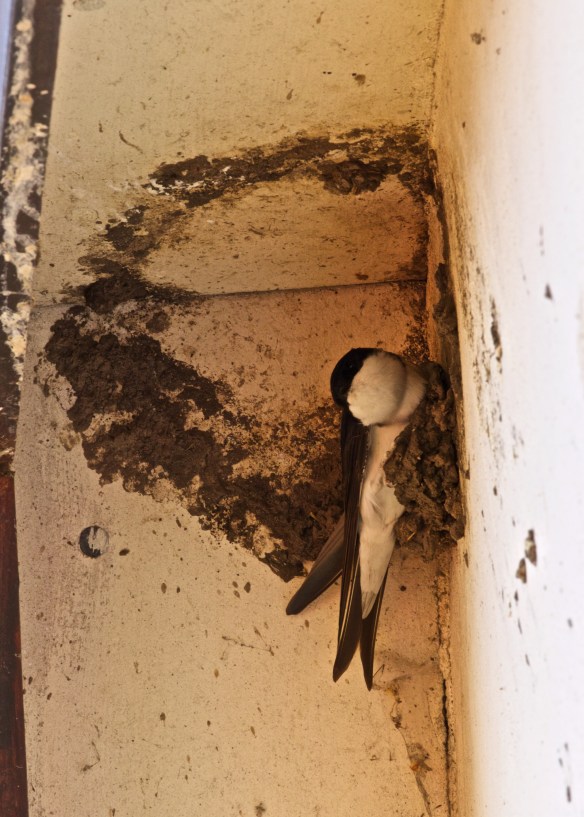
My favourite summer migrants have returned – the swallows, house martins, sand martins and swifts. I’m fortunate that three of these species (not sand martins) breed in the area where I live and I can usually see them flying in the sky above my house. I’m even more fortunate that there’s usually a house martin nest on under my eaves; I say usually but in fact there has been at least one nest for the past 15 summers than I have lived here. I thought the unbroken record was going to come to an end last summer when the house martins failed to return around their usual time. There was no sign of them for most of the spring and summer until I retuned home from work in late August to find droppings on the driveway beneath the nest, which was still up there from the previous year. That seemed very late for a first brood particularly compared to the usual May or June in previous year.
The chicks fledged in late September and it wasn’t clear if this was by accident or design. I worked from home one day and in the afternoon there seemed to be lots of comings and goings from the nest. It was only when I left the house later on that I noticed the nest on the driveway and the fledgelings flying up to the point when it used to cling to the eaves. The next day they were all gone and I didn’t see any more house martins around my home again last year.
Over the years I have sporadically kept a record of when the house martins first arrived back at the nest and most records show it was around mid to late April. When the month changed into May, I started to suspect there would be another late return this year. However, when I was cooking my evening meal yesterday I had a spare moment and popped my head out of the kitchen and popped my head round the corner of my house and looked upwards. Up at the apex of the eaves was the ring of mud, all that remained of the nest, but there was something else up there too. At first it looked like a bit of black plastic blown up there by the wind but after I shaded by eyes from the evening sun, the shape was clearly a house martin and there was another flying around just above the roof.

House martins are ‘amber listed’ in the Birds of Conservation Concern listings and numbers have been in rapid decline. I’m sure that when first moved into my house, another pair nested under next door’s eaves and there were other nests in the area. Now there is mine and very few others. However, the pattern of decline isn’t uniform. Ramsey Island for example (the RSPB reserve where I volunteer for a couple of weeks each year), didn’t have any house martins before a first nest in 2014 and it had eight nests last year (extra emergency artificial nests had to be shipped across!). Something is certainly happening to house martins but fortunately it’s been noticed and hopefully before it’s too late to reverse the overall declines.
Last year I took part in the British Trust for Ornithology’s (BTO) House Martin Nest Survey. I was given an Ordnance Survey grid square, luckily for me the one immediately nest to the one in which I live, and I made several visits to record the number of nests on buildings and the amount of activity. This year there’s another house martin survey for the BTO. The House Martin Nest Study 2016 requires surveyors to choose a nest/nests and record the activity over the course of the spring and summer. The survey can be done with varying levels of detail and I hope to do as much monitoring as I can, doing daily records of activity whenever possible (holidays allowing). Now that house martins have returned to my home, I’m going to have a very convenient nest to monitor!
The chortling house martin chicks wafting in through my landing window on warm summer evenings as I lie in bed really is one of my favourite things about the season and I’m hopeful that it won’t be long until I hear those sounds once again. By doing the survey this year, I hope that I can make a small contribution to helping to ensure this will always be a sound of summer.
This morning was perfect for my first Breeding Bird Survey of the spring for Cheshire Wildlife Trust (CWT). With a milky sun peeping through the cloud, a light breeze and (relatively) warm air, I set out to count the birds at the Trust’s Bagmere reserve.
After two years of doing both Winter Bird Surveys and Breeding Bird Surveys for CWT, there’s a bit of a change this spring. The Trust has been developing an amended methodology, so things are a little delayed this year. Instead of having one transect at Bagmere (and the Blakenhall Moss site that I also survey), it is divided into compartments of different habitats. Bagmere is divided into several grassland, woodland and fenland compartments, in which the birds are recorded separately to show what birdlife the different habitats support. This morning was my first outing with the new methodology and it worked well and clearly showed some differences between the various areas.
As I’ve written before, a bird survey on a spring morning is an idyllic way to spend a bit of time, wandering through the fields and woodlands, listening to the birds singing in their breeding prime. Today was as good a morning as there has been when I’ve done a survey and Bagmere was lovely with the flowers starting to show and the leaves beginning to unfurl on the trees.
All was peaceful…apart from this whitethroat who called out in alarm as I passed on the way out and the way back. He seemed to see me as a great threat and flew from bush to bush berating and scolding me until I was outside of his territory.

I dropped into Whisby Nature Park on the way home from Lincoln today. I last visited when I had a long weekend in the county back in the autumn and one of the local Wildlife Trust’s volunteers told me that nightingales bred there. So after working in the city today I took the opportunity on a warm and sunny afternoon to see if I could find one; I wasn’t disappointed…


