Crewe and Nantwich Circular Walk

As someone with a love of maps and having had a good number of glances over those covering my local area over many years, the Crewe & Nantwich Circular Walk has been in my mind as something to do for quite a while. After completing much of the locally better known Sandstone Trail over the past couple of years, for a bit of quality time with my Dad, and using a guide for other routes in Cheshire, we were looking another set of walks. So finally, we got around to doing our most local of signed routes.

img_1106

Knowing the countryside in the area so well, after cycling around most of it over many years, it was a walk of the familiar in many ways. Yes, it can’t be said that the countryside around Crewe and Nantwich is spectacular in a Peak District kind of way, like the eastern extent of Cheshire, but it does have its own little charms. Whilst most of the walk is within the Cheshire Plain, it can hardly be described as billiard-table flat; it wouldn’t be right to compare it to the Fens of Lincolnshire, Norfolk and Cambridgeshire. The landscape is one of very shallow rolling open countryside, quiet pastureland, hedges and narrow lanes. The walk takes the wanderer through pleasant rural scenes with the occasional village or hamlet, and has its fair share of points of interest.

Well, where do I start? Describing a walk that is. Normally at the beginning would be the answer but this 29 mile circular walk has no obvious start or finish and no guide, that I can find, that suggests one. So, I’m going to say Hough, just to the south of Crewe. The route passes Hough Common, which happens to have a car park, perfect for being dropped off or leaving your at.

We broke the walk into three clockwise sections of very uneven length and did one each in November, December and January. Okay, these maybe aren’t known as the nicest months for a walk but we had good weather in the most part and wrapping up and walking at a reasonable pace keeps the cold away. With the lack of daylight in these months, this walk also leant itself to being split into smaller sections that can be done comfortably in good light.

Setting off from Hough, on a chilly but bright, sunny late autumn morning, we crossed what was to be the most familiar of landscapes – large, hedge-bound, cattle fields and we came across our first cows. The big monochrome milkers took little notice of us as we wandered through the lush, green fields and headed towards Wybunbury. This part of the route is common with a section of the Two Saints Way, a much longer route of 92 miles between Chester and Lichfield. On our route, we kept a look out for snakes, as the sign in the large garden of Hough Hall warned us to, but we managed to remain unstrangled by anacondas and unnibbled by rattlesnakes.

img_0559

My map reading skills aren’t what they used to be, or maybe its my powers of concentration, but as we headed down into the valley below Wybunbury, there was an unplanned diversion via the Church. It’s a nice diversion though, with the Church tower standing alone in its yard at the west of the little village. Back down into the valley, the route passes Wybunbury Moss (of frequent mention on these pages). The bog (three metres of peat floating on top of many more metres of lake), is best avoided but there is a diversion through a permissive path, which presents an additional bit of interest to the walk. Along part of the path, as it joins a vehicle track, the Moss can be seen within the round depression that holds it; the open peatland, with its standing dead trees, has something of the northern wilderness about it.

Heading out of the Wybunbury area, we were back into proper Cheshire pastureland, with wide, open green fields and occasional old oak trees. There’s something missing from most of he Cheshire countryside, woodland, and the route is fairly typical with only the odd little copse amongst the fields. However, after wandering along a few quiet country lanes and crossing the busier, but still relatively quiet roads to Woore and Audlem, the walk passes close to the local Millennium Wood, which is trying redress some of the balance. Shortly afterwards, we crossed the River Weaver for the first time, very much a large brook at this point in its evolution towards a much larger navigable river. On the other side of the water was another type of field which is increasingly typical of the area too; that of muddy bare earth punctuated with the uniform lines of harvested maize stubble. Whilst these fields are usually simple to cross, where the path is clear from months of passing walkers, the next field was less easy. The mud of the recently ploughed field stuck to our boots, adding extra pounds to our weight and making progress a little slower.

Eventually, we came back out onto another quiet country lane, crossed the road to Whitchurch and passed Nantwich Lake. This was where the Two Saints Way left us and headed into Nantwich. This is the closest point of the walk takes to the town centres of either Crewe or Nantwich, which provides a opportunity for the most significant diversion from the route – plenty of pubs, cafes and coffee shops for additional sustenance. However, we headed onwards and up, out of the shallow valley in which the town sits, we crossed the first railway line; which you will see is a common theme of the walk, as you would expect of a route around Crewe, of course. This was the one and only time when we crossed the line at grade rather than passing under or over a bridge; we took particular care. We also came across the first stretch of canal of the journey but for the moment we just crossed it and headed back out into the countryside.

There was a short section of on-road walking and then we turned off and traversed the route through parkland belonging to Dorfold Hall. Much of this land is used for the Nantwich Show each July (including the biggest cheese show in Europe!) but in November, its eerily quiet, despite being so close to the town. On leaving the park setting, we joined the road at Acton, the nice little village, with a fine small church, just to the west of Nantwich. Unfortunately another good watering hole, The Star, has now closed and it’s a while until there are other opportunities for liquid diversions. Out of the village, we wandered downhill and crossed the canal again and headed towards Reaseheath. Before we got there, we had to cross the A51, a busy road, and care needs to be taken, as does the following country lane section. Reaseheath College has small zoo which is open on various days through the year and there are also lambing events that could be called into when passing. However, we went straight past and down the lane towards Poole Hall, a grand old house and more parkland. As we passed the Hall we came across a herd of quite frisky bovines of the beef variety which we had to give a wide berth. They seemed more interested in a couple walking dogs but eventually turned their attention to us but without pressing home their interest too much.

img_0929

A little while onwards we crossed the second railway line, at the interestingly named Aston Juxta Mondrum and further on our route turned from pasture to towpath as we started the long section alongside the Middlewich Branch of the Shropshire Union Canal. This was easy walking with a few interesting spots including the River Weaver passing beneath a surprisingly tall and steep sided aqueduct (surprising that such a tall embankment is needed across what is supposed to be the Cheshire Plain), a marina and a lovely view over the valley close to Church Minshull (which is home to the well-regarded Badger pub if you fancy a liquid divertion off the route).

On leaving the canal behind, the pastureland path returns and there’s a short section on the busy Middlewich Road to be negotiated before passing through a farmyard and back out into the fields. Shortly afterwards it’s worth having a quick look at the moat in a field next to the path close to Minshull Vernon. It’s not possible to leave the path here but the Medieval site can be seen quite well from various spots.

After a few more fields and a country lane and track, we crossed a railway again, this time the West Coast Main Line and, thankfully via a footbridge. On the eastern side of the line, north of Coppenhall, the fields take on the form of west grassland and are almost marsh, with drainage ditches, and plenty of willows and sedge. I never knew this area existed and I wondered whether it would make a good wildlife reserve if the land could be brought together to do so. In fact one of the local landowners had already put up a sign noting that the local wildlife is protected (although I’m not sure just how many snakes and vultures there are in the area!).

After leaving the north of Crewe, we eventually came to an area of lakes, known as the Sandbach Flashes. This is a great area for wildlife and a well known spot for the ornothologically enthused. The Elton Flashes Nature Reserve can be viewed from a permissive path just a short walk up Clay Lane from the route of the Walk.
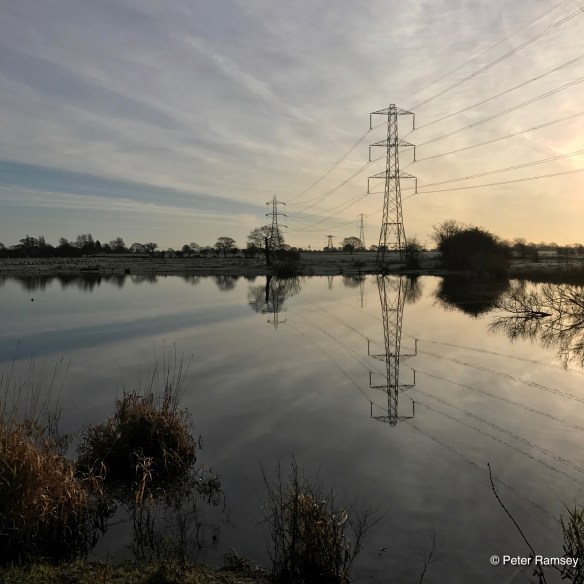
img_0856

Pressing on, the route passes beneath the Crewe to Manchester railway line and then into some very wet fields (or at least they were when we walked through them). It had snowed a few days earlier and there were the last remnants of the skittering lying in sheltered spots but it was the flooding around the stiles that caused a few issues and we made some diversions. However, the fields provided good hiding places for snipe, a few of which flew off as we passed, and there were large groups of gulls gathering in several pastures that lifted on our approach.  These fields also seem to be home to sheep rather than the usual cows which is a little less usual for this part of Cheshire.

More care needs to be taken crossing the Haslington Bypass and we took our time, but once across the road, we headed into Winterley which has another nice small lake which can have some interesting waterfowl – tufted ducks on the day we passed through. It was just after the village that the Walk joined the South Cheshire Way and they continued as one for some time.

After a few more cattle and maize stubble fields, we came across Halslington Hall, a very fine black and white timber-framed house, although the views were difficult and somewhat spoiled by the poor state of the grounds. We then came to Crewe Golf Course straight through which the signed path passes including over the driving range, fairways and greens. We took care not to disturb any games or kick any balls into the rough and the golfists seemed largely oblivious to our presence. On leaving the grounds, the footpath drops down into and crosses the Valley Brook; what could be described as Crewe’s main ‘river’ but it’s hardly the Thames. Shortly afterwards, we needed to negotiate the Crewe to Alsager road, again, care is needed, and then we headed up a country lane and then alongside, and eventually under the penultimate railway line.

This slideshow requires JavaScript.

Soon we crossed over the link road into Crewe at tarmac level and as we walked up the following rise a buzzard was being mobbed by a crow and slowly glided past on the increasingly strong and cold breeze. We then crossed over the Shavington Bypass dual-carriageway but via a nice bridge. Just afterwards we entered Weston, which has a good pub, the White Lion, and the route was joined by the Two Saints Way. We were then on the last leg of the walk, with the final few cow pastures and fields of maize stubble, with only one more railway, the southbound West Coast Main Line, to cross (bridged again). It was only on return to Hough Common that the South Cheshire Way and Crewe & Nantwich Circular Walk went their separate ways, but perhaps this would be a good spot from which to start exploring the former too.

Overall, this is a perfect walk for the winter months, particularly if split into two or three sections. The walking is easy and there’s enough to keep up interest despite the land being relatively flat. It can be muddy and wet in places so frosty days could be ideal and a little care needs to be taken on some of the busier roads.

Splitting the walk made sense for the winter months but I now want to return to do it all in one day. I think is do-able given the easy going of most of the route and hopefully drier, less muddy conditions of spring or summer – maybe on my list of things to do in April once the clocks have gone forward.
The Year as a Shaded Ring

I find there is something slightly melancholy about New Year’s Eve. Saying goodbye to a year, to times not to be lived again. No matter what the year has brought, good, bad or just average, the passing of a year has a sadness about it.

I don’t know if what I’m about to reveal is unusual or many people think along the same lines, but I’m going to say it anyway. I see years, individual years, in my mind’s eye, as a ring of time. A ring is perhaps not quite a perfect description as the ring is squashed so that it almost has sides. It’s also not a ring I could draw as it changes shape depending on whether a point of the year is considered from within that particular time or from within another. The ring isn’t uniform in colour but has shades and subtle hues. As the year draws to a close, the ring is very dark, almost to be black; a work of the dark nights no doubt, but also of a year fulfilled – like a glass of water, the yet-to-be-lived year, becomes increasingly dark as more ink of time is added.

But waking on New Year’s Day, standing within the mass of the ring, there is a blinding white light of renewal; the bright sun is shining straight through the clear water in the glass, not clouded by time yet to be lived. January and February are at the top of the ring but March is on the first real bend which flows down into April and May; these months turning into warmer colours of yellow, with June darker and flowing round a long bend into July. August is the flat bottom of the year and orange and is followed by another month on a bend, September. The autumn months are monochrome but become increasingly darker as they head back up the last side of the ring and turn into December as it reaches the top.

Well, as it’s New Year’s Day, everything is brightly white; well, it would be if it wasn’t grey, miserable and raining outside! But anyway, I need to fill the year and I have plans. I need to continue doing some things: wildlife surveys for Cheshire Wildlife Trust and BTO, species protection shifts (ospreys, and others, possibly), setting fire to trees and I’ve got two weeks on RSPB Ramsey Island in May. There are some things I need to do more of including photography (I’ve got a new camera that needs more use) and I’ve just bought a fitness tracker which is already making be slightly obsessed about burning calories and I need to get even fitter this year – cycling, walking, running and I want to get back into Mountain biking.

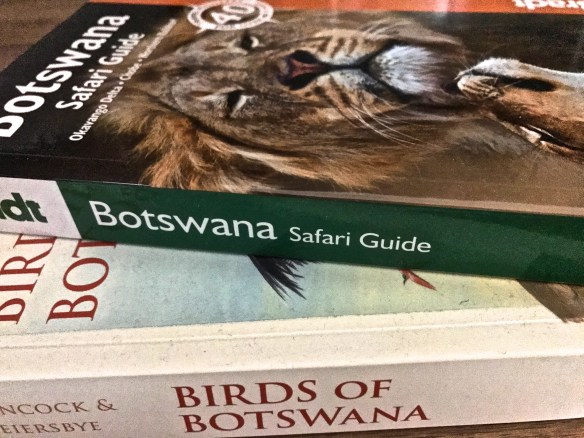
However, I also need to do even more new things and go to new places. Well, I don’t have all these new things planned yet but I have one big one in the diary so far – visiting a new continent; I’ve got a trip to Botswana planned in April. I also want to visit new places closer to home and am planning a week somewhere in Scotland and some long weekends in new places in the English countryside (there’s also a little new thing in the form of my new nephew to meet for the first time!)

And, of course, I’m going to write about all this on the pages of my blog.

Happy New Year!

img_0995-1

A problematic fire

Today, I had another day out with Crewe & Nantwich Conservation Volunteers on a task at Wybunbury Moss.  We continued with the job of removing trees and spent the day cutting down birch saplings and burning them at the edge of open Moss.

img_0619

The task was made more difficult by the problems we had getting the fire started.  We had a good base of old tree trunks and some cardboard boxes to keep the bottom of the fire dry while getting going.  With firelighters, kindling and a bag full of my shopping receipts, the fire started straightaway but we couldn’t get it roaring.  The brash from cutting down the saplings burned far too quickly and left only light ash, so we cut down a couple of medium-sized birch to give the fire some more substantial wood to go at but none of this would catch properly while the fire burned straight through the light brash.  The conditions seemed quite good for a fire – it has stopped raining and there was a light breeze to feed the fire with air – but we couldn’t work out why the fire wouldn’t roar as usual.  It was only when we got stuck into some larger saplings that the mix of brash and thicker trunks, after at least a couple of hours of trying, that the fire started to burn well.  It seems that each autumn we have to re-learn the techniques of building a good fire all over again.

img_0597

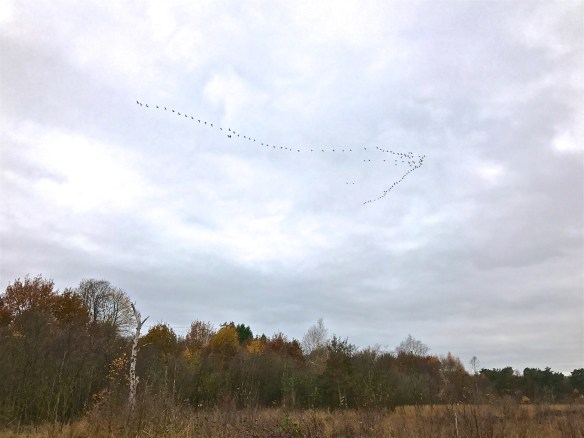
It was quite a gloomy and moody day for most of the task; we still have a month to go to the shortest day but it seemed like we were already there.  However, the day was brightened by two skeins of pink-footed geese flying over the Moss, probably on their way east to Norfolk for the winter.

img_0604


Decaying Buildings

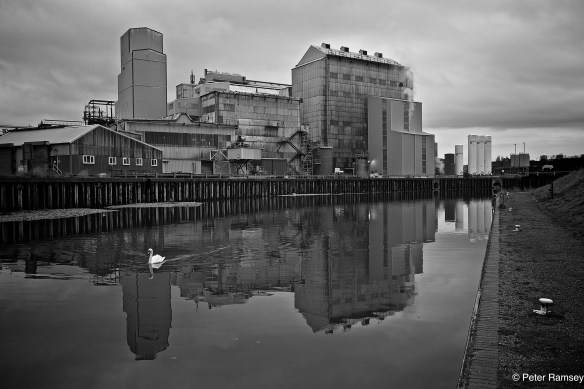
With a spare bit of time this afternoon, I went to take some photos of the Anderton Boat Lift at Northwich. I wasn’t particularly inspired by the Lift itself; the light was pretty poor and flat, and there was no definition to the clouds behind it.  With a fence all the way around the Lift, I also could get close enough to take the photos I wanted.

However, across the water from the Lift was this industrial complex which caught my eye.  I’ve started to have an interest in decaying buildings and the swan floating past made for quite a nice image.  Unfortunately, the idiot in me forgot to charge my camera batteries before I left, so I had a very short trip!

5r0a4768

Back to burning trees!

I spent this morning with Crewe & Nantwich Conservation Volunteers (CNCV) out at Wybunbury Moss doing a task for Natural England.  I missed the last task two weeks ago, and with the early weather looking sparkling, I was keen not to miss another.

img_8663

The group is a frequent visitor to the Moss and we have worked in today’s particular spot a few times over the past couple of years.  We were removing trees to soften the edge where the woodland meets wet pastureland on the outside of the Moss.  The strip that we have cleared so far has transformed over the summer, turning from a big patch of mud to an area of lush reeds and regrowing coppice.  This regrowth of the understorey plants will provide good habitats for breeding birds over the coming years but we will no doubt have to return to the cleared areas every so often to cut it back again.

img_8649

Unfortunately, I could only stay for the morning – I had work to do – but at least I could go out for part of the day and enjoy the first fire of the autumn, it had been a while!

A late summer gathering…

After being off exercise due to an injury, tonight was the first time in a week and a half that I had the chance to go out for a post-work cycle. For the last few days we have been blessed by a the Spanish plume that has brought warmth to a late summer and the air was still well above 20 degrees when I went out.

Part way along my route I came across a busy gathering of swallows lining up on the telegraph wire, waiting to start their autumn migration southbound to Africa.  I tried to get a picture of all of them on the wires but each time a car came along, they all took off.

img_8570

Time Moves On

A subdued atmosphere hangs in the trees as I head down the track today, the sounds of spring have fallen away and the only noises are the thwack of bracken against the wing mirrors and the crack and crunch of twigs under my tyres. There’s a coolness in the breeze coming through the open window and a muffled light, stifled by the thick woodland cover and held back by the patchwork of passing clouds. Out onto the open valley floor, between stone walls and damp meadows, the air becomes warmer but quicker, the breeze increased to windy gusts, chilling in the gloom. The seasons have moved on here, spring prime gone and summer just beginning. The plants have grown to their full height but faded from their bright freshness to darker, fixed tones and early flowers are a distant memory, even some later blooms are starting to fall. The fruits of the dawn chorus are out in the open, young finches, tits and thrushes feed, chase and squabble in the trees and bushes, all under the eye of a waiting hawk. I get a first sight of the other young in the valley, high above the fields in the tall copse. My last visit was spent in wait for eggs to first crack but so much time has passed since then; the chicks are almost in full feather and beginning to flex their wings. It won’t be long until those wings are lifted into the summer air.

5R0A3223

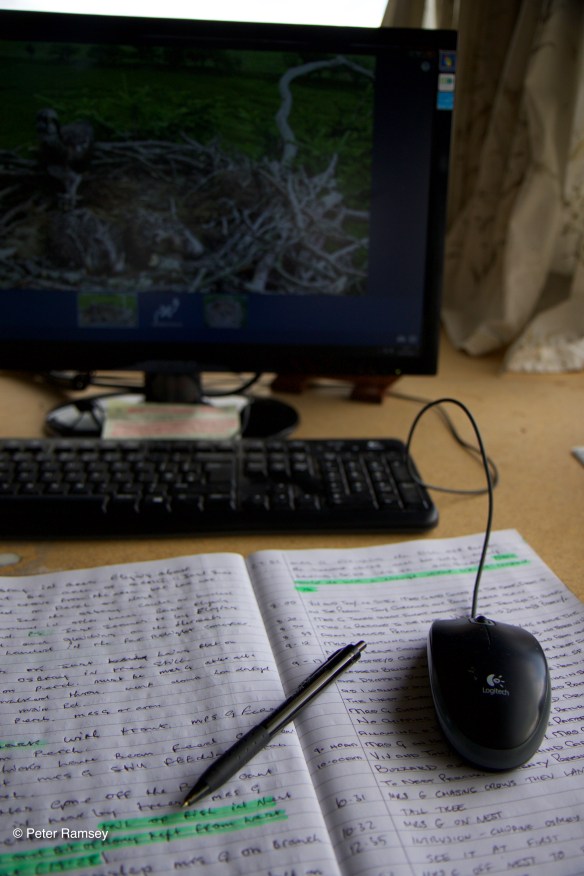
It was a quiet shift today with the chicks resting in the cup of the nest for most of it, with a bit of preening and wing flexing; there was more snuggling than arguing. They are also starting to stand properly on straightened legs, bringing them to their full height, although not yet up to their parents size. Mrs G was either sat on the perch or on the nest much of the time or occasionally chasing crows, and I didn’t see Aran until early afternoon when he returned with a trout. It all got a bit panicky for them mid-afternoon when the farmer came into the field by the nest with his dog to check on the sheep. Both adults took to the air and flew around for a while but she returned to the nest after a short time and he disappeared into the distance; the chicks seemed oblivious. He returned later with what looked like a whole sea trout (could easily be wrong as my fish ID skills are pretty poor). It got quite windy towards the end of my shift; I thought the caravan was going to lift off it’s wheels at one stage!

This slideshow requires JavaScript.

During my shift I had a strong feeling of time moving on; the seasons, the year, the years, and the subdued atmosphere I sensed on my arrival seeped into my thinking. The five weeks since my last shift has brought changes to the valley; the plants have grown, flowers bloomed and fallen, and birds fledged. I’ve missed the early stages of the osprey chicks’ growth since hatching and they don’t seem far from the size of their parents.

I had a sense that the year is moving past at speed. It doesn’t seem long since the Glaslyn training event in the dark days of late winter, spring has been and gone, and summer is already upon us (although no one has told the weather apparently!); it won’t be long until osprey parents and fledglings start their journeys south. The busiest period of my, now usual, conservation year is coming to an end with bird surveys finished, my two weeks on Ramsey Island gone and not many osprey shifts left.

I also had a sense of greater scale of time moving on. I have a significant birthday to mark soon, one I’m not altogether comfortable with but one to mark all the same. It’s strikes me that there’s only so much time in life to make a difference – whether that time be the hours in the week, the weekends in the year, or the years in a life. It’s easy to let time pass unmarked and let life drift and that risks missing chances to make an impact and a difference. It got me thinking about conservation and what contribution I make. I’ve already had my ‘midlife crisis’ moment, an early one if that’s what it was; it was now nearly five years ago when I started 12 months away from work and began my stop/start journey through conservation – including a month, altogether, with Mrs G and 11/98.

In the decades of my life so far, so much of nature has already been lost. What the new generation is beginning with, the environment, the plants, birds, insects and animals, is so diminished from what my generation started with and that in turn was much diminished from previous generations. There is a risk that the new generation may use what they inherit as the benchmark norm, to see that as what nature should be like, as others have done so before. Those benchmarks are lowering with every new generation and mine only has so much more time to lift it back up to a higher point from which our successors can take it on.

What has been lost over that time was put into sharp focus by the State of Nature report in 2013 – a copy of this sobering document can be found here. The report highlighted many frightening trends including that a group of 155 species it had data for, some of the most threatened in the UK, had declined by 77% over the last 40 years with little sign of recovery and that the UK has lost 44 million breeding birds since the late 1960s.

However, over the last five years, I’ve been involved with a range of conservation organisations and projects, some large and some small, some well established and some just starting out. Whilst what we have now is much diminished, these organisations give hope and there are good signs amongst all the bad. When I came into the world, there were barely any ospreys in the whole of the UK and none at all in Wales. Over time this has changed and not only are they thriving in Scotland, there are now growing pockets of populations in England as well as in Wales. The work of the volunteers at Glaslyn and many others like them, have helped to reverse the decline of this species and bring the growth in numbers – there just needs to be many more people making efforts to bring success to other parts of nature.

5R0A3502

Time moves on…no one knows yet what impact recent decisions will have on conservation, with potentially so much to do, what time will be given in government to the environment and nature? What will happen to the existing legislation and policies? With these challenges, of politics, governance and available time, is the chance for this generation to repair the damage of the past slipping away?

There may be opportunities as well as problems but that’s the exciting thing about time, it keeps moving on…and not always in the direction we hope or expect.

5R0A3569