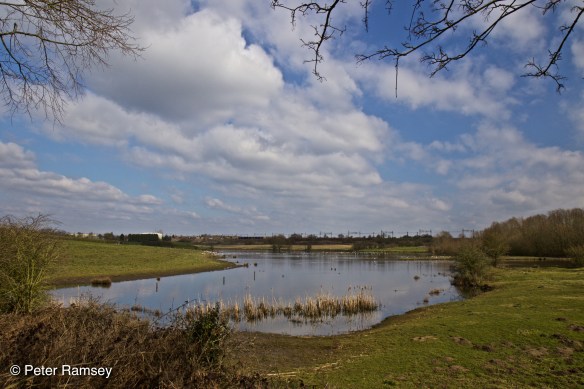
Another day, another song bird…

I dropped into Whisby Nature Park on the way home from Lincoln today.  I last visited when I had a long weekend in the county back in the autumn and one of the local Wildlife Trust’s volunteers told me that nightingales bred there. So after working in the city today I took the opportunity on a warm and sunny afternoon to see if I could find one; I wasn’t disappointed…

5R0A7675 (2)

A warbler hour

With a spare couple of hours, I popped out to a good birdwatching spot not far away – Sandwich Flashes – and it was certainly worth it.  The arrival of summer migrants is in full swing and warblers in particular were of note as I went between several of the pools and lakes.

There were the usual warblers I see (or more normally just hear) including chiff chaff, willow warbler, blackcap and sedge warbler but also a couple of more notable ones.  Below is a shot I took of a Cetti’s warbler. Its loud and distinctive call immediately caught my attention as I stepped out of my car and it flew right in front of me, giving just enough time to get my camera ready and fire off a few shots.

5R0A7553

Even more special though was my first ever sighting of a wood warbler but unfortunately I just couldn’t get my camera trained on it for even a record shot.

Why we protect nests…

The brightness doesn’t look set to remain as I turn onto the quiet Sunday morning roads. The clouds are building in compliance with the forecast, spreading beneath the blue sky, pushed on by the strengthening breeze. In the countryside spring is still battling to win through; after a week of four season confusion, there’s still no sign of the much longed for warmth. The trees and hedges are doing their bit, leaves breaking out and blossom starting to form but the sense that summer may not be far away is dulled and diminished. Turning from main road to country lane, there are signs that work in the fields is bringing forward the time for growth; fields ploughed, muck spread and seeds drilled. The pastures are also starting to build their crop; grass growing stronger and brighter, helped by the rain and occasional sun. The short drive doesn’t give me much time to ponder the scenes I pass but time enough to observe more of the constant changing patterns in the countryside. There’s also time to start considering the purpose of my journey and it’s continued need…

5R0A7535

This morning I was out in the countryside again but this time to do my second shift protecting a nesting pair of peregrine falcons.

As I arrived it was thankfully less chilly than my first shift and there is now a heater to keep the volunteers warm. I also arrived later in the day as I wasn’t on the dawn shift, which would have meant getting up well before 5:00am and the need for even more layers. All was quiet as I took over the watch, with the male stood above the nest and the female, unseen, incubating the eggs below. There was soon activity however, as both falcons took to the air to drive off a buzzard that came far too close to the nest for their comfort. I later saw the buzzard doing its rollercoaster display but much further away from the nest.

This is the first year I’ve volunteered with the peregrine team, after a number of seasons doing shifts protecting the osprey nest at Glaslyn. I’m still volunteering at Glaslyn but thought I would help out somewhere closer to home.

The Glaslyn osprey nest has thankfully so far managed to avoid the fate of many other raptor nests; being raided for its eggs. After so long with no successful attempt to harm the nest, it’s easy to think that the threat isn’t there and doing a Glaslyn protection shift is simply a bit of fun and an opportunity to spend some time close to nature. Any sense of complacency that may have started to creep in has quickly been knocked out of me by volunteering at the peregrine site.

It’s only three weeks since my first shift at the beginning of the ‘protection season’ but already there have been a number of incidents at the peregrine site involving people more than likely trying to take the eggs or destroy the nest. I’ve also learnt of at least one other clutch of peregrine eggs in the area that has already been taken.

Having got used to the relative safety of the Glaslyn nest, it’s quite shocking to know that other nests are under what appears to be constant threat of attack. Raiding raptor nests seems like something from the past; it’s ridiculous that in our ‘modern’ world there are still people who think it is their right to harm wildlife for their own benefit. Whether it be for sporting gratification or protecting sporting interests, satisfying a need to collect rare objects or purely for financial gain through serving a demand for wildlife trade, there are still many people who will act with ill intent towards raptors and their nests.

This shows quite starkly that at Glaslyn we can’t lower our guard and that there are those out there who may wish harm to the nest. Whilst I wouldn’t want to scale the Glaslyn nest tree myself, there are some who would and could. Compared to Glaslyn, the peregrine nest is in a no less awkward, inaccessible or dangerous location to attack yet people appear to regularly try to get to it. Furthermore, whilst the peregrine nest may be targeted by a wide range of interests (egg collectors, falconers, pigeon-racers, etc), the range of interests that threaten the osprey nest isn’t much narrower.

As long as there are people who will prey on raptor nests, there need to be others who are willing to spend time trying to ensure they don’t succeed. Just because no one has successfully targeted the Glaslyn nest to date doesn’t mean there are aren’t people willing to take significant risks to get at it. I’m no longer open to even the slightest sense of complacency.

A sunny start to osprey season

Spring is in full swing as I head out for my first osprey protection shift of the year but as I make may way across the border, the season seems to go into reverse. Into the hills, a familiar story begins to play out, with the cloud growing and blocking out the early brightness, my car beeps as the temperature falls below five degrees. It is not only rain that starts to fall from the sky but sleet, snowflakes thrown in to make my hopes for a nice day fade.

Up onto the top of the moors, hope no longer seems lost as the first few breaks in the gloom start to form and the sun shows its strength as the moisture on the road begins to lift. Steam rises from the tarmac and the car parts the mist which gathers in the hollows. Patches of fog hang over the fields and forestry blocks, drifting across my path on an increasing breeze. As I reach the crest before dropping down into the valleys, the scene opens up below and in the distance is the sea, shimmering blue beneath the strong glare of the newly emerged sun.

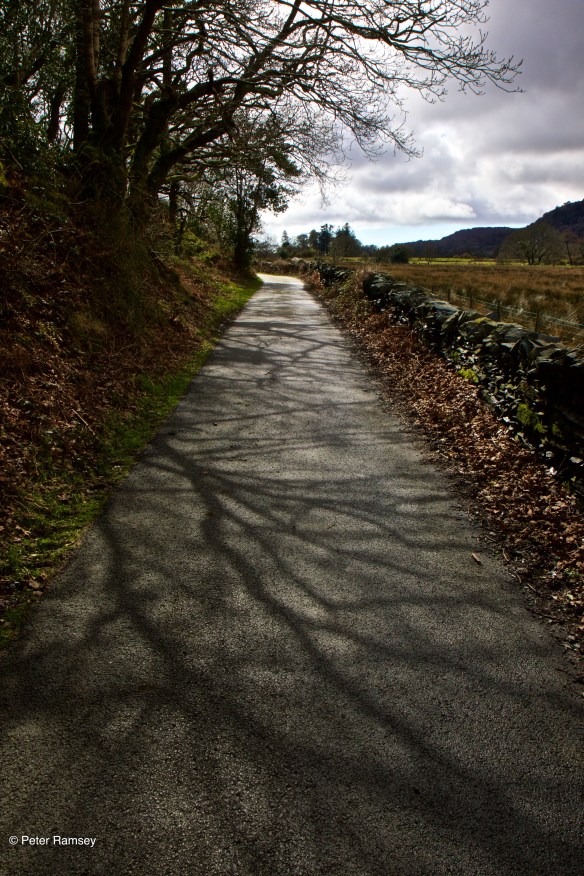
Turning through the gateway, the brightness is unexpected, the clouds diminishing as each moment passes. Driving through the wooded valley, the leafless branches of the enclosing trees cast shadows; I’m driving along a zebra-patterned track.

Leaving the trees behind, emerging out into the flat wet meadowland, little of the cloud remains. The sun falls strongly onto the land but the wind has a sharp chilling edge and the mountains tops have a new coat of white, showing winter, not spring. Here the season is less progressed, the permanent residents may have been singing for a while but the summer migrants are few in numbers and weak in their calls, yet to make this place their own. Those that have arrived seem unsettled, one in particular; she stands alone in the nest at the top of the fir tree copse looking out into the distance, patiently waiting for another to return.
5R0A1699

Writing is a bit of a struggle, the flu that has knocked me for over a fortnight still drags on my energy, both physical and creative. Others don’t seem to have such trouble; buzzards, four or five at a time, were performing their aerobatics, rising into the sky only to stoop into a rapid dive before racing back up high again. At one point in the day, they got too close to the nest and they were chased by the newly arrived female osprey, protecting her claim while waiting for her new partner from last year to make an appearance.

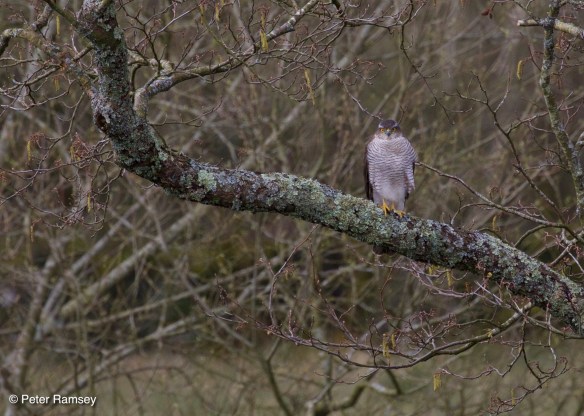
There were plenty of other birds present in the Glaslyn Valley today but few signs of other new arrivals. The great tits, chaffinches, meadow pipits, pied wagtails and robins were all busy going about their days feeding and calling loudly from tree, bush, wall and post. As well as the buzzards, other raptors were about, with a red kite sailing past and a large sparrowhawk staring fiercely at me from a low branch. The corvids were in evidence too with carrion crows and jackdaws feeding in the fields and an occasional raven ‘cronk’ could be heard from the hillsides. The summer migrants though were thinly spread, no hirundines yet and the slightest of hesitant calls from a willow warbler came from a nearby wood.
5R0A1743

The landscape seems a bit further behind here too with only the willows showing leaves so far although there are buds coming on other trees. The gorse is showing its bright yellow flowers but the grass has yet to turn a more vivid shade of green.

Maybe this osprey breeding season will be as melodramatic as the last, with the female having returned but the new male from last year still yet to appear. There’s plenty of time for him to come back though as it wasn’t until the end of last April that we first saw the handsome new partner for ‘Mrs G’. During the day, both before and during my shift, there were several ‘intrusions’ by other ospreys including by Blue 24, one of the usual suspects who has an eye on the Glaslyn nest. No doubt much will happen before my next shift in May.
5R0A1944

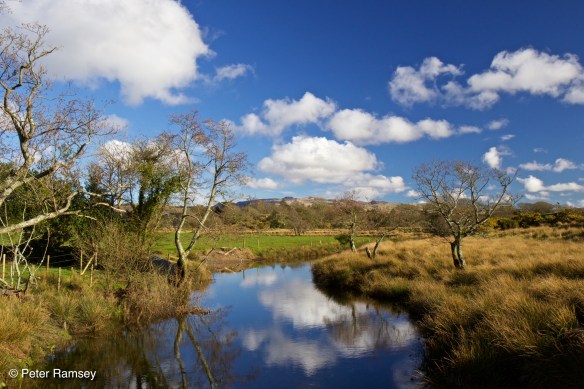
I finished my shift in my favourite spot, sat on the bridge in the sun, listening to a robin and song thrush and watching a peregrine circling high above the woodland – perfect!
A mix of winter and spring at the equinox

After a bit of work this morning, I headed out to make the most of the nice weather and went to one of the local birdwatching spots.  Sandwich Flashes are a series of lakes and wetlands between Crewe and Sandwich, formed by subsidence caused by the solution of underlying salt deposits.  I occasionally pay a visit if I have a spare hour or two on an unplanned Saturday or Sunday and can usually get a good bird list of 40 or more species, depending on the time of year.  It’s usually a focus of more seasoned birdwatchers, birders and twitchers but it’s also good for less persistent observers of birds like me.

5R0A1390

Despite the unexpectedly fine weather with a warm sun out of the cool breeze, the birdlife was as much of winter than of spring.  The waterbirds, such as wigeon and teal, that have stayed over the colder months have yet all to leave and the winter thrushes (redwings and fieldfares, are still about in goof numbers (and I’ve seen good flocks elsewhere too).

However, the calls of the breeding residents are growing stronger and pairing behaviour is becoming more obvious – the roving tit flocks have now broken up and the long-tailed tits are moving around in twos; no longer in the merry bands that pass swiftly and noisily by.  The hedgerows are also showing signs of new life with the hawthorns breaking out into leaf.

The most spring-like of all signs I noticed today were the very tentative and quiet first calls of a chiffchaff; not the full call of the height of spring but a sure sign that the new season is here.

Owl’s That!

It’s been a great start to my wildlife year as I’ve already seen four of the five common UK species of owl in 2016.  For many that may not be such a great achievement but I only saw two species in the whole of last year!

On the second day of the year, I saw both long-eared and short-eared owls up on the Wirral and yesterday, an unusually nice day given recent weather, I saw both barn owl and tawny owl at the Wildfowl and Wetlands Trust’s Martin Mere reserve.  The barn owl siting was particularly good as there were three out in broad daylight, all within the same view.  Barn owls are particularly badly affected by rain so it is likely that they were out making the best use of the first bit of nice weather for a while.

The only other common species of owl left to see this year is the Little Owl and I’m bound to see one or more on Ramsey Island in June; they often sit outside the volunteers’ bungalow in the evenings, meowing like cats.

There is a small population of breeding eagle owls in the UK, either the result of escapes from captivity or immigration from the continent.  I’m very unlikely to see one here but I have had a fleeting glimpse of one in Sweden when it flew across a forest trail in front of the me.

Another positive owl-related development is the recent night-time calling of a tawny somewhere in trees around my house. Over the years I’ve lived here, I’ve very rarely heard owls but for the last few weeks the calls have become a fairly regular nocturnal sound. Hopefully this might be the start of a new territory close to my house. I love to hear the sounds of wildlife while I’m lying in bed – either the calls of owls and foxes through the darkness or the songs of dawn chorus as the light begins to grow.

I wish I had some photos to include in this post but my laptop doesn’t appear to like the images taken on my new camera – need to sort that out!

Mid-winter? The lowest ebb?

It’s been a strange winter so far; well, it’s hardly winter is it? Surely 2015 was just one long autumn with occasional bright day to give hope which was cruelly ripped away again by the now predictable misery of cloud, wind and rain.

IMG_7747

With the first signs of spring appearing over Christmas (I saw flowering brambles and hawthorn coming out in leaf), it seems strange that we haven’t even got to the point in the seasons when the northern hemisphere should be at its lowest ebb. The end of January and early February should be the coldest period of the year but up until very recently the signs have been that the usual lowest ebb might not even happen this time around.

Yesterday morning as I left home, well before even the slightest rumour of light appeared on the horizon, a robin was singing from a nearby hedge and as I left my car at the station a song thrush called out from the darkness. I previously wrote a post about the first time last year that I had heard the birds starting to sing as I left home – the date of that post was well over a month later than the first time I heard the initial notes of the dawn chorus this year.

I’m sure my body clock is still waiting for last summer to happen and I think without a bit of proper winter weather it might go completely out sync with the world.

Maybe the weather over the past year and particularly the recent warm few weeks has been exactly that…weather. Alternatively, it could be that El Niño is having an effect, causing our temperature and rain records to be broken. However, it could also be that global warming is starting to take hold, to some extent, and the exceptionally early blooming of flowers and bursting of leaf buds is something we may need to get used to – we certainly will if predictions come to pass.

If global warming means the weather over the past 12 months is a sign of things to come, I might just have to move to somewhere that still has proper seasons.

I thought that the time birds started singing at dawn was more linked to light levels that weather but perhaps the higher temperatures have kickstarted their territorial behaviour early. But what wider effects will changing climate have on flora and fauna? I’m no expert but there are some obvious implications – habitat loss, changing levels of food availability and shifting of migration patterns.

Take just one species – ospreys (okay, they don’t really do the dawn chorus but humour me!) – what could global warming do to them? They have two habitats to rely on, at either end of their migration. Will rising temperatures mean that their food source changes? Will fish stocks deplete or current species move out and new ones move in? We can only wait and see…and hope.

In just a couple of months the ospreys will begin their journeys north from their wintering grounds. In North Wales there is a group of dedicated volunteers who will once again spend days and nights protecting a nest from egg collectors and showing the public views of the birds from a visitor centre. Their hard work is undertaken in the hope that their efforts will help establish a larger and sustainable population of these birds not just in Wales but across the UK.

However, in the long term, if equal efforts aren’t made by everyone, to reduce their environmental impacts and help to restore what has already been lost, it could be that the work of these volunteers, and thousands like them working elsewhere, is permanently undone by climate change; the work of the few undone by the many.

The biggest threat is the indifference of the many leaving the fight to the few; this is not a fight that the few can win, it can only succeed if fought by the many. Without that effort, it could be that missing the lowest ebb of the seasons this winter is just one of a growing number of signs that the life our environment as a whole will irrecoverably ebb away.

(P.S. In writing this, I am, of course, a hypocrite; I do enjoy those two-hour drives each way for a protection shift!)

Washed-up Starfish

A couple of weeks ago I had a weekend away in Lincolnshire and on one of the days I went for a walk at Gibraltar Point, one of the local Wildlife Trust reserves.  While I was there, walking along the beach, I came across hundreds, perhaps thousands, of washed-up starfish.  It was a sad sight on what was otherwise a beautiful walk along the sands.  It was a typical autumnal day with a keen wind and dark clouds threatening to deliver their load at any moment, the rain held off for a while but eventually soaked me.  Despite getting very wet, it was a lovely way to spend an afternoon.

IMG_7653

When I got home at the end of the weekend, I looked up what could have caused the mass washing-up of the starfish and came across a newspaper article from nearly three years ago – another similar incident not far north up the coast.  I was worried that this might have been caused by man but it appears it was probably just the result of bad weather.

Rain stops play?

I was meant to be out with Crewe & Nantwich Conservation Volunteers today but with a poor weather forecast the task for Cheshire Wildlife Trust was called off. Disappointed I was but cutting back birch saplings and trying to burn them in heavy rain doesn’t sound like too much fun, especially when there is no good shelter on the Bagmere site.

I didn’t let a bad weather forecast force me to spend the day inside, however, and I went on a damp and blustery walk along the Cheshire sandstone ridge.  I’ve been there so many times that I must know most footpaths that cross the series of low hills.

IMG_7575

I set off from the far end of the hills, from the Bickerton Hill car park near Duckington.  I walked up onto the ridge and headed north-eastwards and then down into the village of Bickerton.  I stopped for a moment outside the church to listen to the Remembrance Sunday service but then walked up the road and onto the next hill towards Raw Head.

Across the top of the ridge, there was dampness in the air but no rain, the wind growing in strength and beginning to roar in the trees.  I stopped momentarily at the trig point but then pressed on towards Coppermine Lane and then on to Bulkeley Hill.  On top, low cloud was hanging in the trees giving an ominous feeling to the woodland.

IMG_7589

Coming down off the hill, I walked through the fields to Burwardsley and then down the roads towards Harthill.  The sky started to brighten as I walked around the small hill behind the village, with even a bit of blue sky appearing between the briskly blown clouds.

Behind that small hill I came across a newly built replica Observer Corps watchtower – looking over the Cheshire Plain towards the Wirral and Merseyside.

IMG_7598

After passing through Brown Knowl and making my way up the last hill, the clouds finally started to drop their rain as I neared the car. Nine miles with rain only at the very end wasn’t exactly what had been forecast.

Rain stopped play? Well, somethings are better in the dry but a threat of rain isn’t going to stop me getting outside.

IMG_7582