At this time of year I usually do a review of the previous 12 months and another looking forward to the next 12. I may get around to writing them but I really want to get blogging more and rather than waiting for those longer posts, I thought I would start 2022 with something shorter.
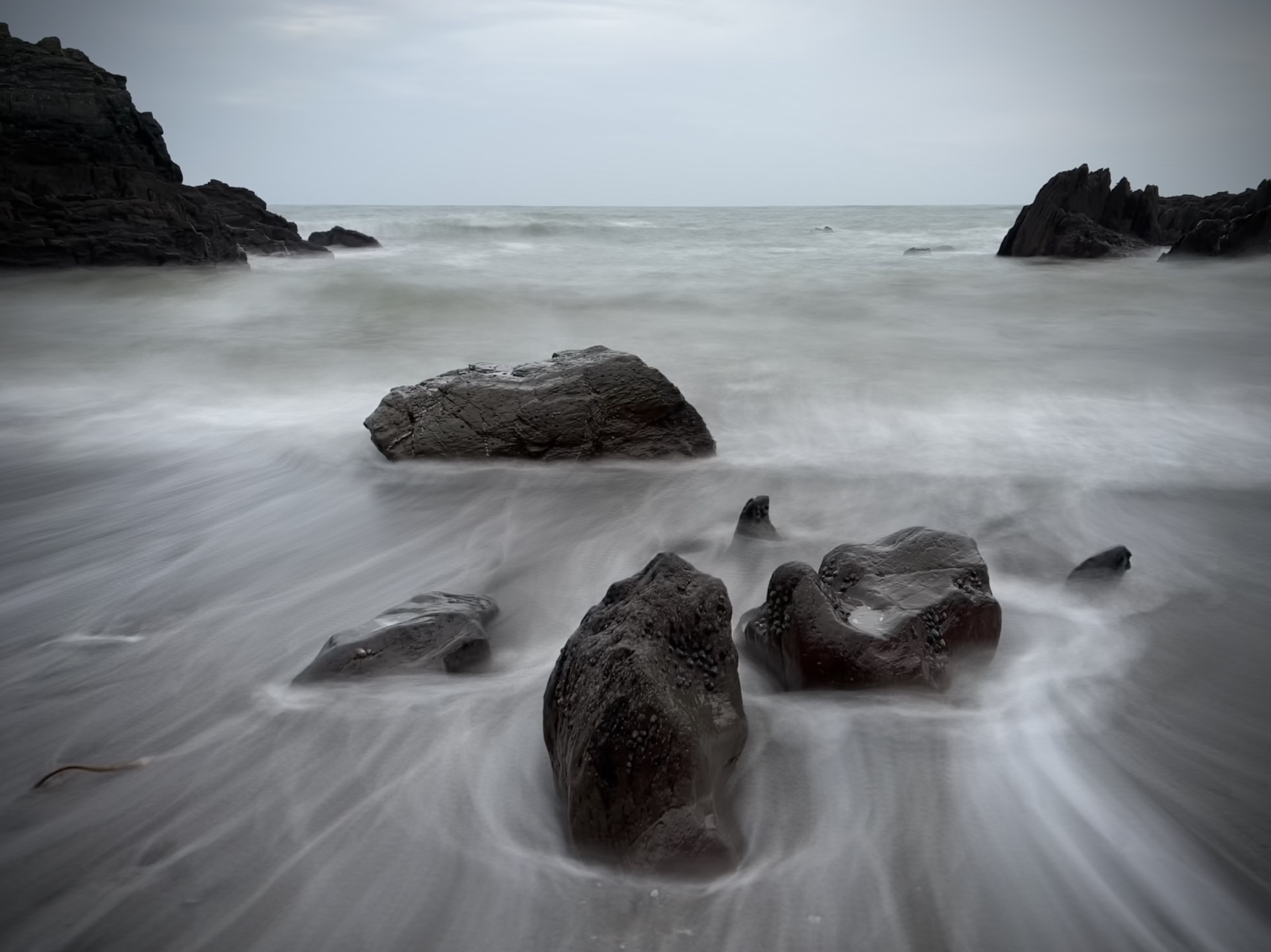
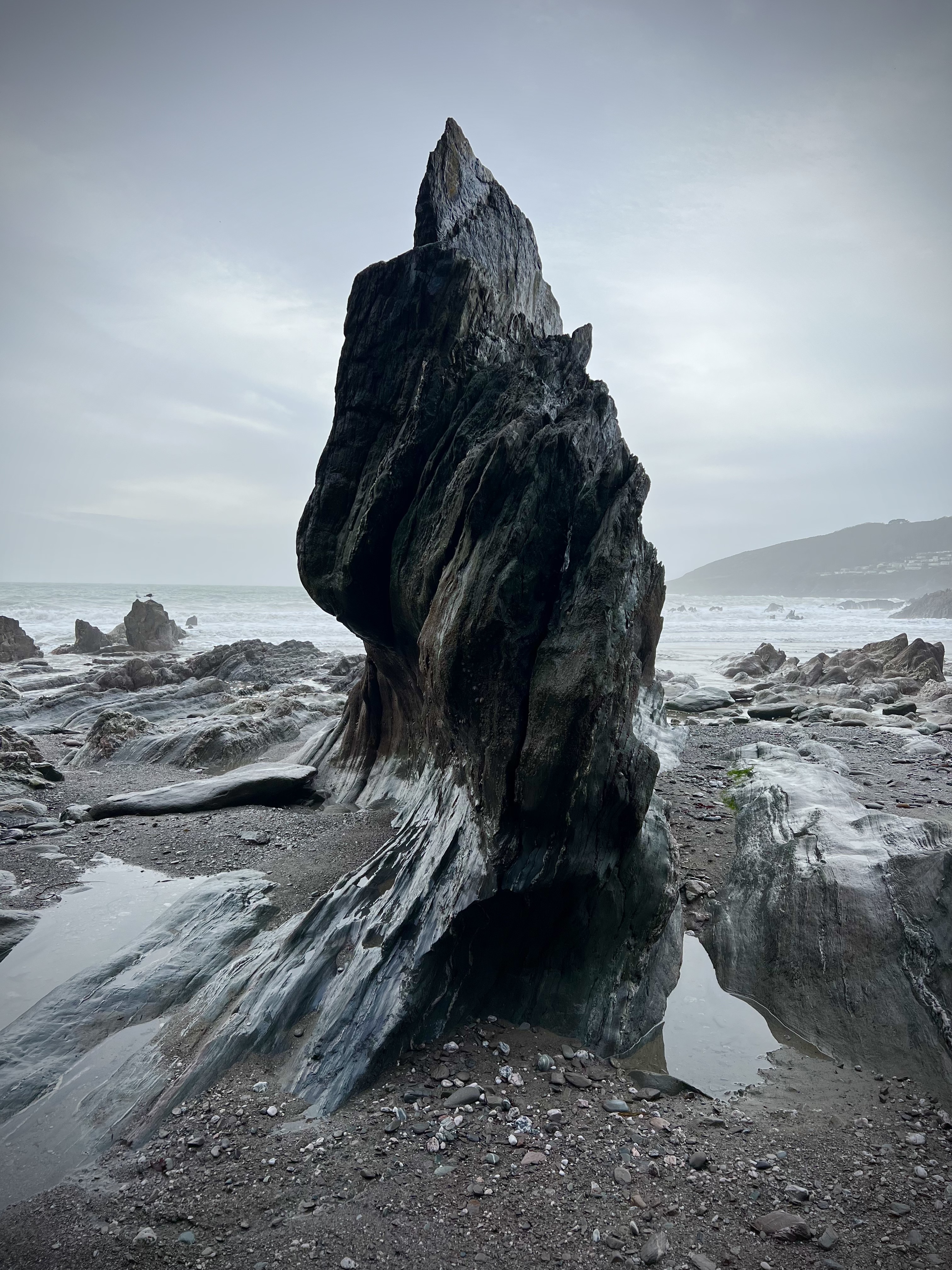
After Christmas as home, we spent New Year with friends renting a couple of cottages on the South Devon coast. We’ve done this before and South Devon was no less lovely, despite not having the best weather. We stayed close to Noss Mayo and just a few metres from the South West Coast Path. Down the hill was Stoke Beach which had some spectacular rock formations and crashing waves racing in with the tide; these photos taken on New Year’s Day…
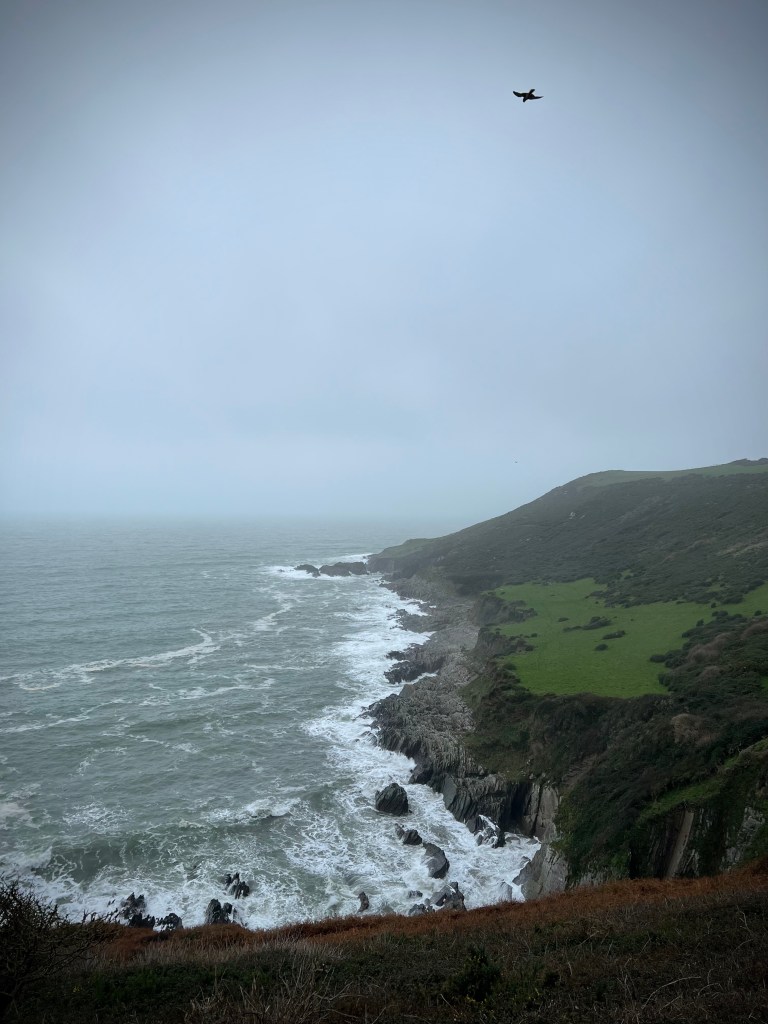
After the walk on the beach, some of us went for a further walk on the Coast Path and while short, it gave me a chance to see some of more wildlife on the first day of the year, adding to the seabirds seen on the beach. In addition to the hovering kestrel in the image below, at Stoke Point we also saw a long sought-after bird for my UK list – Cirl Bunting. They’re very rare in the UK with the only populations being on the coast around where we were staying and a little further down into Cornwall. We didn’t have great views as the flock of birds was mostly feeding in a stubble field and when they were airborne, they weren’t so for long and the light was really poor but a great bird to see in the new year. On the walk we also saw a whinchat, which is the first time I’ve seen one for a few years.
Hopefully, this year will be full of wildlife and the first day won’t be the high mark for the 12 months!
Come the early days of February, we will have lived in our cottage in a quiet Northamptonshire village for a year. So much has happened and so much has changed over the 12 months that I could write about but I want to get back to the basics of my blog; my love of nature and my concern for the natural environment.
As I have written previously, we knew very little of Northamptonshire before we started looking for a new home. I’d only ever passed through the county, racing through by train or car, usually on the West Coast Mainline or along the M1 or A14. It came as a surprise to us when we started looking at the county, having first focused on Warwickshire, just how lovely rural Northamptonshire is.
Our part of the county, particularly, is rolling, steeply in places, with a patchwork of large arable fields for growing grains and smaller pastures primarily for sheep and beef cattle. The fields are bounded by both mixed hedgerows and dry stone walls and the area is criss-crossed by a network of country lanes and relatively quiet more major roads. The west of the county is very lightly wooded for a rural area, with West Northamptonshire having only 5.6% woodland cover, less than some cities, but what it is missing in trees it makes up for with water.
We have a good selection of open water around us with Ravensthorpe, Hollowell, Stanford reservoirs close by and the much larger Pitsford Water a ten minute drive away. There is also the River Nene, which passes through Northampton a few miles to the south of us and makes its way through the county and onto Cambridgeshire, briefly into Lincolnshire, before it meets the North Sea at The Wash. As it meanders through Northamptonshire there are groups of lakes, many being former gravel pits, that have increased the water habitats through a large area of the county.
This wold-like landscape, with its mixed farming and its range of water habitats has had a particular positive effect on me. It holds a range of wildlife, birds, mammals and insect life, that was so often missing from my former home in South Cheshire. It is altogether a richer place in nature terms and in being so has rekindled some hope that rural England doesn’t have to be so nature-depleted, that it can mix farming with wildlife and that man’s impact on the land doesn’t all have to be bad.
I won’t pretend that everything is as it should be in rural Northamptonshire; that would be very far from the truth. Only in the last month have I seen flood water inundating rivers with soil from autumn-ploughed fields, turning them to the colour of fudge. Chalara die-back is taking many of the ash trees which are so widespread around the edges of the county’s fields. I also expect, like so many other places, that the wildlife I am seeing now is in a very much diminished state compared to earlier decades. However, what wildlife I have seen over the last 11 months has been in a positive contrast to where I used to live.
In that time, we have recorded 53 bird species seen in or from the garden and a further five heard. We have also had 11 species of mammal, including six species of bat over the garden, as well as 11 different types of butterfly. I could only dream of such richness in my old garden (although I do still miss the badgers that suddenly started sneaking in under holly hedge in the last few months before I left).
Almost from the moment we moved in to our cottage, the wildlife was evident. From the owls calling during the first night, to a kestrel landing on the telegraph post next to the house the following snowy morning, it was immediately clear that this might be a better place for wildlife.
That owl on the first night wasn’t the last. We hear tawnies almost every night and in the spring we heard little owls nearby and as well as a barn owl once or twice in late winter. During our first drive around the area after we moved in we saw a barn owl in broad daylight sitting on a post and also saw one in an old barn at Hanging Houghton, a place we have come to love for a walk when we have a spare hour or so. This was also the first place we heard skylarks this year and we saw upwards of a dozen at a time on some of our spring and summer walks there. I love to just stand or sit, eyes closed, listening to the skylarks; a perfect way to meditate for a while.
Working from home for so much of the year, wildlife has been a release, during the working day as well as after it. Red kites and buzzards frequently fly over the house and I hear them from my desk. I also often hear green woodpeckers from the same spot yaffling away in the nearby gardens alongside their great spotted cousins hammering on the trees down in the shallow valley beneath us. There’s usually a few birds flitting about in the trees and bushes behind the drystone wall opposite my home office but the best view I had this year was a fleeting one, of a spotted flycatcher perching on the telegraph wire just outside my open window.
Some of the flora has also been notable, particularly in the hedgerows. During the spring there was a procession of blossom over the months with apple and cherry coming first followed by the blackthorn and hawthorn, then the elder and finally the bramble. With such a display of flowers we expected, or rather hoped, for a great glut of berries and we weren’t disappointed. Several autumnal walks resulted in good harvests of sloes, blackberries and elderberries and our hedgerow gin has just been decanted and kicked off a few festive evenings.
My cycles around the local countryside were accompanied in the spring and summer by yellowhammers and whitethroats, as well as more skylarks. In some spots it seemed as though they were in every hedge and tree; a continuous calling as I pedalled along the country lanes. As summer started to fade and the crops were harvested, I got frequent views of groups of red kites feeding on the creatures exposed in the stubble left behind by the combine.
It’s not just our walks that have revealed the richness of nature in the area; there are quite a few nature reserves too and our favourite to date has probably been at Titchmarch. In the eastern half of the county, it is one of those series of lakes on the Nene and our first spring time walk there was lovely with a wide range of warblers calling from the reeds and undergrowth. We also saw a cuckoo for the only time this year, standing in clear view in a stand of poplar calling out over the water.
We have visited a few of the reservoirs and particularly like Pitsford and Ravensthorpe, which are so close by. A walk around the nature reserve half of the former is always very quiet despite the number of bird hides provided. I particularly loved watching the common terns which nest there, a species I never saw in Cheshire. The autumn and winter have revealed a place for thousands of waterfowl of a wide variety. Ravensthorpe on the other hand, whilst also good for ducks and swans, gave us views of hundreds of hirundines hawking over the water as they arrived for the breeding season and we’ve also seen a small starling murmuration over the reed beds and grey wagtails on the dam.
Returning to home, we also have a grey wagtail visiting our often waterlogged patio at the moment and our bird feeders have more visitors than I can remember seeing at any other. We often have a dozen or more goldfinches supported by a cast of greenfinches, chaffinches and a range of tits.
Good numbers of my favourite bird, swifts, appeared around the village in the summer. The Chairman of the parish council not only has his own swift boxes on his house, he’s installed some in the village church tower along with speakers playing recordings of swifts. Often on a spring lunchtime walk around the village I would stare upwards expecting to see them flying above only to (again) realise that it was just the recording. However, one late spring day they were actually chasing around above my head and I stood watching as they raced between the steep roofs of the ironstone houses, my heart lifted by the sight of them. Over the course of the next few weeks we regularly saw them around the village and could lie in the back garden watching them wheel and dart above us.
Perhaps, however, the birds that has most made an impact on us in our new house have been the starlings. They were calling in their slightly crazy way from tree tops and TV aerials around the house when we first arrived in but then they moved in too. We have had three pairs nesting in the eves of the house and we regularly hear them in the morning before we get out of bed and during the rest of the day. When they had chicks, we heard them grow; their calls starting as quiet ‘cheeps’ but developing into raucous screeching to wake us every morning for two weeks running before they fledged. They then had creches in the back garden, the fat balls on the feeders being rapidly devoured each time we put them out. Now we are at the quiet time for them but some are wintering in our roof and we still hear them as they chatter and slide down the sloping section of the eaves.
Despite all the above, the view that pleased me most was a very recent one. As we headed down the hill for our usual walk at Hanging Houghton, we saw four roe deer feeding quietly in one of the fields. We stopped the car and watched them for a moment and they looked back at us. I never saw free-roaming deer in Cheshire in the 40 years I lived there, but these roe add to the muntjac we have seen on several occasions at various places in the county. I love seeing deer, they remind me of wllder places, particularly of my trips to Sweden where they are so often seen in forest glades at dawn or dusk, and seeing them in my new home county really lifted my spirits on an otherwise gloomy day.
I’m sure we have only just touched the surface of Northamptonshire’s wildlife and I can’t wait for the new year to start and to see what else we can find out about nature in this quiet and so little known county. If we find even more, this place will make that hope for a better future for nature in our rural places even stronger.
With Christmas upon us, it now feels an age since our summer trip to the Outer Hebrides but the memories remain vivid. Our week staying in a croft cottage on South Uist was spectacular in so many ways and deserved a much quicker blog post but such tasks have been on a back burner this year. Finally, I’ve written the post and, hopefully, the coming year will have many more.
We travelled up to South Uist via a night in Fort William and the CalMac ferry from Mallaig to Lochboisedale. Our cottage was only a 15 minute drive from the ferry, located in the very far south-west of the island; much further south and you meet the causeway across to Eriskay, from where you can catch the ferry to Barra.
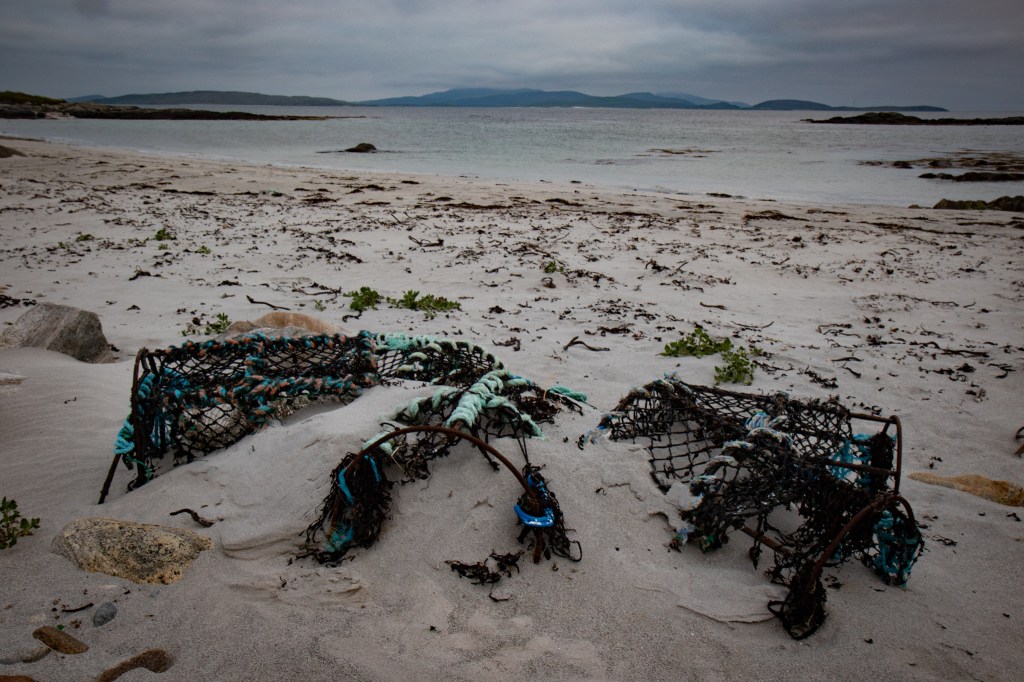
The village where we stayed, Smercleit, like many settlements in the Outer Hebrides, is formed of single homes or small collections of houses, spread over a wide area, rather than more clearly defined villages on the mainland. Our cottage stood alone down a gravel track, set back from two road-front houses and the beach beyond them. It stood on a small island above the surrounding wet pasture, which was dissected by drainage channels and punctuated by small lochans and the remains of old crofts. Looking behind the cottage, the land eventually started to rise into the southern hills between Lochboisdale and Eriskay. They are not high, only 243m at the most and tiny compared to those further up the island; the highest being Beinn Mhor, standing a 620m. Out to the front, looking south west, was the Atlantic Ocean, but with a glancing view of Barra too.
The wildlife of the rich, wet pastureland around the cottage was almost immediately visible. That first evening there was a short-eared owl patrolling in front and around the house and snipe ‘chipping’ in the long grass and ‘drumming’ overhead. Drumming snipe are one of my favourite wildlife sights – the sound not unlike a comb kazoo as the bird drops quickly through the air vibrating its wing feathers. There were other birds too, easily seen with a walk along the quiet road behind the beach front; plenty of starlings, lapwing, redshank, swallows and the ever watchful and noisy oystercatchers.
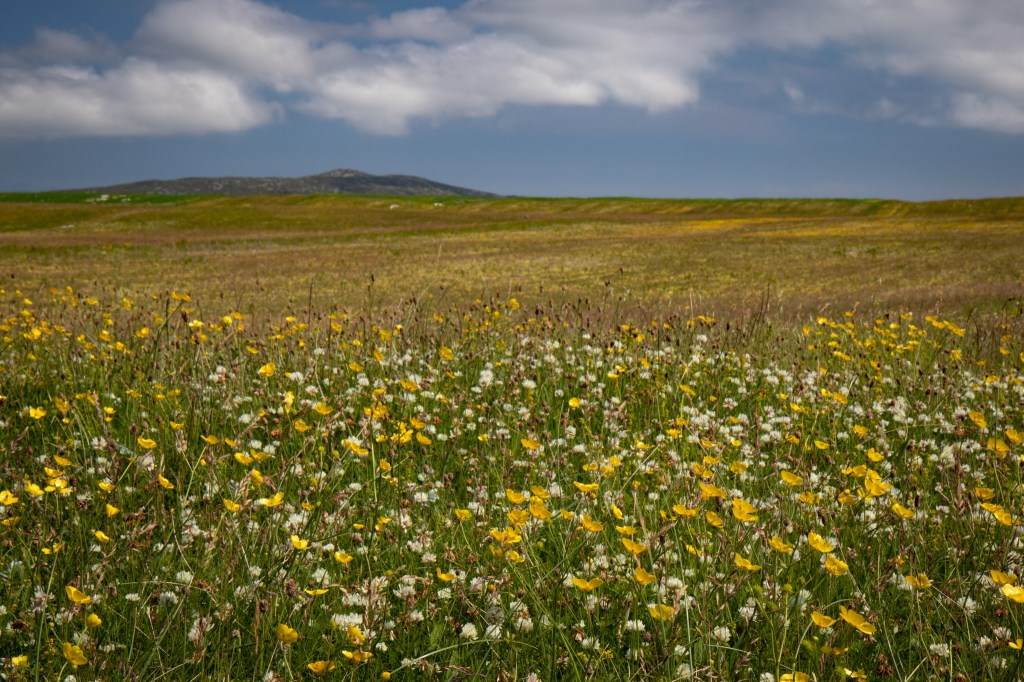
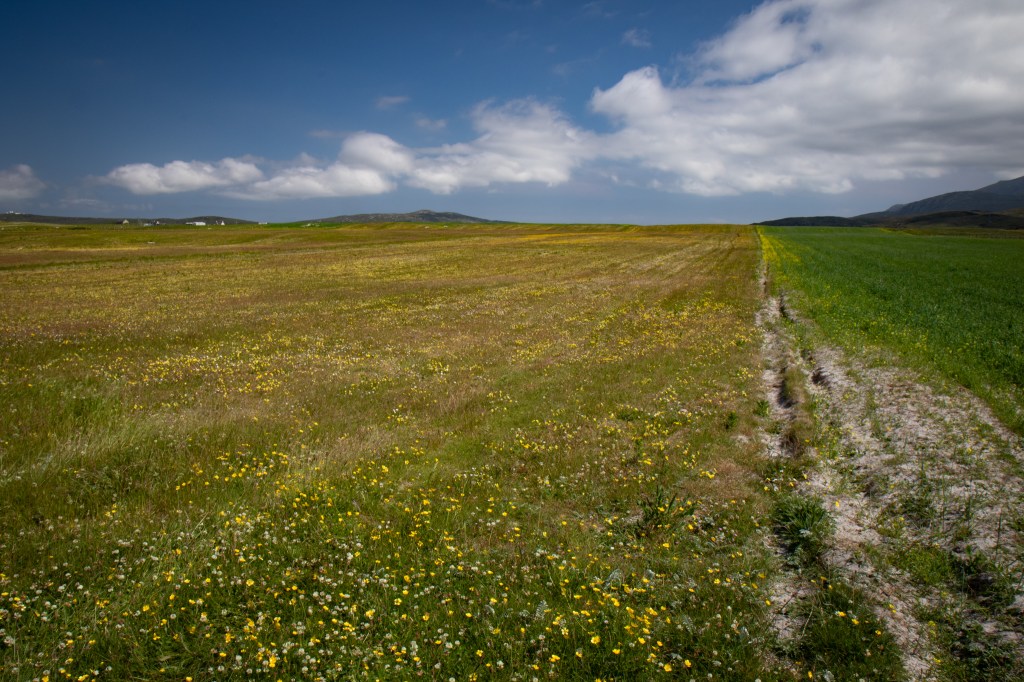
There’s one word that it synonymous with the Outer Hebrides at this time of year: machair. The low-lying sandy and rich coastal pasturelands are at their best in June and July with the scent of their flowers drifting across most of the islands. Away from the damp pasture, the machair coats vast areas on the west coast of the islands with the flowers spreading from the sea to the bottom of the eastern hills and mountains in some places. The lanes that run at right angles from the central spine road towards the sea put you right into the middle of the scenes with sandy tracks then leading off through the flowers. I’ve visited the islands a few times before but always at the wrong time of year for this seasonal spectacular – this time, at the end of June and beginning of July, we hit the perfect moment for the flowers to be at their peak.
However, the Uists do not just have flowers out on the Machair; the harsher moorland areas were surprisingly rich in flora too. A walk around the national reserve Loch Druidibeag revealed great numbers of orchids, the scale of which I’ve seen nowhere else.
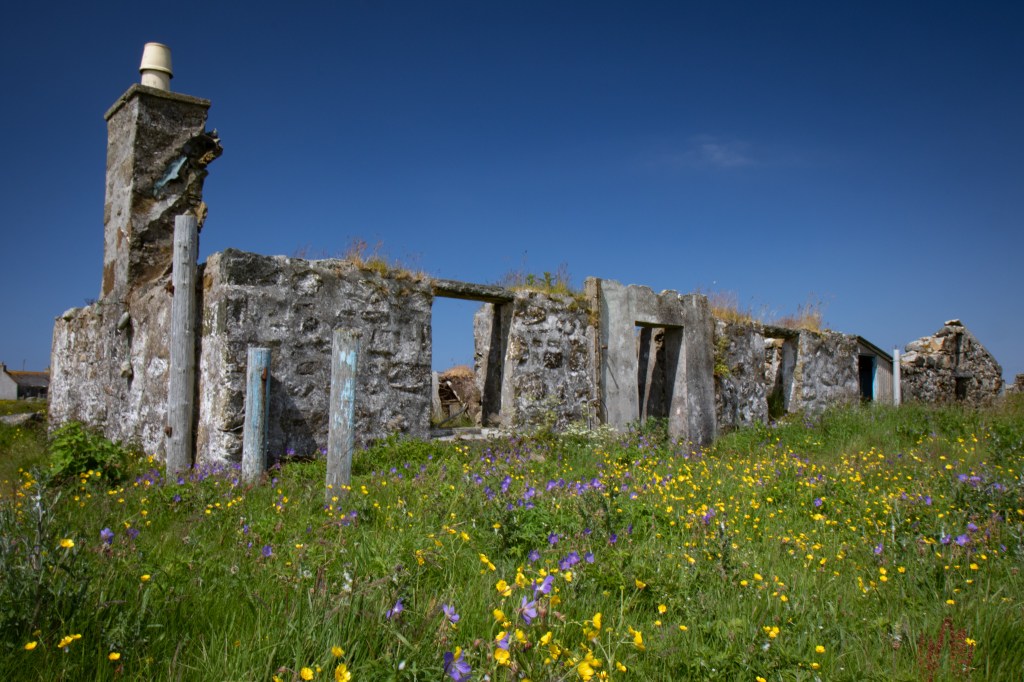
Like so many remote islands, the landscape is dotted with abandoned houses and farmsteads and in the case of the Uists, abandoned vehicles left to decay on the machair. I often feel drawn by the human signs being taken over by nature and disappearing into the landscape and these islands are full of such sights. Some of the abandonment is very old but even with relatively new vehicles left out in the fields, nature hasn’t taken long to take control, with a few becoming homes to small flocks of starlings.
As with most of my trips, watching wildlife was a big part of the experience. Many of the birds we saw may have left the area now, replaced by winter visitors or others passing through on their autumn migration from the high north.
There was one particular summer visitor to the islands I’ve wanted to see for many years but they can be particularly challenging. Gone from the vast majority of their former range, populations of concrakes hang on in some of the Scottish islands and the Uists are a particularly good place to find them. We were driving down a single track road one sunny lunchtime when we saw partridge-like birds walking along the road. We immediately knew what they were and as we came to a halt, they jumped into the long road-side grass. However, they didn’t go far and were quite obliging in providing us with very close views from within the car. We eventually got out but they slinked off further into the long grass, not to be seen again.
That wasn’t the last time happened upon them. We didn’t see them again but we heard them several times at the RSPB’s Balnarald reserve and while out walking along an area of Machair – the video below recorded their instantly recognisable call.
We saw 75 species of bird over the course of the week with plenty of species of note. We particularly went to see those species of the remote areas of Scotland; those of the moorland, the lochs and the sea. There were red-throated divers, eiders, Manx shearwaters and storm petrels, there were white-tailed eagles, hen harriers and peregrines, dunlin, common sandpipers and curlew, and there were arctic and little terns, and great and arctic skuas, and twite and wheatears. All in all, a great range of birdlife amongst quite spectacular scenery.
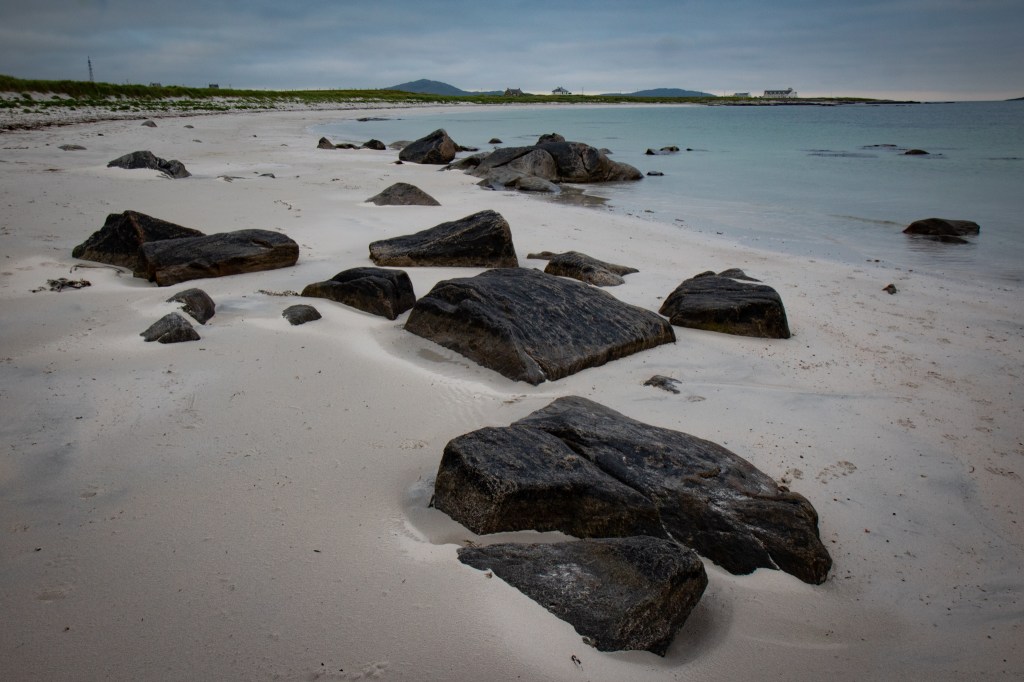
Perhaps the most spectacular of all the scenery is down on the coastline. The Uists are home to some of the most fabulous beaches in the UK and, for the most part, even in summer, you may find you have vast areas of sand to yourself. We were very lucky on the days we went for beach walks in that the sun shone strongly with very little breeze, giving fairly balmy weather for the Outer Hebrides.
The Uists, North Uist and South Uist with Benbecula in the middle, are 54 miles, or just under 1.5 hours to drive north to south. Staying at the very bottom of the islands, it was a long drive to the top each time we went and I’d perhaps suggest it’s better to stay in the north of South Uist or the south of North Uist, to provide better access to the islands as a whole. For me, Benbecula perhaps has less to offer in wildlife and scenery terms but it well worth a look around and certainly shouldn’t just be pass through on route between the Uists. In fact the causeways that join the three islands together are good places to see wildlife from, although our otter targets never appeared when we were looking.
Overall, if you like remote islands with few other people around, beaches to yourself and scenery and wildlife to linger long in the mind, the Uists need to be on your holiday list.
I’m so far behind my blogging at the moment that I’m writing a post about a previous holiday when actually on the next one. This current trip follows on from so many now to the west coast of Scotland; a place I’ve grown to love for its remote and stunningly beautiful islands. Sat inside sheltering from wet and blustery autumn day on the Isle of Skye, it’s seems hard to write about a summer’s day back at the beginning of July – although that day did have a hint of autumn about it, come to think about it.
Staying on the Outer Hebridean island of South Uist for a week, we wanted to take a boat trip to an even more remote island. There are a few to choose from including St Kilda but we decided instead to go to Mingulay at the southern tip of the archipelago (only Berneray is further south).
First we had to make a 40 minute ferry journey between Eriskay (joined to South Uist by a causeway) and Barra. Usually this crossing of the Sound of Barra would have provided great views of the islands but due to COVID-19 restrictions passengers had to stay within their cars for the entire trip. Not that walking around the ferry would actually have given us much of a view, however, as the clouds on this summer day were shrouding the ferry and the surrounding sea and land.
On arrival on Barra, we drove one half if the road that loops around the island and arrived in the main town of Castlebay still cloaked in cloud. This didn’t look promising for our trip but as we waited at the small marina the cloud started to lift a little; the gloom remained but it didn’t obscure every view.
We were welcomed aboard ‘Spirit of the Hebrides’ by the Hebridean Sea Tours crew for 30 minute from Barra to Mingulay. The boat was comfortable and stable as it powered across the open sea, helped by the good conditions. The water was almost bubbling with birdlife all the way to the island with auks, cormorants and gulls flying in groups or fishing alone on the surface. There were lines of gannets too, skimming low over the sea and we had a glimpse of a possible albatross tagging on to the back of one of those groups.
As we neared the island, we entered Mingulay Bay and moved slowly over towards the rocks on the northern tip of the beach. Anchored to the seabed, the boat sat still as the crew unloaded an inflatable at the back and half the passengers disembarked and were taken across to the shore, making the sometimes nervy step onto rocky land. We immediately headed up the grassy slopes above our landing place to seek out the puffins. Once halfway up the hillside we sat and waited for them to come in to land. They almost immediately started to appear but flew onwards, both above and below us, and sometimes straight past our heads. It took a while for them to get confident to land with people close by but eventually they were popping into and out of their burrows all around us.
After a while, we decided to take a wander down to the beach and up to the abandoned village. The island has no resident population after the final permanent inhabitants left in 1912. The island was not cleared like so many old communities around the Highlands and Islands; this was a much later and voluntary, if to some reluctant evacuation, when the last remaining families decided that a better and easier living could be made elsewhere. Mingulay was a tough place to live and as numbers dwindled the living became even harder. Other nearby islands had natural harbours and landings from which to load and unload boats; Mingulay does not and could be cut off for months at a time.
I find the old abandoned islands and villages of Scotland, as can be seen in some of my other posts, fascinating and hugely magnetic. There is something I can’t quite explain that draws me to them. I find silence where communities used to thrive, or survive, is almost tangible. There is a spirit to these places where the human past is being claimed by nature as the signs of former habitation slowly melt into the landscape.
The island around the bay is one large amphitheatre with four peaks along its outer edge. The sandy beach at its centre, on a clear day, reflects turquoise up through the lapping water but for most of our four hour stay, the sea remained a dark steel blue grey. Occasionally, the sun would start to break out through the dominant cloud to reveal the true colour of the bay but it was soon obscured again as the cloud got its way. As we sat having our lunch by the old school house, a sailing ship came in to moor while we were distracted by the old village, giving the island an even greater feel of times long gone
All too soon, the time had come to return to the boat but having made a more confident return by the inflatable, we didn’t sail straight to Barra but had a tour around the other side of the island, unseen as we approached in the morning. Away from the green eastern-facing slopes of Mingulay, the island is rocky with high, precipitous cliffs, towering dark and foreboding over passing boats and ships. I’ve seen quite a lot of sea cliffs around the UK and further afield and Mingulay has some of the most spectacular I have been fortunate enough witnessed. They seem almost endless at times and so steep that you have to be careful not to fall backwards as you stare vertically upwards. They are covered in seabirds from guillemots and razorbills, fulmar and kittiwakes to shags, cormorants and puffins. The cliffs are patrolled by gulls and great skuas picking on unsuspecting nests as they pass. Just as we left the island behind a white-tailed eagle appeared and made is purposeful way along the cliffs looking for its next meal.
The sights, sounds and smells of the cliffs were a spectacle like few I’ve seen and the cliffs made all the more ominous by the dark looming clouds above. As I’ve written before of other sea cliffs, these are probably not the spectacle they once were with many seabird populations in serious decline compared to the historical scales but it was a privilege to see such a place while such large numbers of birds are still there.
Just to add to the great day, the cliffs were not the last spectacle. As we made our way back to Castlebay, we were joined by a pod of common dolphin, playing in our wake and riding the waves alongside us. They were distant at first but as we slowed, they soon caught up and we had a good ten minutes of action. Unfortunately, we had eventually to leave them behind and return to the marina – some of us had a ferry back to Eriskay to catch.
As we retuned to the ferry slipway and waited for our crossing, the sun started to break through the cloud and patches of the Sound of Barra took on its stunning turquoise shimmer. In the distance, the were grey seals hauled up on sandbanks and we could hear their eerie calls washing over the water – quite a lovely way to end a day in the wilds of the southern Outer Hebrides.
P.S. Whilst this post is really about the Mingulay and it’s wildlife, I can’t not mention that up on that grassy slope watching the puffins, I proposed to my girlfriend, Sarah, and got a positive answer! Mingulay will therefore always be an even more special place to us and this gives us another reason to return in the years to come.
We’ve just got back from a week’s holiday on South Uist in the Outer Hebrides. Hopefully more blog posts to follow but I had to write about the ferry crossing on the way home; I don’t think I’ve had a more lovely one!
We caught the very early morning ferry from Lochboisdale to Mallaig, getting up at 4:30am to pack the last bits into the car and make the 15 minute drive to the port. The day started dull and cloudy but as the ship (the Lord of the Isles) pulled away the sun started to break through the cloud, although the thick haze never lifted completely. The Sea of the Hebrides was as flat calm as I ever recall seeing open water. The ripples weren’t strong enough to break the surface and it had taken on a liquid glass appearance. This meant that we could see far further across the water than normal and the wildlife wasn’t obscured behind waves as it so often is; even individual birds hundreds of metres away could easily be picked up with the naked eye.
Having seen cetaceans before in this sea, including on the way across at the beginning of the week, I was hoping for more and there was no disappointment. We saw common dolphins four times during the crossing and a couple of pods of porpoise. The dolphins were leaping clear of the water as they chased across the flat calm sea while at times they circled around catching fish. The porpoise, however, we more subdued in their movement, simply breaking the surface and rolling down again, often barely noticeable.
The birds were equally special. At first there was some arctic terns slowly flying out to sea but there were many more birds to come. I saw my first ever storm petrels, as they darted swallow-like, close to the surface of the sea. I’ve helped to install nest boxes for them but never seen one before – they were lovely and so much easier to pick out against the calm waters.
More spectacular were the Manx shearwaters. Large flocks of them sat on the sea, feeding on the surface but they lifted almost swarm-like as they were harried by the skuas after their catches. They raced across the water, escaping their tormentors and eventually settled back on the surface again.
The were groups of other seabirds, often gulls and fulmar, fishing around concentrations of fish, with gannets plunging in from above. There were also auks everywhere; individuals fishing, sitting on the surface and long chains of birds racing across close to the water. We saw guillemots, black guillemots, razorbills and puffins for much of the way across, often dipping below the surface as the ship passed by.
All the sea life was laid out in front of the stunning backdrop of Skye and the small isles (Canna, Rum, Eigg and Muck) as well as the Outer Hebrides disappearing in the mist behind us.
I generally love a ferry crossing but this was was spectacular!
I wildlife and I like gadgets, so what could be better than combining the two? So I bought a new bat detector recently to cheer myself up and it works a treat!
I bought an Echo Meter Touch 2, which slots into the bottom of my iPhone, along with a couple of books about British and European bats. The big difference between the new gadget and my old bat detector is that it automatically recognises the type of bat producing the echolocation calls it records. This enables a novice (basically) like me to easily note the bats in an area without the need to gain specialist knowledge around calls and call frequencies, which will take a some time to develop.
However, it has spurred me on to learn more about bats and to spend more time outside at dusk and into the night to see and hear them. It is now quite a few years since I went out with a couple of friends, who are much more knowledgable than me, to do some Daubenton’s surveys along a nearby river. I loved doing the surveys and seriously considered getting my own survey spot and maybe I should do actually do it this time – but first, I think I need to do more reading around the subject and testing out my new kit.
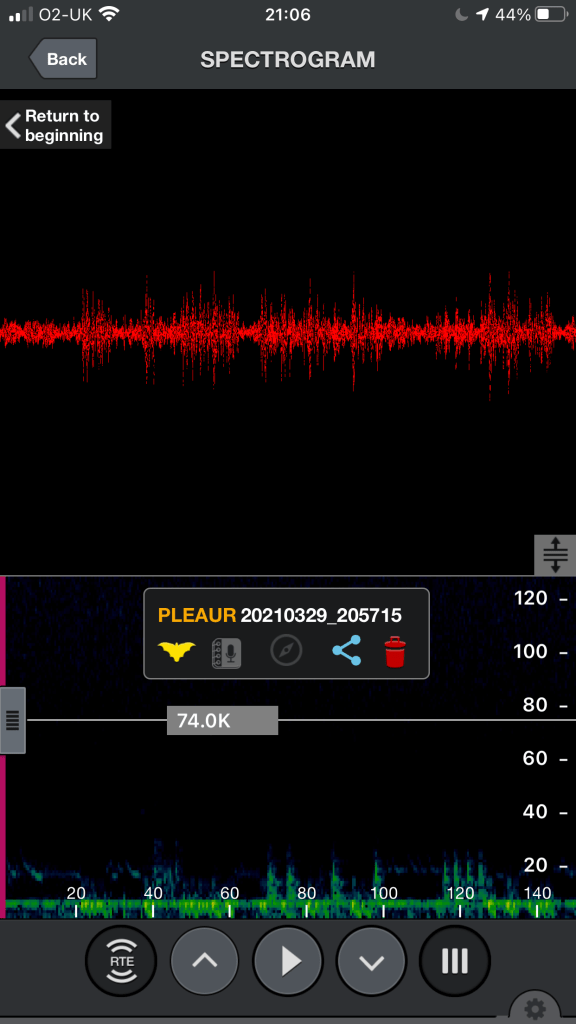
Over the first two nights of using the detector, I was amazed to recorded four species of bat in our garden, both Common and Soprano Pipistrelle and Brown Long-eared and Noctule. I’ve never recorded Soprano Pipistrelle or Noctule before, which was particularly pleasing, but simply to record four species at all was great. I’m planning to take a few nocturnal walks around the village soon to see what else I can pick up and I also want to find a nice stretch of water to see if I can find some Daubenton’s too.
Unfortunately, on searching the Bat Conservation Trust’s website, there doesn’t appear to be a Northamptonshire bat group but I’m hoping there may be some opportunities to undertake bat surveys in the surrounding area once I’ve gained some more knowledge and skills.
Despite still recovering from COVID and glandular fever, I’ve started to get itchy feet and have a growing urge to get out into the countryside around our new home in Northamptonshire. We woke this morning to a sunny spring day and headed out to a newly-found favourite spot nearby.
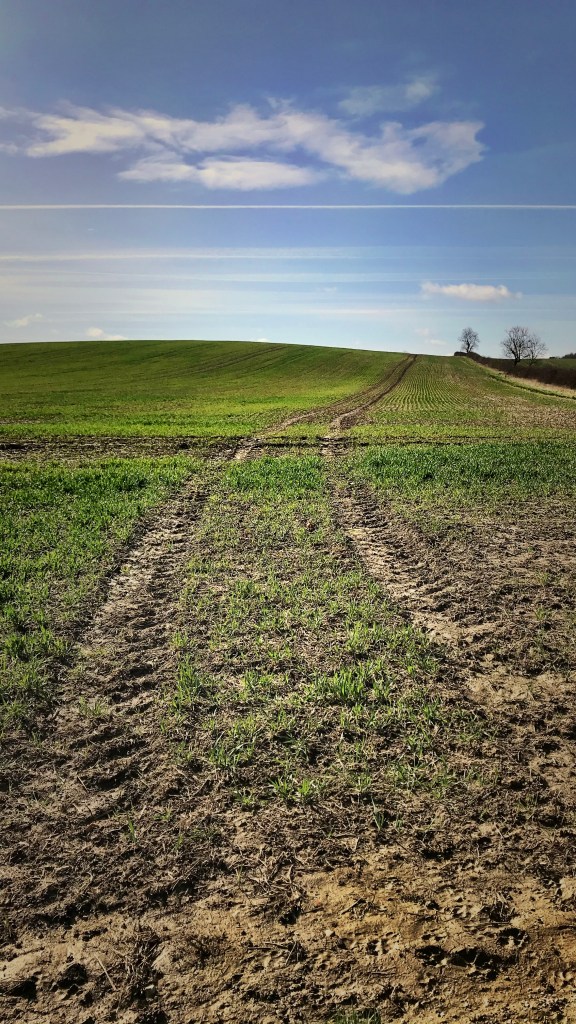
Hanging Houghton is only a ten minute drive away; it is a small, picturesque village sitting at the top of the wide shallow valley, the other side of which our village sits, albeit a couple of miles to the south. At the bottom of the hill on which the village ‘hangs’ is a small car park from which walks can be had along the Brampton Valley Way or along tracks across the open countryside. Today we walked out into the fields, only a short distance in total as tiredness soon prevailed over itchy feet. However, the walk lifted spirits more than I thought it would.
As soon as we left the car behind the songs of skylarks filled the air above the sprouting crops. A bringer of spring, the song is like no other, called from often unseen heights against the blue sky, a rapid succession of undulating notes, more complicated than the human ear can perceive. There must have been skylarks in double figures along the track, each marking out its territory and spreading the message of the new season and warmth to come.
They were, however, only one of the birds along the track. A pair of buzzards cried out as they circled above the narrow strip of woodland and red kites floated on still wings as they passed over head. A kestrel completed the raptors, hovering over the longer ditch-side grass, hunting for a vole or two from a hover or a nearby stubby hawthorn tree.
Out in the fields, the skylarks were joined by meadow pipits, also starting to display, calling as they parachuted to the ground with outstretched wings and upwardly pointed tails. A solitary reed bunting chirped from a stand of teasel and yellowhammers flitted from tree to tree.
As we returned to the car, far sooner than usual, there was a pied wagtail picking about the gravel and a stock dove cooing from within the farm buildings. Despite looking again, there was still no sign of the barn owl, though, the old brick barn in the middle of the fields still not providing a view despite the numerous visits.
Finally, after five and a half months since putting an offer on a house, we moved home in early February. We have combined my house in Cheshire and my girlfriend’s flat in Kew into one by moving to rural Northamptonshire. Once offices fully reopen, I will be working in Birmingham (instead of Manchester) and Sarah will continue working in central London. Whilst this will entail quite a lot of travelling, although for fewer days per week than before the pandemic, we both wanted a move into the countryside and we’re already seeing the value in that decision – albeit without any of the long commutes yet.
This post has taken quite a while to write, on and off over the last few weeks. Moving house, obviously, has taken precedence over blogging, and almost everything else, but we’ve also been hit by a double illness of COVID-19 and glandular fever. One is bad enough, but two has really taken the wind out of us. Fortunately, Sarah has had less severe symptoms but for me it’s been the worse illness I’ve ever had. The COVID symptoms themselves were not particularly bad, like a strong flu, but the combination with glandular fever has left me in almost continuous pain and discomfort and I don’t know how long I will be laid low for. With lockdown still in place, our travel restricted, we haven’t been able to explore widely around our new home area anyway but I’m hoping I get over this in time to take advantage of the relaxations of restrictions as they come over the course of the spring.
Anyway, that’s enough writing of illness, that’s not the purpose of this post. The move to the countryside and to an entirely new and unknown area of England has been a huge change for both of us, particularly Sarah who has lived in London for the past 14 years. Whilst I have spent so much of my time over many years in the countryside, living on the edge of rural Cheshire, it is very different to live in a village some distance from the nearest major town.
Neither of us knew anything about Northamptonshire before we started looking for a new home. In fact we really stumbled across the area after failing to find anything we liked in neighbouring Warwickshire. To me, the county has just been somewhere to pass through on the M1 or A14 but on our first visit to view a property we found a hidden gem of a county. We have moved to a small village north of Northampton itself in an area of countryside that is not unlike the Cotswolds. The land is rolling, steeply in places, dotted with old ironstone villages and farms, with hedges and drystone walls enclosing a mixture of large arable fields and small pastures. There is not a great deal of woodland, a bit like my former Cheshire home, but as spring brings the trees into life, I’m sure the area will be swathed in green cover of trees. We’re also close to a number of reservoirs which contrast to the rolling agricultural land and provide different environments for the wildlife we search for.
Our house is down a quiet dead-end village lane with very little traffic save for the occasional tractor and passing ponies. We are sheltered by a hill from any noise from the relatively lightly-trafficked main road that passes the village and the area is so quiet that at night we can hear a single car as it drives between our village and the neighbouring one a couple of miles away. In fact, standing in the back garden at any time of day, the dominant sound is of birds, not traffic – a very different situation to the flat in Kew with the constant passing of vehicles on the road and planes overhead on way into Heathrow.
So far, the birdlife has been great at the cottage and in the surrounding countryside. Our newly erected birdfeeders have a constant passing trade of sparrows, tits and finches, with collared doves and wood pigeons clearing up beneath. We also have regular visits from rooks which seem to have taken a liking to the seed feeders but haven’t quite worked out how to get at them. The most entertaining birds so far have been the starlings which appear to be nesting in our eaves, in at least three spots. Their calls are so varied and often mimic those of others including blackbirds and buzzards, but their songs also frequently seem to end in a fight amongst themselves across our rooftop.
Sitting at my desk I can hear green woodpeckers in the neighbouring gardens and fields as well as the great spotted variety drumming on nearby trees. At night, lying in bed, we’ve also frequently heard tawny owls and the occasional barn owl. The latter we have also seen in broad daylight perched on a fence post as we drove down a country lane. We have had raptors in and over the garden including kestrel and sparrowhawk passing through and buzzards and red kites soaring overhead on nice days.
We haven’t had many walks in the area yet, and I’ve only been for a couple of cycles, due to unpacking and setting up home, illness and the very wintry weather when we first moved in. However, we have found some nice spots already and the birdlife has been great. There are plenty of footpaths in the area as well as a dismantled railway and a number of cross-country tracks. Walking along these has revealed a quiet and unspoilt corner of rural England with birdlife I rarely saw in my former home. The real stars to date have been skylarks and yellowhammers, in a level of abundance I don’t think I have seen anywhere before and so early in the spring that I would not have expected to have heard them sing.
So far, we have only had very limited insights into the nature of Northamptonshire but over the coming weeks and months, I can’t wait to get out there and visit new places to the experience wildlife around our new home.
Despite all I wrote in my last post about lockdown foxes, we haven’t seen one for a couple of weeks. Yesterday, however, we saw one in Kew Gardens in broad daylight, wandering around the southern, wilder, area of woodland. There were plenty of people about but he (assuming he was a he) seemed quite unconcerned. We stopped and watched him while other visitors walked past quite oblivious to his presence. I could quite easily have missed him as he at first appeared to be a log lying in a dip but he obviously wasn’t when he moved and trotted through the grass.
He had a very distinctive white tip to his tail so he could have been one we have seen a few times from the flat. The white tip stood out particularly at night; a furry beacon at the end of a darker tail and body enabling us to track him through the shadows of the neighbouring front gardens.
Unless we see another fox today, he will have been our last fox sighting in Kew. Today we are packing up the flat and tomorrow moving to Northamptonshire – hopefully with more fox sightings to come! The former owner of our new house actually mentioned she had foxes in the garden when we had a viewing of the property, so there’s a good chance!
After spending so much time in rural and semi-rural areas during of my life, I thought being locked down in Kew would limit my wildlife-watching opportunities. However, I have been pleasantly surprised. The birds have been as plentiful in species as my home in Cheshire; more plentiful in fact, as the habitats are actually more varied with gardens, parkland, lakes and the River Thames providing a variety that I don’t have at home. As I wrote a few blog posts ago, my mammal-watching at home had been pretty poor up until finding badgers coming into my back garden in the autumn. I can’t say that the mammals of Kew have been particularly spectacular but there is one species that has given us almost constant sightings and entertainment throughout the different stages of lockdown – foxes!
I find something particularly exciting about a wild species of dog living amongst us. Our country is so denuded of its nature, particularly its large wild mammals, that knowing that there is one particularly charismatic species wandering around right outside in our streets and gardens brings quite a thrill. I have a bit of a thing for wolves and have travelled abroad to see them, and foxes bring a little bit of that wildness of wolves to our towns and cities, as well as our countryside. They don’t have the majesty of wolves or the power to bring out the most visceral of feelings that their larger cousins do, but they’re now, unfortunately the closest thing to wild wolves we have, and they’re living right here amongst us.
We have seen foxes in both daylight and night time, heard them calling through the darkness and we smell their musky scent often as we walk around the streets for our daily exercise. They are usually oblivious to our presence as we look down from the windows of the second floor flat – even when we’re standing outside on the balcony. One night I whistled out of the window at one as he trotted up the road. He stopped, looked back for a while, and then happily trotted off again on his nightly business. However, not all our sightings are from such distance. I was out running a few days ago and saw a tail disappear into a driveway. As I approached, I came across him standing on the brick paving only a metre of so away, waiting for me to pass, before carrying on way.
I particularly like animals that are active at night, they have dimensions that we don’t, they live at times we prefer to be settled down inside the comfort of our homes, they have that added bit of mystery and are hidden from our view so much of the time. The calls of nocturnal species have always given me a thrill to hear as I lie in bed and the cries of foxes are no different. Sometimes in Kew it’s been just a single far off bark but other times they’ve been right beneath the window, shrieking. There was one late autumn night when an almost painfully high-pitched yelping could be heard in far off streets but it came closer and louder until the fox ran past the flat and onto other streets continuing its noise as it went – took me a while to get back to sleep after jumping up to look out of the window at some silly time in the early morning.
It isn’t just night-time sightings we’ve had. In the early days of the first lockdown I got a surprise when I saw one running up the road in the early afternoon but we have regularly seen them during the daytime and there was one that frequently sat on the grass outside of the flats taking in the early evening summer sun.
Across the road from us, Kew Gardens has been particularly good for foxes over course of the last year. At the height of the first Lockdown we would often walk past and look in through the gates; wishing we could go in. On one evening amble we saw a fox wandering close to the Elizabeth Gate; it turned to look back at us and then, gambling behind it, was a youngster, and off they went, deeper into Gardens amongst the darkening and silence lawns, trees and flowerbeds. They must have enjoyed the lack of people when the gates were closed for so long but perhaps they missed some of the leftover food too.
As soon as we were allowed back in, we went at least a couple of times a week. On one of the first trips, we were there just before closing time and came across a fox in the naturally wooded area. It stood and stared back at us and then disappeared into the undergrowth, waiting for us, and everyone else, to leave him to roam in peace when then gates closed for the day. We also saw another young fox playing in the grass just outside a small group of trees but again, we were soon spotted, and it loped off back into the cover, away from human eyes. In recent visits, as we’ve been walking close to the Thames end of the lake, we’ve seen a fox amongst the visitors in broad daylight, with seemingly little concern about the people around it and often not being spotted it trots past.
There was one particularly memorable sighting, however, just a few weeks ago. We were wandering in the Gardens close to the outside wall when a fox suddenly appeared alongside us busily running around the base of some some bushes. We heard a crow calling and it swooped down to mob the nervous looking animal and it was soon joined by a second. Over a period of a minute or so, they played cat and mouse with each other. The crows calling angrily and flying fast down to the ground, sometimes landing, while the fox either ignored them or prepared to duck and dive its way to avoid being attacked. As a crow landed on the grass, the fox stopped and then ran towards it but only for the crow to be easily launch itself back out of reach.
We have even started to recognise some of the individuals with a small and pale female seen regularly early in the first Lockdown and more recently fox with a brightly white-tipped tail who likes to walk along garden walls and an impressively large male we’ve named FBF.
It’s common for one of us to call ‘FOX’ across the flat in the evening as we look out of the window and looking out for them is last thing we do before we go to bed; one final bit of wildlife watching before closing the curtains on the day. They have become part of Lockdown life in a way that no other wildlife has, bringing a bit of natural thrill each time we see one.
With only a couple of weeks now until we leave Kew behind and move to rural Northamptonshire, I hope we get as good and as frequent views of foxes at our new home – they have really brightened up our days and nights and brought much needed bursts of nature into our lives over the past few months.














 Daft Mumblings