A very fine Spring day on Wybunbury Moss.
Wybunbury Moss
Reply

A very fine Spring day on Wybunbury Moss.
Okay, so I said Manchester is full of great photographic subjects but I can’t stop taking pictures of Town Hall and usually from similar angles…it’s a truly great building and it grabs my attention every time I walk past.

On my walk each morning from my parked car to the railway station, I frequently have to move aside while on the footway to avoid being knocked over by a cyclist. When I say ‘frequently’, I mean this happens several times a week to me and I’m sure it happens on an hourly basis every day in that particular area. Yes, the road isn’t that nice for cyclists; with cars having little room to pass, I’m sure it can be a quite intimidating stretch of road. However, out of concern for themselves, these cyclists show no concern for others, and this is the real issue I’ve been thinking about.
Embed from Getty ImagesCar versus cyclist conflict is rarely out of the media these days and most people can gripe about cyclists on footways. I’m a driver, cyclist and pedestrian, and my views change whenever I change mode. Cyclists on footways annoy me but so do drivers passing too close to me when I’m cycling, while cyclists riding two abreast on narrow roads is just plain stupidity; so I can see arguments from all sides, but most people should be able to. This leads to the over-riding issue, as it really is about thinking about the other person.
The big issue isn’t about cars versus cyclists, cyclists versus pedestrians, or cars versus pedestrians for that matter, the issue really is about an absolute lack of care and respect for each other. The society we live in has led to people becoming so self-absorbed and blinkered towards their own well-being and comfort, that many, if not most, people show a complete disregard for their impact on others. If we all started to consider the impact we each individually have, instead of automatically putting ourselves first, these kinds of conflicts would reduce. I think it likely that a change of attitude towards each other would have a bigger impact than spending millions of pounds of road safety engineering.
Unfortunately, changing behaviour is a lot more difficult than putting in speed humps.
Trundling down a woodland track, past the stone cottage and old barn, I splash through rainfall streams crossing the path. Winding round the rocky hillside, a wren flits across the way in the darkness under the enclosing trees. Emerging from cover, the landscape opens up from the old moss-covered oaks into wide damp pastureland bounded by water channels and stone walls. Across the river and the sheep fields, sits a tumbledown building, long past its best and beyond use. In the quietness of its surroundings, silence broken only by the low bleating of sheep and the occasional steam train whistle, it stands alone. Within a neighbouring copse, high up in a fir tree, watched over by Snowdon, is a large, jumbled collection of branches, twigs and turf – a cradle for a precious clutch of Welsh osprey eggs.
 The nest isn’t only watched over by the mountain; it also stays observed by a dedicated group of volunteers putting in hours and days to ensure that no one disturbs the birds or steals their eggs. The rarity of these eggs is what makes them so valuable to collectors. A display of Welsh osprey eggs would enhance any collection, but this would not require the theft of one clutch but two. For whatever reason, egg thieves must have five eggs to display, and at up to three eggs a clutch, it takes two nests to fulfil this requirement. However, the value of these eggs is even greater to those who give their time to protect them and there is a growing band of people willing to put up with rain, cold and discomfort to prevent any attempts to take the clutch.
On Saturday morning I got up at 6:30am to travel to the Glaslyn Osprey protection site near Porthmadog, north Wales. It takes just over two hours to get there from home driving via a choice of scenic roads across the hills and moors or via the fast coast route. My first shift of the year started at 10:00am and as I settled down for a long eight-hour guard duty, tinkering with the new camera equipment, the female started to shuffle on the nest. As she stood up and stepped to one side, there beneath her was the first white and speckled egg of the year, her thirtieth and hopefully one of three to come. As the first to see the egg, I let Elfyn, the organiser of volunteers, know what I had seen, and within a few minutes the news was out. Quite a start to the shift!

With the rain coming down from the start, the caravan with the monitoring equipment (Osprey Protection Spy Cave) seemed the best place to stay but eventually I went out to the forward hide, where the volunteers get closer to the nest and have a chance of better views. The hide gives a clear sight of the nest and tree and any one approaching them would be seen easily, even at night.
The quietness and natural beauty of the valley is one of the bonuses of volunteering there. While the rain, wind and cold can make it an uncomfortable existence for a few hours, we are rewarded with views across Snowdonia and the sights and sounds of wildlife, both birds and mammals.
After my shift I checked-in at a local hotel and then decided to really get into the Osprey way of living and try some water from the Glaslyn Valley and Porthmadog fish for my tea (pictured below!)


…well almost.
The change to British Summer Time signals the real start of my cycling year. While I do cycle during the late Autumn and Winter, the light nights after the clocks go forward mean I can make the most of the evenings and cycle out into the countryside. The state of the roads in South Cheshire and the lack of care taken by some drivers, means that I don’t feel safe cycling in the pitch darkness, so I keep most of my cycling to the Spring, Summer and early Autumn months.
I’m a moderately keen road cyclist with a occasional return to my former mountain-biking ways. I try to cycle as often as I can and since last Summer I’ve started cycling and running, one immediately after the other, with the hope of getting to a good level of all-round fitness. This approach has started to pay off but I need to get back into the cycling element after this took a back seat over the winter (and following my bike being pinched).
Yesterday was the first really nice evening when I could cycle after work. With light winds and a strengthening Sun, the Summer seemed just around the corner and I was quite pleased with my time over my usual 15mile route around some villages close to Nantwich.
My improving ear for picking up bird sounds seems to have spilled over into my cycling and I noted many more birds than I have done on any previous ride. The highlight was a skylark singing high up in the warm Spring air as I passed along a quiet country lane – I almost paused to listen but once I get pedalling, I find it hard to stop. I also noted mute swan, canada goose, mallard, carrion crow, jackdaw, magpie, starling, blue tit, great tit, chiffchaff, greenfinch, goldfinch, chaffinch, dunnock, house sparrow, robin, wren and woodpigeon.
No swallows, martins or swifts yet, but they’ll soon be swooping past while I’m on my evening pedals around the Cheshire countryside.
After a late Saturday afternoon trip to the pub, I listened to the dusk chorus of robins, wrens and blackbirds while slowly making my way back to the warmth of my house. The accompaniment to these wanderings got me thinking, quite deeply. As I strolled along suburban lanes and across a busy main road, my concentration on those songs, bringing the day to a close, was interrupted by the passing of cars, vans and lorries.
Whether it is the soft but ever-present rumble of the far off A-road or the neck-less, under-developed one burbling past in his Subaru, road noise has an impact on all our lives. Even in the depths of the far off wilds of this nation, you are often never quite free of the background hiss thrown out by our metal dreams.
Many people in this modern world complain of the seeping, penetrating, all-pervasive presence of road noise in their lives; that it disturbs their peace; that it prevents silence. Yet, there is little silence in this world, and if there is silence, there is something missing, and something very wrong. As, if silence exists, other sounds are absent.
Wishing for silence is like wiping the paint from the canvas of a masterpiece. Wishing for silence means denying the chorus at dawn and dusk. Wishing for silence means hoping for a world empty of birds. Instead of complaining about road noise, we should be more positive, more aspirational, more in touch with the non-human world around us; we should be standing up for bird song.
This week I was given a Breeding Bird Survey (BBS) grid square by the BTO (British Trust for Ornithology) and this morning I went out to complete the habitat survey for the two transects (survey routes).
The survey site is out near the Cheshire Sandstone Ridge, close to Bulkeley and just by the Bickerton Poacher pub on the road between Nantwich and Wrexham. The BBS will require two visits, one at either end of Spring, but I’ll go into more detail about what the surveys entail in a future post.
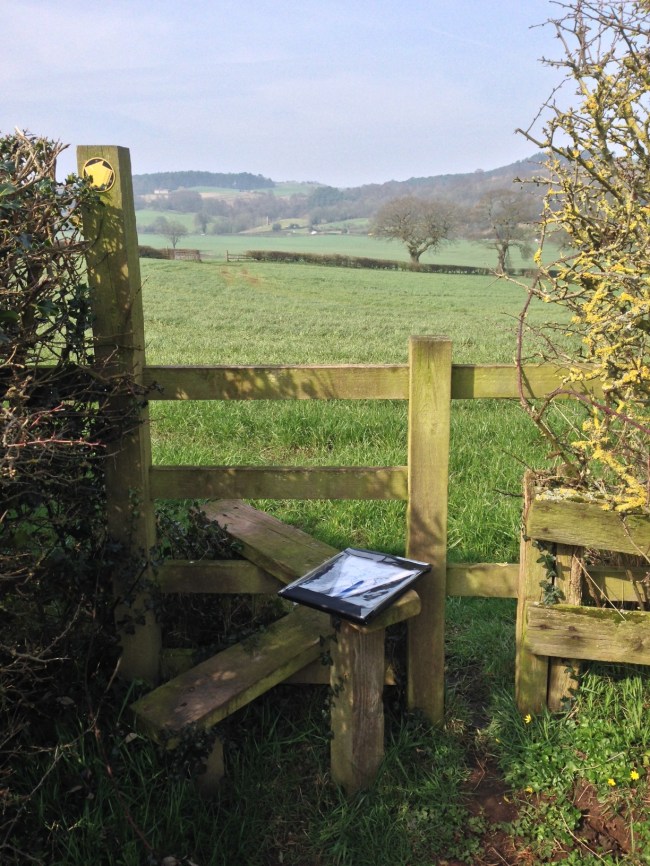 The two survey transects are very typical of that part of Cheshire, with large pastures, bounded by hedges, with the backdrop of the low wooded hills. Unlike much of the county, the land is quite rolling but the Cheshire Plain starts only a short distance away.
Spring really is in full swing now, with the daffodils out in full bloom, leaf buds starting to burst and the birds singing for all their worth. This survey and the similar surveys I’ve been doing for Cheshire Wildlife Trust have given me a better ‘ear’ for bird song and picking out individual species. I don’t think I have ever appreciated so much the sheer volume and strength of the combined weight of bird song at Springtime. Just standing by my car at the starting point of the first transect, by the woodland at the bottom of the hills, the sound was so intense and vibrant – the countryside bursting with life!


I have a few large posts in the offing but I just wanted to highlight two great examples of volunteering and what can be achieved by many people putting contributing a little (and in some cases not so little) of their time.
Late last year, the British Trust for Ornithology, Birdwatch Ireland and the Scottish Ornithologist Club released the 2007-2011 Bird Atlas. This is an amazing book that details the breeding and wintering ranges of all bird species in the British Isles and not only is it a scientific marvel, it is a lovely ‘coffee table book’ too (if fact it’s almost as big as a coffee table!). The book importantly also highlights how bird populations have changed over the past few decades and, in many cases, is quite a depressing read. However, it’s an extremely helpful aid to the work of conservation organisations and fascinating for those of us who like wildlife, statistics and maps!
The most startling thing about it, is that 40,000 people helped to create it by collecting bird survey data and they’re all named in the back – it’s just a pity my name’s not in there and it will be many years until the next one comes out.
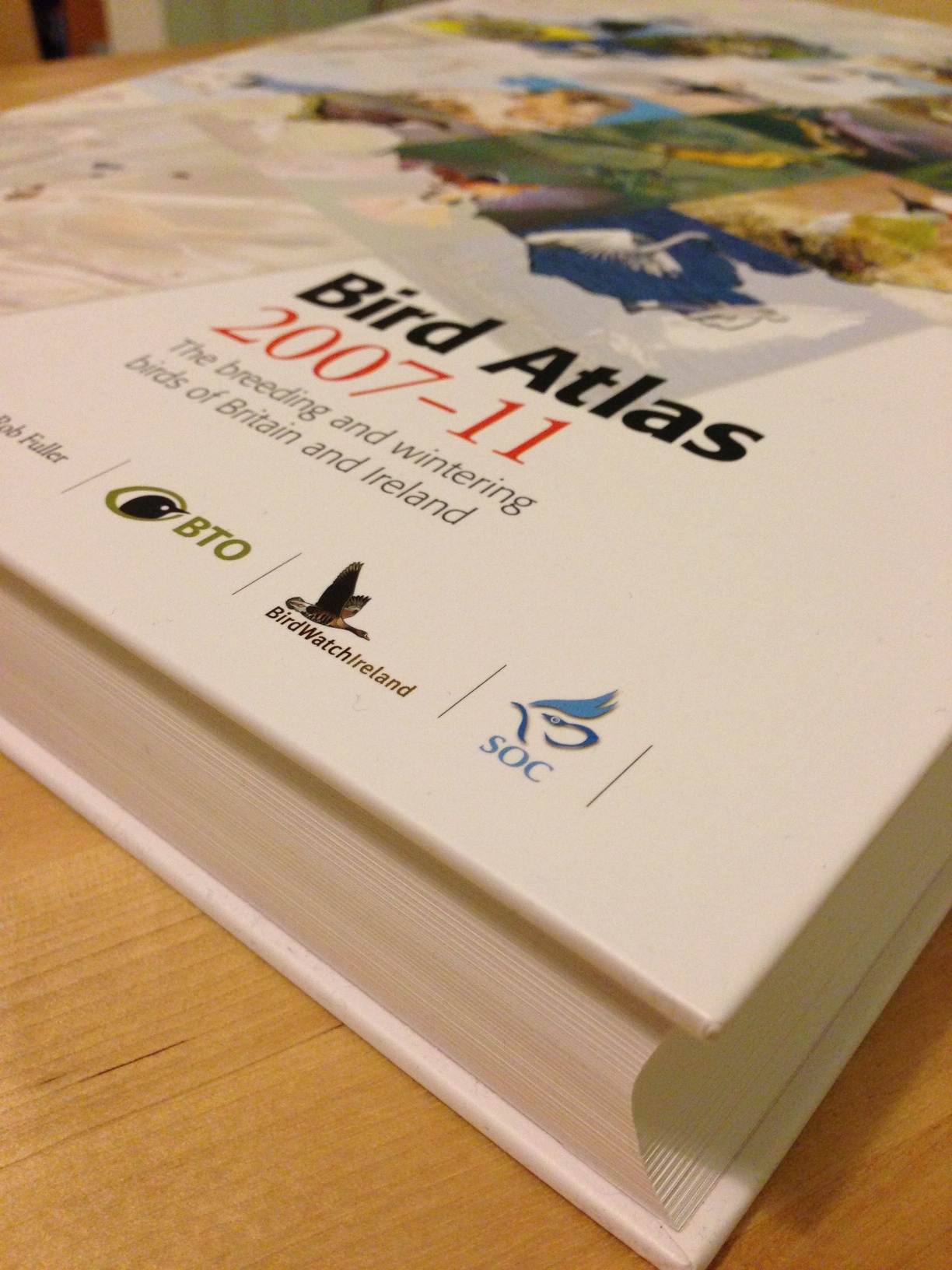
You can find out more on the Bird Atlas and the Bid Garden Birdwatch at the following locations:
With all the debate around the visual (and other) impacts of wind turbines, I really have to say that they are certainly no worse that pylons.

I visited Cheshire Wildlife Trust’s Gowy Meadows reserve yesterday and the pylons shown in the photo above (obviously tinkered with for effect!) really do scar the landscape
I should mention here that the reserve is right next to a large chemical works, which doesn’t exactly provide a nice backdrop either. However, I enjoyed my quick visit and will return.
After spending the winter in sub-saharan Africa, the Glaslyn osprey pair have returned to their nest site. For the last two years I have helped the RSPB to protect the nest during breeding season, reducing the chance of disturbance from walkers and stopping collectors getting their pathetic mitts on the eggs.
Bywyd Gwyllt Glaslyn Wildlife, a Community Interest Company run by volunteers, has taken over the operation of both the protection and visitor sites and I have put my name down to do some more shifts over a few weekends, once the eggs have been laid.
http://www.glaslynwildlife.co.uk
I can’t wait to get back to the osprey protection spy cave!
 Daft Mumblings